
7 min read ·
Change the Cleanser Without Neglecting Your Healing Tattoo
Learn when cleanser-related tightness calls for a gentler wash, when a rash needs clinical advice and which tattoo symptoms require prompt care.
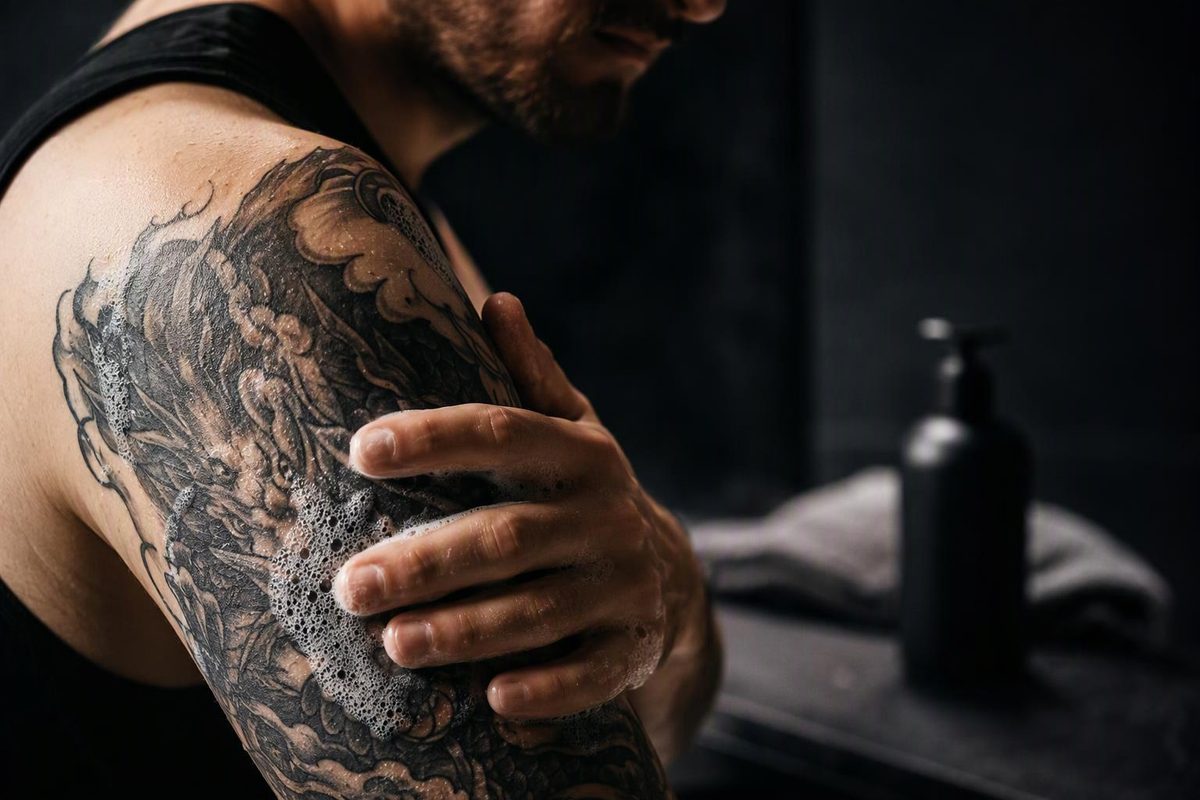
If a foaming cleanser leaves your healing tattoo tight, stinging or noticeably drier after washing, stop using that cleanser on the tattoo and replace it with a mild, fragrance-free one. Do not stop cleaning the tattoo altogether unless a clinician or your tattoo artist has told you to, and do not disturb an intact adhesive dressing merely to wash beneath it.
Select what you see now; the checker separates likely dryness from reactions and infection warning signs.
Check What Your Tattoo Needs Next
Choose the dressing status, symptom pattern and direction of change.
Change Both the Cleanser and the Next Wash
At the next scheduled wash, use clean hands, lukewarm water and a small amount of the replacement cleanser. Move your fingertips gently over the exposed tattoo without trying to polish away peeling skin, dried fluid or flakes. A washcloth, sponge or brush adds friction that an already uncomfortable tattoo does not need.
Rinse until no cleanser remains. Residue can prolong contact between the formula and the skin, defeating the purpose of using less and washing gently. Pat the area dry with a clean, soft towel rather than rubbing it.
If moisturizing is already part of your aftercare plan and active weeping has eased, apply only a thin layer of lightweight, fragrance-free moisturizer. The goal is to relieve uncomfortable tightness without leaving the tattoo beneath a thick coating. The appropriate product and amount can change as the surface heals; see how to match a tattoo moisturizer to the healing stage.
The American Academy of Dermatology recommends mild, fragrance-free soap, thorough rinsing and no scrubbing when cleaning a minor skin wound. It also advises against antibacterial and deodorant soaps in that setting. A tattoo is not a skin biopsy, but those wound-care principles support a simple, gentle wash rather than a strong formula marketed for deep cleaning. The details are in the AAD wound-care guidance.
Do not compensate for a drying cleanser by washing with cleanser repeatedly. More washing means more exposure to the product and more opportunities for friction. Follow the washing schedule given for your tattoo rather than adding extra washes whenever the skin feels tight. The available guidance does not establish one washing frequency that fits every tattoo, dressing and healing stage.
Leave an Intact Adhesive Dressing Alone
A tattoo covered by intact adhesive film is a different situation from an uncovered tattoo. Do not peel the film back simply to clean underneath it. Follow the removal timing and washing instructions supplied by the tattoo artist or the dressing manufacturer.
If cleanser has only touched the uncovered skin around the film, rinse that exposed skin gently without lifting an edge or pushing liquid underneath. Once the dressing is removed according to its instructions, the tattoo can be cleaned as directed.
A concerning reaction or possible infection should not be managed by repeatedly removing, replacing or washing around a dressing. Worsening pain, warmth or swelling, pus, yellow or golden crusting, fever or red streaks calls for medical assessment rather than another cleanser experiment. Tell the clinician that the tattoo is covered and follow the instructions you receive about the dressing.
Foam Does Not Identify a Harsh Formula
The amount of lather is not a reliable verdict on whether a cleanser is suitable for your skin. Surfactants are the ingredients that help lift oil and debris, and different surfactant systems produce different amounts and textures of foam. Formulas also contain other ingredients that can affect how skin responds. DermNet explains the distinctions among soaps, synthetic detergents and surfactants.
That means a foaming product is not automatically harsh, just as a cream or non-foaming cleanser is not automatically gentle. Your skin’s response is the practical test during healing. Tightness, repeated stinging or a clear increase in dryness after each wash is enough reason to stop using that particular formula on the tattoo.
The method can intensify the problem even when the cleanser itself is not the only cause. Hot water, long showers, an excessive amount of cleanser and repeated washing can compound dryness. The AAD’s guidance for dry skin recommends warm water, a gentle cleanser, patting rather than rubbing and applying fragrance-free moisturizer after washing. That dry-skin guidance was updated in January 2026.
Changing only the bottle while continuing to use hot water, scrub at peeling areas or leave cleanser residue behind may therefore produce little improvement. Make the formula and technique changes together so you can judge whether the skin becomes more comfortable.
Choose Fragrance-Free Rather Than Merely Unscented
A practical replacement is a mild cleanser labeled fragrance-free and formulated for sensitive skin. Those label claims are useful screening criteria, not guarantees that a formula cannot irritate you. Stop using the replacement if it causes the same stinging, burning or tightness.
“Unscented” is not interchangeable with “fragrance-free.” An unscented cosmetic can contain fragrance ingredients used to mask the odor of other ingredients, according to the FDA’s fragrance-labeling guidance. For a healing tattoo that already feels irritated, fragrance-free is the clearer label to seek.
Avoid using a cleanser with scrubbing particles, exfoliating acids, retinoids or acne-treatment ingredients on the healing tattoo. These features do not solve cleanser-related dryness and make the product unnecessarily complicated for this use.
A non-foaming cream or gel cleanser may feel more comfortable than the product that caused the problem. Judge it by what happens during and after rinsing, not by the absence of bubbles. A product that burns or leaves the tattoo progressively tighter is not a suitable replacement merely because it does not foam.
Antibacterial soap is not automatically a better option either. The relevant priority is cleaning the tattoo gently with a simple product that your skin tolerates, not seeking the strongest-sounding claim on the package. This distinction is covered further in why mild, fragrance-free soap is usually the more useful priority.
Dryness, Contact Dermatitis and Infection Look Different
Mild tightness or fine flaking that improves after you stop the suspected cleanser, wash more gently and moisturize lightly is more consistent with dryness. Improvement matters: a reaction that continues to intensify should not be dismissed as ordinary dry skin.
| Pattern | More Consistent With | Appropriate Response |
|---|---|---|
| Tightness or fine flaking that eases | Dryness | Change cleanser and technique |
| Red, itchy or burning product-shaped rash | Contact dermatitis | Stop the product; monitor closely |
| Worsening pain, warmth, swelling or pus | Possible infection | Seek prompt medical care |
A red, itchy or burning rash concentrated where the cleanser touched may be irritant or allergic contact dermatitis. Soaps, detergents, antiseptics, fragrances and preservatives can all trigger contact dermatitis, according to the NHS overview of contact dermatitis. Because several parts of a formula can be responsible, the amount of foam does not identify the specific trigger.
Stop the suspected cleanser rather than testing it repeatedly on the healing tattoo. Contact a clinician if the reaction is spreading, blistering, very painful or not improving. Those features require more than a switch between cosmetic products.
Possible infection has a different level of urgency. Seek prompt medical care if pain, warmth or swelling is worsening, or if you develop pus, yellow or golden crusting, fever or red streaks. The AAD wound guidance and Alberta Health Services’ tattoo-infection guidance advise medical follow-up for these symptoms.
Do not use a new cleanser to test whether those warning signs disappear. A cleanser change can address dryness or product irritation; it cannot determine whether worsening symptoms are an infection.
Judge the Change by the Skin’s Direction
After changing the cleanser and technique, pay attention to whether the discomfort settles, remains unchanged or worsens. Mild dryness that becomes less noticeable supports continuing with the gentler routine. Persistent stinging after every wash suggests that the replacement product, the washing method or both still need attention.
Look at the distribution as well as the sensation. Irritation that corresponds to where a product ran or sat on the skin supports concern about contact dermatitis. Symptoms extending beyond that contact area, blistering or escalating pain warrant clinical advice rather than further product swapping.
The tattoo artist can clarify the intended dressing schedule, washing routine and when moisturizer belongs in the aftercare plan. A clinician is the appropriate contact for a spreading or severe rash, symptoms that are not improving, or any infection warning sign. Product advice from an artist should not delay medical assessment when pain, heat, swelling or systemic symptoms are worsening.
Until the situation is clear, keep the routine simple: one tolerated mild, fragrance-free cleanser, clean fingertips, lukewarm water, complete rinsing and gentle drying. That removes the suspected product without abandoning the cleaning step a healing tattoo still requires.