
7 min read ·
Choose a Cleanser That Will Not Aggravate Healing Skin
Choose fragrance-free soap for tattoo aftercare, read cleanser labels, wash healing skin gently, and recognize irritation or infection warning signs.
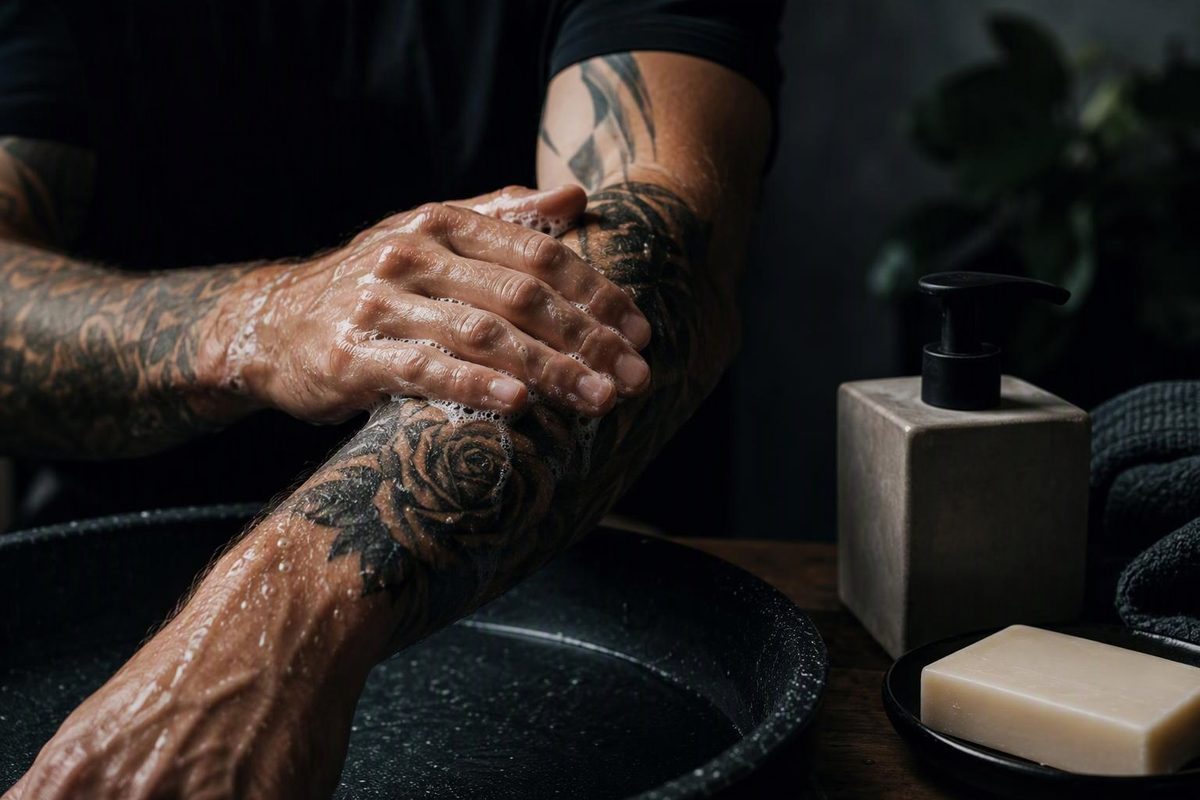
For a new tattoo, choose a mild, fragrance-free cleanser that rinses away easily. It does not need to be expensive, antibacterial or tattoo-branded. The goal is to remove surface fluid and debris gently without scrubbing or exposing already-sensitive skin to perfume.
Check the package and ingredients; the tool will flag unsuitable or uncertain labels.
Fragrance-Free Soap Label Checker
Use the exact wording on the package and ingredient list.
The default result is uncertain because no product details have been selected.
What a passing label check means
- Prefer “fragrance-free” over “unscented.”
- Avoid fragrance, parfum and exfoliating formulas.
- Among passing products, look for mild, gentle or sensitive-skin wording.
- A passing label is a useful screen, not a guarantee against irritation.
Sources: FDA fragrance guidance and AAD and Cleveland Clinic skin-care guidance cited in the article.
A Fragrance-Free Label Is the Best First Screen
Look for the words “fragrance-free” on the package. Do not treat “unscented” as an equivalent claim. An unscented product may contain fragrance ingredients that mask the smell of other ingredients, while fragrance-free indicates that fragrance has not been added for scent or masking. The American Academy of Dermatology (AAD) recommends fragrance-free rather than unscented products for sensitive skin (FDA; AAD).
The product should also be described as mild, gentle or intended for sensitive skin. These terms are useful starting points, but no front-label claim guarantees that a cleanser will suit your skin. A fragrance-free label narrows the search; it does not rule out irritation or allergy from every other ingredient.
Read the ingredient list rather than relying only on the name or scent of the product. Avoid a cleanser that lists fragrance or parfum. Be cautious with products promoted for essential oils, botanicals or scent, even when the front says “natural” or “unscented.” The AAD notes that some unscented and plant-based products can still contain fragrance-related ingredients (AAD).
Skip anything intended to exfoliate. That includes scrubs, acids, textured cleansing tools and washes marketed to polish or resurface skin. A healing tattoo does not need exfoliation, and Cleveland Clinic advises against rubbing, scrubbing or exfoliating it (Cleveland Clinic).
The practical label hierarchy is straightforward:
- Confirm that the package says fragrance-free, not merely unscented.
- Check the ingredient list for fragrance or parfum.
- Exclude exfoliating formulas and textured products.
- Prefer a mild, gentle or sensitive-skin cleanser among the products that remain.
If you already use a mild fragrance-free cleanser without problems, you may not need a specialized tattoo soap. Tattoo branding does not replace the label checks above.
Test an Unfamiliar Cleanser Before the Appointment
Someone with reactive skin can test an unfamiliar cleanser on intact, untattooed skin before the tattoo appointment. This is not a way to prove that the product will be safe in every circumstance, but it may expose an obvious reaction before the cleanser is needed on healing skin.
The AAD’s home test uses a small area twice daily for seven to 10 days. For a rinse-off cleanser, leave it on the test area for about five minutes—or for the time given in the product directions—before rinsing. Do not conduct this test on a fresh tattoo. Patch testing repeatedly would expose the healing area to a new product instead of protecting it.
If the appointment has already happened and the cleanser is unfamiliar, do not improvise a multi-day test on the tattoo. Use the aftercare instructions supplied for the tattoo and stop the product if it causes notable burning, persistent stinging or a new itchy rash.
Antibacterial Soap Is Not Automatically Better
Tattoo soap does not necessarily need an antibacterial claim. Cleveland Clinic includes a mild, fragrance-free antibacterial soap in its example tattoo-care routine, but “antibacterial” alone says nothing about whether a particular formula is fragrance-free, non-exfoliating or comfortable on your skin.
The FDA says there is insufficient evidence that over-the-counter antibacterial washes prevent illness better than plain soap and water. That conclusion concerns consumer antibacterial washing generally; it is not a direct comparison of infection rates in healing tattoos (FDA). It therefore does not prove that every plain cleanser and antibacterial cleanser perform identically on tattoos. It does show why the word “antibacterial” should not be treated as automatic evidence of a better tattoo cleanser.
If your artist recommends a particular antibacterial wash, assess the exact product rather than the product category. Confirm that the formula is also mild and fragrance-free and that it is not intended to exfoliate. For a closer look at this distinction, see whether antibacterial soap is necessary for tattoo aftercare.
Start Washing When the Covering Instructions Allow It
Begin washing when your artist’s instructions say to remove or change the covering. Adhesive film, cling film and absorbent dressings do not all follow the same schedule. A general cleanser recommendation cannot determine when a particular covering should come off, and shower timing depends on the covering.
Do not remove a covering early simply because you have bought soap. Conversely, once the instructions call for the tattoo to be uncovered and cleaned, use clean hands and a gentle technique rather than a washcloth or bath tool.
If the written directions supplied with the tattoo conflict with a general routine, clarify the covering schedule with the artist. The soap choice and the covering schedule are separate decisions: a suitable cleanser can still be used at the wrong time.
Wash With Fingertips and Lukewarm Water
Once the tattoo is ready to be washed, use this sequence:
- Wash your hands. Do this before touching the tattoo, the edge of a covering or aftercare products.
- Wet the tattoo with warm or lukewarm water. Do not use hot water.
- Lather a small amount of cleanser in your hands. Apply it gently with clean fingertips. Do not use a loofah, sponge, washcloth or scrub brush.
- Rinse thoroughly. Do not leave cleanser sitting on the skin.
- Pat dry with a clean disposable paper towel. Press lightly rather than rubbing back and forth.
- Follow the moisturizer or dressing instructions you were given. Washing does not replace the rest of the covering or aftercare plan.
Cleveland Clinic recommends gentle washing with warm water, no rubbing or scrubbing, and patting the area dry with a clean paper towel. Its example routine uses twice-daily washing, but the appropriate schedule may vary with the tattoo and covering. Sacramento County’s public-health guidance likewise says to wash your hands first and clean the tattoo gently with mild soap and water after removing the bandage (Sacramento County Environmental Management).
The cleanser and the technique matter together. A mild fragrance-free product does not make a loofah, scrub brush or vigorous rubbing appropriate. Similarly, a gentle fingertip wash cannot make an exfoliating or fragranced formula the preferred choice.
More washing is not automatically better. If the skin becomes progressively tighter, drier or more uncomfortable after cleansing, review both the product and how often you are using it. Check whether you substituted “unscented” for fragrance-free, overlooked parfum in the ingredients or started using more cleanser than needed. Do not scrub more aggressively to remove flakes or peeling skin.
Burning or a New Rash Can Point to Cleanser Irritation
A suitable wash should not produce notable burning, persistent stinging or a new itchy rash. If those changes begin after using a cleanser, stop using it and rinse it away gently. Do not keep applying the product to see whether the tattoo will become accustomed to it.
Contact dermatitis can cause itching, burning, tenderness, swelling, excessive dryness, blisters or an oozing rash (AAD). These signs can overlap with other skin problems, so timing alone does not confirm which ingredient or product caused the reaction.
Review everything that recently touched the area, including the cleanser, but avoid testing suspected products again on the tattoo. If the reaction is substantial, continues to worsen or does not begin to settle after the suspected cleanser is stopped, ask a clinician or dermatologist for advice.
Switching products repeatedly can make the cause harder to identify. When a replacement is needed, return to the basic criteria: fragrance-free on the package, no fragrance or parfum in the ingredient list, no exfoliating purpose and a mild or gentle formula.
Spreading Redness or Increasing Pain Needs Medical Attention
Do not assume every worsening change is “just the soap.” Irritation is one possibility, but a healing tattoo can also develop an infection or another reaction that requires assessment.
Seek prompt medical care if redness spreads or darkens, pain increases rather than improves, the skin feels unusually hot, pus or foul-smelling drainage appears, or you develop fever, chills or red streaks. The AAD identifies concerning tattoo reactions, and Cleveland Clinic includes worsening pain, spreading redness and systemic symptoms among reasons to seek care (AAD).
The distinction is based on the pattern, not merely on whether soap was used shortly beforehand. Local burning or an itchy rash beginning with a new cleanser may suggest irritation, while spreading redness, increasing pain, unusual heat, pus, foul odor, fever, chills or red streaks should not be managed only by changing soap.
A cleanser is one part of aftercare, not a treatment for infection. If warning signs are present, replacing the wash or cleaning the tattoo more frequently is not a substitute for medical care.