
16 min read ·
Choose the Right Moisturizer for Every Stage of Tattoo Healing
Once active weeping has stopped and peeling begins, choose a lightweight, fragrance-free product and use it sparingly.
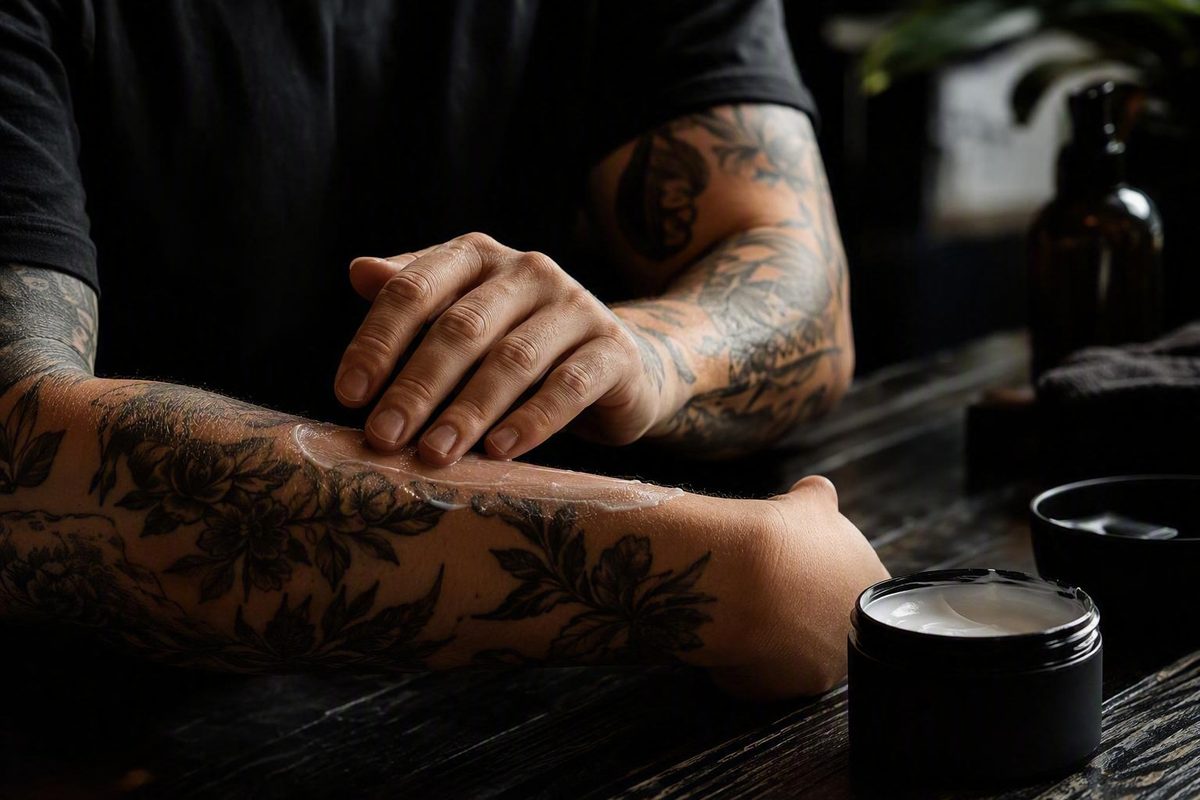
A good aftercare lotion for tattoos is generally a lightweight, fragrance-free product used sparingly after active weeping has stopped and peeling has begun. It does not need tattoo-specific branding, and the available evidence does not identify one lotion as best for every tattoo or every person.
Timing matters as much as the formula. A raw tattoo—or one beneath protective film—requires a different approach from a dry, flaking tattoo. Follow the instructions from the artist who performed the tattoo, including the protocol for any film dressing, rather than changing products solely because a certain number of days has passed.
The evidence available for this guide comes mainly from tattoo-studio articles and manufacturer pages, not independent clinical trials or medical guidelines. Their recommendations are best understood as attributed aftercare practices rather than proof that a particular product improves healing. This article provides general education, not diagnosis or individualized medical advice.
What makes a lotion suitable for tattoo aftercare?
Club Tattoo and other tattoo-shop guides favor a lightweight, fragrance-free or unscented lotion once active weeping has stopped and the tattoo has entered the peeling stage. Their stated goal is modest hydration without a heavy or greasy residue. Club Tattoo describes this stage-based approach and recommends using only enough lotion to keep the skin supple.
“Fragrance-free” is a useful first screen, but it is not a guarantee that a product will suit every person. No supplied source establishes that fragrance-free products are universally hypoallergenic or non-irritating.
Assess the exact product rather than relying on its brand. Companies may sell similarly named lotions with different formulas, textures, fragrances, and directions. Studio recommendations illustrate the problem: one article names Lubriderm Daily Moisture Lotion Fragrance-Free, while another recommends Lubriderm Advanced Therapy. These are different variants, so “buy Lubriderm” is not a sufficiently precise shopping instruction.
Before buying, use this checklist:
- Exact fragrance-free designation: Look for those words on the current package. Do not assume every product from the same brand is unscented.
- Light texture: For the peeling stage, favor a lotion that can be spread in a very thin layer without forceful rubbing.
- Minimal residue: The tattoo should not remain persistently wet, slick, sticky, or heavily coated.
- Compatibility with known allergies: Review the complete current ingredient list, especially if you have reacted to skincare ingredients before.
- Clear directions: Check the manufacturer’s stated intended use and whether it fits the tattoo’s present condition.
- Appropriate healing stage: Do not assume a daily body lotion is intended for raw, open, or actively weeping skin.
- Consistency with the artist’s protocol: Reconcile any prospective purchase with the instructions supplied by your tattoo artist.
Tattoo-specific branding may make a product easier to identify, but it does not establish superior performance. Packaging, price, endorsements, manufacturer claims, and customer-review volume do not prove that a product heals a tattoo better than an appropriate ordinary moisturizer.
The supplied evidence also does not show that lotion prevents infection, scarring, fading, or delayed healing. Its practical role in these studio routines is narrower: keeping dry, peeling skin comfortable without leaving it overloaded with product.
Choose by healing stage, not by product hype
Approximate dates can provide context, but visible healing signs and the artist’s protocol are more useful than a fixed deadline.
Days 1–3: raw or weeping
Club Tattoo and Tattoo Aftercare Guide describe the first three days as a commonly observed raw or weeping stage. Plasma, excess ink, and small amounts of blood may appear, while early localized redness and swelling should diminish rather than grow. These are general descriptions, not a diagnostic test for whether a particular tattoo is healing normally. The stage timeline describes days 1–3 and advises medical evaluation when redness or swelling increases instead of subsiding.
During this early stage, the supplied studio sources commonly favor a very thin layer of an artist-approved ointment or balm rather than automatically beginning a standard lotion. That is a description of studio practice, not proof that ointment is medically superior.
If an intact protective film covers the tattoo, follow the artist’s directions for wearing and removing it.
Days 4–14: peeling and flaking
The same stage-based sources commonly describe days 4–14 as the peeling period and introduce a lightweight, fragrance-free lotion once weeping has stopped. The transition around day three or four is a recurring studio recommendation, not a universal medical deadline.
Peeling may look similar to light sunburn flaking, and mild itching is commonly described during this stage. Do not pull at loose skin or scratch the tattoo. Lotion should make dry skin feel more comfortable; it should not paste down flakes beneath a thick coating.
Use the tattoo’s condition as the deciding factor. If it remains raw, wet, or covered, continue the artist-directed early-stage protocol. If weeping has ended and dry flaking has begun, the lotion stage described by these sources may apply.
Weeks 2–4: continued surface recovery
After visible peeling subsides, the surface may remain shiny, milky, silvery, or slightly hazy. That appearance does not by itself mean the area needs more lotion.
Tattoo Aftercare Guide places surface healing at approximately two to four weeks and says deeper remodeling can continue for three to six months. These are general ranges rather than promises for an individual tattoo. Its timeline distinguishes surface closure from longer underlying recovery.
A large, densely colored tattoo may settle differently from small linework. Areas exposed to repeated bending or rubbing may also recover less evenly. These differences make observation and artist guidance more important; they do not establish separate evidence-based lotion schedules.
Let the actual protocol take priority
Use this order of priority:
- Instructions from the artist who performed the tattoo
- Directions for the specific film or dressing being used
- The tattoo’s visible condition—covered, weeping, peeling, or surface-healed
- Approximate stage ranges
- General product marketing
Contact the studio if its instructions are unclear or appear inconsistent with the tattoo’s current condition. Avoid combining several competing aftercare routines or adding products simply because different commercial guides mention them.
Commonly recommended lotion options and what the evidence actually shows
The products below are examples mentioned in tattoo-studio or manufacturer material. They are not ranked, and inclusion is not an endorsement. Except for Mad Rabbit’s manufacturer page, the stated product characteristics come from commercial studio articles rather than verified current manufacturer labels.
Golden Tarot Ink Club names Lubriderm Daily Moisture Lotion Fragrance-Free, Aveeno Daily Moisturizing Lotion, and Eucerin Advanced Repair Lotion for mid-to-late healing. Its descriptions are studio opinions, not independent product testing. The commercial studio article provides the three product names and attributed characteristics.
| Exact product name | Source of the recommendation | Stated characteristics | Source-proposed role in the routine | Evidence limitations |
|---|---|---|---|---|
| Lubriderm Daily Moisture Lotion Fragrance-Free | Golden Tarot Ink Club | The studio describes it as fragrance-free, fast-absorbing, and non-greasy | The studio proposes it for mid-to-late healing | The description is not independent testing or verification of the current label. Confirm the exact variant and current formula. |
| Aveeno Daily Moisturizing Lotion | Golden Tarot Ink Club | The studio describes it as a daily moisturizer containing colloidal oatmeal | The studio lists it among options for mid-to-late healing | The source does not prove that it is best for sensitive, itchy, or healing tattooed skin. Current formulation details remain unverified here. |
| Eucerin Advanced Repair Lotion | Golden Tarot Ink Club | The studio describes it as fragrance-free and intended for more intensive hydration | The studio proposes it for drier skin in later healing | Suitability for a healing tattoo has not been independently established. A richer texture may not suit every user or protocol. |
| Lubriderm Advanced Therapy | The Honorable Society tattoo shop | The shop recommends it as a lighter lotion after the first few days | It illustrates one shop’s transition from early ointment use to lotion | This is different from Daily Moisture Lotion Fragrance-Free. The article includes affiliate links and is not neutral comparative testing. |
| Mad Rabbit Daily Tattoo Lotion | Mad Rabbit manufacturer page | The manufacturer markets it as fragrance-free, lightweight, non-greasy, and intended for morning and evening use | The manufacturer presents it as daily skincare for tattooed or non-tattooed skin | Manufacturer marketing is not independent evidence, and the supplied page does not establish suitability for fresh, open, or actively weeping skin. |
The Honorable Society recommends Lubriderm Advanced Therapy after the first few days, showing why the full variant name matters. Its article also participates in affiliate advertising, so its recommendation should be treated as commercially interested shop guidance. The shop identifies Advanced Therapy as its preferred Lubriderm variant.
Mad Rabbit describes Daily Tattoo Lotion as a fragrance-free, lightweight, non-greasy moisturizer for morning and evening use on tattooed or non-tattooed skin. Those are manufacturer claims, not evidence of better tattoo healing. The page does not clearly state that this daily lotion is intended for a fresh, open, or actively weeping tattoo. Mad Rabbit’s product page states the marketed characteristics and daily-use directions.
The practical comparison is therefore not simply “tattoo lotion versus regular lotion.” Ask:
- Is the exact current formula labeled fragrance-free?
- Can it be applied in a very thin layer?
- Does it leave minimal residue?
- Does it contain anything you already know you cannot tolerate?
- Has the tattoo stopped weeping and begun peeling?
- Do the product directions fit its present condition?
- Does the choice align with the artist’s protocol?
A budget-friendly ordinary lotion may meet those criteria. A more expensive tattoo-branded product may not. Conversely, an ordinary moisturizer is not automatically appropriate merely because it is familiar or widely available.
How to apply tattoo lotion without over-moisturizing
Once the tattoo has reached the lotion stage, good technique limits unnecessary product and rubbing. Unless your artist provided different instructions:
- Wash your hands. Do this before touching the tattoo or dispensing lotion.
- Clean the tattoo as directed. Follow the artist’s method and avoid aggressive scrubbing.
- Pat it dry. Use gentle pressure rather than rubbing, and do not apply lotion while the surface remains visibly wet.
- Start with a small amount. It is easier to add a little than to remove a heavy coating from sensitive skin.
- Spread a thin, even layer. Use light contact and avoid prolonged massage.
- Check the finish. The skin should feel comfortable and supple, not wet, slick, sticky, or heavily sealed.
Tattoo-shop sources commonly suggest approximately two to three lotion applications per day during the peeling stage. The Honorable Society suggests twice daily with adjustments for the healing stage, while Club Tattoo suggests two to three times daily from about day four. These are commercial studio practices, not medically required schedules. The Honorable Society emphasizes clean hands, gentle drying, thin application, and frequency adjusted to the healing stage.
Inspect the tattoo before applying more. If it feels comfortable and still has a noticeable coating, another application may not be necessary. If it is dry and tight during the peeling stage, a small amount may fit the studio guidance.
Possible signs that the application is too heavy include:
- Glossiness that persists long after application
- A wet or damp appearance
- Sticky or heavy residue
- Product collecting in creases or around flakes
- New bumps appearing after repeated applications
These observations cannot determine whether a problem is simple over-application, irritation, dermatitis, or something else. Club Tattoo warns that excessive moisture may contribute to maceration, while Golden Tarot Ink Club warns about clogged pores and trapped moisture or bacteria. Those are commercial warnings rather than findings proven for every formula.
If you used too much, apply less next time rather than layering on another product. Do not repeatedly wipe or scrub the sensitive surface.
Never apply lotion beneath an intact protective film unless the tattoo artist specifically instructs you to do so.
How to screen labels for sensitivity and irritation risks
For a peeling tattoo, fragrance-free status is the clearest product-selection criterion consistently supported by the supplied studio guidance. Check the exact front and back labels because brands may package scented and fragrance-free variants similarly.
Fragrance-free does not mean universally hypoallergenic.
The Honorable Society also advises avoiding alcohol-containing products. Treat that as one tattoo shop’s guidance, not a universal rule that every ingredient containing “alcohol” in its name is harmful.
Do not assume these ingredients are automatically beneficial because they sound natural, soothing, or cleansing:
- Botanical extracts
- Essential oils
- Tea tree oil
- Witch hazel
- Optional antimicrobial ingredients
- Strongly scented plant oils or butters
A longer ingredient list is not necessarily better, while a short list does not guarantee that a product will be non-irritating. The available evidence does not establish that botanical or antimicrobial additions improve tattoo healing.
If you have known allergies or a diagnosed skin condition, review the complete current ingredient list and seek individualized advice from a qualified professional. Generic shopping lists cannot establish product suitability for eczema, acne-prone skin, contact dermatitis, or another diagnosed condition. Marketing phrases such as “gentle,” “sensitive,” or “for all skin types” do not settle that question.
If a lotion causes burning, stinging, bumps, or a spreading rash:
- Stop using the suspected product.
- Avoid rapidly cycling through several replacements.
- Record when the symptoms began and where they appear.
- Contact the artist or an appropriate healthcare professional if the symptoms persist.
- Obtain professional evaluation if the reaction spreads, intensifies, or involves substantial swelling.
These symptoms do not allow a reader to diagnose the cause. Mild itching can occur during peeling, but persistent burning, a raised rash, or new bumps after introducing a product warrants more caution than uncomplicated dry flaking.
The rest of the routine matters as much as the lotion
Keep the routine simple:
- Wash your hands before touching the tattoo.
- Clean the area gently according to the artist’s directions.
- Pat rather than rub it dry.
- Do not pick flakes or scabs.
- Avoid scratching peeling skin.
- Reduce avoidable rubbing from clothing where practical.
- Keep the healing tattoo out of pools, hot tubs, and other soaking environments.
- Avoid direct sunlight while it is healing.
The supplied sources disagree about the no-soaking period. Club Tattoo recommends avoiding pools, hot tubs, ocean water, and deep baths for at least two weeks, while Tattoo Aftercare Guide and Lubriderm’s educational page advise avoiding long baths or soaking for about a month. These are source-specific recommendations, not a single clinically established deadline. Follow the artist’s instructions and do not select the shortest estimate merely for convenience.
Placement may affect recovery. Tattoo Aftercare Guide says areas subject to frequent bending or rubbing—including fingers, elbows, feet, and waistband areas—may heal more slowly or unevenly. It also says large, densely colored pieces can take longer than simple linework. These observations do not establish a different lotion protocol; they make monitoring and artist guidance more important.
Sunscreen belongs on fully healed skin according to the available manufacturer guidance. During active healing, keeping the tattoo out of direct sunlight is preferable to treating sunscreen as a substitute for physical protection.
After complete healing, Lubriderm recommends broad-spectrum SPF 30 or higher during sun exposure and a water-resistant product when water exposure is expected. Its tattoo-care page places this sunscreen recommendation after complete healing.
Until then, use shade and clothing that do not stick to, compress, or abrade the area. Ask the studio how to protect a difficult placement if sun avoidance conflicts with work, travel, or other practical constraints.
Normal healing, product irritation, and warning signs
The supplied stage guides describe a general progression that may include:
- Early weeping of plasma and excess ink
- Localized redness and swelling that decrease
- Later dryness, peeling, or flaking
- Mild itching during peeling
- A temporary shiny or hazy surface after flaking subsides
These descriptions are not diagnostic. The overall direction is more informative than any isolated feature: redness and swelling are described as decreasing rather than spreading or intensifying after the first few days.
Timing alone cannot identify the cause, however. Stop the suspected product and obtain advice if the symptoms persist or worsen rather than trying to cover them with another moisturizer.
Tattoo Aftercare Guide specifically directs readers to obtain same-day medical care for spreading redness, fever, red streaks, or pus. Its terms state that these signs require a doctor rather than another ointment.
Other supplied tattoo guidance recommends medical evaluation for excessive swelling, severe redness, heat, unusual discharge, or a suspected allergic reaction. It does not assign a precise urgency level to every one of those symptoms, so seek prompt professional guidance rather than attempting to manage them by switching lotions.
Particularly concerning changes include:
- Redness that spreads or continues to increase
- Increasing heat
- Swelling that spreads or becomes excessive
- Fever
- Red streaks extending from the area
- Pus or thick yellow discharge
- Severe redness
- Other unusual discharge
- A significant or suspected allergic reaction
Do not try to moisturize away expanding redness, heat, discharge, streaking, or systemic symptoms. Lotion is not an infection treatment. This guide cannot distinguish infection, allergy, contact dermatitis, or another complication; uncertain, severe, spreading, or worsening symptoms require qualified assessment.
A practical decision guide for selecting your lotion
Use the tattoo’s current condition to choose the next step.
1. Is the tattoo beneath intact protective film?
- Yes: Follow the artist’s film protocol. Do not put lotion under the film unless specifically directed.
- No: Continue to the next question.
2. Is it raw or actively weeping plasma or ink?
- Yes: Do not begin an ordinary lotion automatically. Follow the artist’s early-stage cleansing, dressing, or ointment instructions.
- No: Continue.
3. Has weeping stopped, with dryness, peeling, or flaking beginning?
- Yes: Consider a verified fragrance-free, lightweight lotion consistent with the artist’s protocol. Apply only a thin layer after gentle cleaning and careful drying.
- No: If the tattoo does not fit a clear stage or appears to be worsening, contact the artist or an appropriate healthcare professional.
4. Does the lotion leave the tattoo shiny, damp, sticky, or heavily coated?
- Yes: Reduce the amount at the next application. Do not add another product to counteract the first.
- No: Continue using only enough to keep the area comfortable.
5. Does the product cause burning, bumps, or a rash?
- Yes: Stop using it. Do not test several replacements in quick succession. Obtain professional advice if the symptoms persist, spread, or worsen.
- No: Continue monitoring rather than assuming a reaction can never develop.
6. Is the tattoo fully surface-healed?
- Yes: Acute aftercare is giving way to ordinary skincare. Moisturize as needed and use appropriate sun protection during exposure.
- No: Continue the stage-appropriate routine and avoid picking, soaking, repeated friction, and direct sun.
7. Are redness, heat, swelling, discharge, fever, or streaking increasing?
- Yes: Seek professional medical assessment. Spreading redness, fever, red streaks, or pus are specifically identified in the supplied guidance as requiring same-day care.
- No: Continue observing whether the tattoo is steadily settling.
The final shopping rule is straightforward: choose the exact formula that fits the tattoo’s stage, carries the appropriate fragrance designation, leaves minimal residue, avoids known allergens, and aligns with the artist’s protocol. Do not assume that the most expensive, most reviewed, or most visibly tattoo-branded option is superior.
Frequently asked questions
Can I use an ordinary fragrance-free lotion instead of a tattoo-specific product?
An ordinary fragrance-free lotion may be reasonable once weeping has stopped and peeling has begun, provided the exact formula is lightweight, leaves little residue, does not conflict with known allergies, and fits the artist’s instructions.
Tattoo-specific branding does not prove better healing. Apply the same screening criteria to both categories, and do not use a general daily lotion on raw or actively weeping skin merely because it is fragrance-free.
When should I switch from ointment to lotion on a new tattoo?
The supplied studio guidance commonly places the transition around day three or four, when active weeping ends and peeling begins. That is an approximate commercial aftercare pattern, not a mandatory medical deadline.
Visible condition and the artist’s protocol should take priority. Continue the directed early-stage routine if the tattoo remains raw, wet, or protected by film.
How many times a day should I put lotion on a peeling tattoo?
Tattoo-shop sources commonly suggest approximately two to three applications per day, but they also allow for adjustment based on dryness, healing stage, and artist guidance. This is not a medically required schedule.
Check the surface before applying more. If it remains shiny, damp, sticky, or coated, use less rather than applying automatically.
What should I do if tattoo lotion burns, causes bumps, or produces a rash?
Stop using the suspected lotion and avoid trying several replacements in rapid succession. Seek professional advice if the symptoms persist, spread, or worsen.
Spreading redness, fever, red streaks, or pus call for same-day medical care under the supplied warning guidance. Severe redness, increasing heat or swelling, unusual discharge, or a suspected significant allergic reaction also warrants professional evaluation rather than another aftercare product.
When can I put sunscreen on a tattoo?
The supplied manufacturer guidance recommends waiting until the tattoo is fully healed before applying sunscreen directly. During active healing, keep it out of direct sunlight and use non-abrasive physical protection where practical.
Once fully healed, use broad-spectrum SPF 30 or higher during sun exposure and consider water resistance when exposure to water is expected.