
8 min read ·
When Aquaphor Fits Your Tattoo Healing Routine
Find out how to apply Aquaphor sparingly, why tattoo aftercare advice differs, when to switch to lotion, and which reactions need prompt medical care.
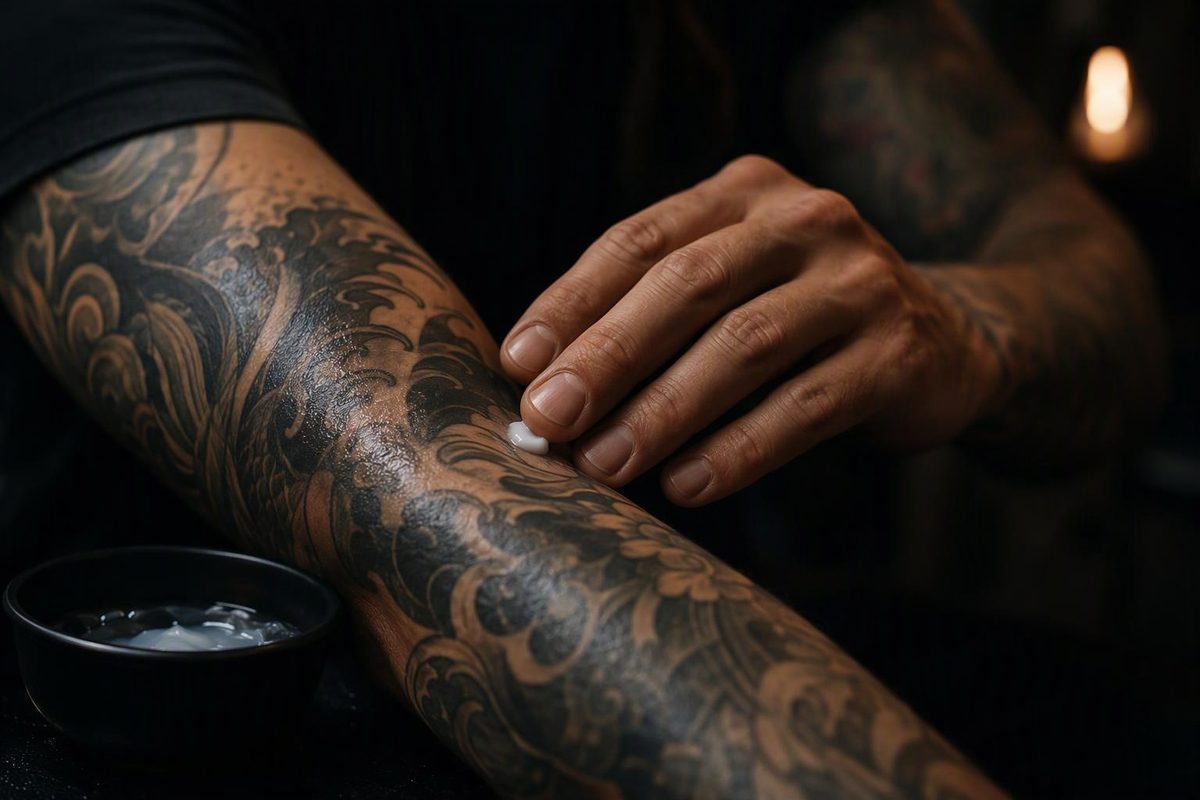
Aquaphor Healing Ointment can be an option for tattoo healing, but it is not necessary for every tattoo and the advice is mixed. If it is part of your care plan, apply a very thin layer after gentle washing and drying—not a thick, greasy coating. Healthline supports this use, while Cleveland Clinic advises avoiding petroleum jelly during tattoo healing. The U.S. Aquaphor label also says not to use it on deep or puncture wounds and does not provide a tattoo-specific protocol. If your instructions are unclear, ask a dermatologist rather than adding it by default.
Choose your skin symptoms, dressing status, and care plan to see the next step.
Aquaphor: Your Next Step
Confirm the Product Plan First
Do not add Aquaphor by default. Clarify your aftercare instructions; ask a dermatologist if you are unsure whether it suits your fresh tattoo.
The U.S. label does not give tattoo-specific directions and says not to use it on deep or puncture wounds. Guidance on petroleum-based tattoo care differs.
Decision Notes and Limits
Urgent symptoms: Trouble breathing, chest tightness, dizziness, or intense swelling needs immediate medical care. Spreading or darkening redness, worsening pain, pus, fever, or chills needs medical care right away. Aquaphor does not treat infection.
Allergy or rash: Avoid this ointment with a known lanolin or lanolin-alcohol allergy. Stop it and ask a clinician if a new rash appears after application.
Intact dressing: Do not remove an intact second-skin dressing to add ointment. Follow its specific care instructions.
Product plan: If Aquaphor is specified, use a very thin layer after gentle washing and drying, according to your schedule. If your plan uses lotion or another product, do not add Aquaphor automatically. If the plan is unclear, clarify it before starting.
No listed warning sign does not prove normal healing. This tool cannot diagnose a reaction or resolve the product-label warning.
Sources: U.S. Aquaphor Healing Ointment label; Healthline tattoo aftercare and Aquaphor guidance; Cleveland Clinic; DermNet; American Academy of Dermatology, linked in the article.
Aquaphor Is an Optional Product, Not a Required Healing Step
The useful question is not whether Aquaphor is popular, but whether this particular ointment belongs in your particular aftercare plan. A routine using a suitable moisturizer does not need an extra ointment simply because another person used one successfully.
Healthline’s tattoo-aftercare guidance includes Aquaphor among products that may be used after washing and drying. That supports describing it as an option. It does not establish that every fresh tattoo needs Aquaphor, that a heavier application is better, or that it should remain in the routine throughout healing.
Cleveland Clinic’s tattoo-aftercare guidance recommends a simple moisturizer or recommended ointment but advises avoiding petroleum jelly during healing. These sources do not give one shared recommendation about petroleum-based care. Presenting Aquaphor as universally recommended would hide that disagreement.
If your artist has given you a lotion-based routine, do not add Aquaphor as a second moisturizing step without checking. If your written instructions specify Aquaphor, make sure they also explain when to start, how sparingly to apply it, and when to move on. If that plan conflicts with a product warning or advice from your clinician, ask a dermatologist to resolve the conflict.
Check That You Have Aquaphor Healing Ointment
This guidance concerns Aquaphor Healing Ointment, not every product sold under the Aquaphor name. A brand name alone is not enough to identify the formulation or its intended use. Read the full product name and the label on the package you actually have.
The U.S. formula contains 41% petrolatum, plus mineral oil, ceresin, lanolin alcohol, panthenol, glycerin, and bisabolol. It is fragrance-free and labeled as a skin protectant, not an antibiotic. Those details come from the U.S. product label and manufacturer’s product information. Check your package because formulas and labeling can change.
The label has a significant limitation: it does not list tattoo aftercare and says not to use the product on deep or puncture wounds. Its general direction to “apply as needed” is therefore not a tattoo-specific application schedule. The product’s minor-wound claims do not, by themselves, settle whether you should use it on a fresh tattoo.
The formula and labeling described here are U.S.-specific. Do not assume a product purchased elsewhere has identical ingredients or directions. Likewise, fragrance-free does not mean free of every ingredient that could cause a reaction; this ointment contains lanolin alcohol.
If you are uncertain about the label warning, your skin’s condition, or the product your artist meant, ask a dermatologist before proceeding. Do not substitute a different Aquaphor-branded product on the assumption that the same advice applies.
Leave an Intact Second-Skin Dressing Alone
Begin washing and moisturizing when your dressing instructions say to begin. An intact second-skin dressing is not a reason to remove it early so that you can apply Aquaphor. Follow the specific dressing-care plan instead.
This distinction prevents two separate care stages from being mixed together. Instructions for exposed skin after dressing removal are not automatically instructions for skin still covered by a dressing. Healthline’s aftercare guidance discusses dressing care as part of the routine; it should not be reduced to an ointment schedule alone.
If your instructions explain how to care for the dressing but do not say what to use afterward, clarify that next step with your artist. If you have concerning symptoms, use the warning signs below rather than treating the dressing or ointment decision as the main problem.
Aquaphor is not a reason to override dressing instructions. Nor should a generic recommendation to moisturize be read as permission to put ointment under an intact dressing. Keep the dressing plan and the later product plan distinct.
Apply a Thin Layer After Washing and Drying
If Aquaphor is part of your agreed routine and you are at the stage when the tattoo should be washed and moisturized, use the following sequence. These are application steps, not a reason to choose Aquaphor over a different product.
- Wash your hands first. Then gently wash the tattoo with lukewarm water and mild, fragrance-free soap.
- Rinse and pat dry. Use a clean paper towel and allow the skin to dry before applying the ointment.
- Spread a very thin layer. Use only enough to lightly cover the area. Do not leave visible blobs or a heavy, greasy coating.
- Leave peeling skin alone. Do not rub or pull off loose skin while spreading the product.
- Use the agreed schedule. Do not keep adding ointment simply because the previous application is no longer noticeable.
Healthline’s Aquaphor-specific guidance describes washing, drying, and applying it two to three times daily during the early days. That is the source’s suggested routine, not a universal prescription for every tattoo or permission to apply it repeatedly between scheduled care.
“Thin” is a description of the finished layer, not a fixed spoonful or blob size. The cited guidance does not supply a measured amount per square inch of tattoo. There is no supported gram amount here to calculate from tattoo size. Use the visible result: lightly covered skin, without deposits of ointment or a heavy coating.
Do not try to make one application last longer by putting on more. A thick layer does not follow the thin-application advice, even if you intend to wash it off later. Similarly, adding more whenever you notice flaking turns a scheduled routine into repeated coating without a clear stopping point.
If you already applied too much, do not scrub the tattoo to remove it. At the next gentle wash, rinse, pat dry, and use less. If the skin has also developed a new rash or worsening symptoms, follow the stop-and-seek-help guidance rather than assuming the only issue is the amount.
Switch to Lotion According to the Plan, Not a Universal Day
There is no universal day when everyone must stop Aquaphor. Healthline describes switching after several days to about a week, with the artist specifying the timing. That range belongs to its suggested routine; it is not a deadline that establishes what every tattoo needs.
Once your care plan moves to lotion, choose a lightweight, fragrance-free product and apply it sparingly. You do not need to layer Aquaphor and lotion. For help choosing the next product, see fragrance-free lotion for a tattoo.
If your instructions say only “use Aquaphor” without a transition point, ask when to stop rather than extending the ointment stage indefinitely. The product label’s “apply as needed” wording does not answer that tattoo-specific question.
Flaking alone is not a reason to increase the amount of ointment, restart it after switching to lotion, or pull away loose skin. Keep those decisions separate: choosing the product, choosing the schedule, and leaving peeling skin undisturbed.
A calendar can help you follow an agreed plan, but it cannot resolve conflicting instructions. If you were told to switch at a particular stage and cannot tell whether you have reached it, ask for clarification. If symptoms are becoming more concerning, seek clinical advice rather than changing products to see whether they disappear.
Stop Aquaphor if a New Rash Develops
Avoid Aquaphor Healing Ointment if you have a known lanolin or lanolin-alcohol allergy. Its fragrance-free formulation does not remove that ingredient concern. DermNet’s guidance on lanolin reactions explains that lanolin can cause contact allergy and that compromised skin can be more susceptible.
If a new rash develops after you apply the ointment, stop using it and ask a clinician for advice. Do not repeatedly reapply it to test whether the rash settles, or cycle through several new products without guidance. A reaction after application is a reason to reassess the product, not to put on a thicker layer.
The timing alone does not establish that lanolin caused the rash. A clinician can assess the reaction; the practical step here is to stop the suspect product and seek advice. If you also have worsening pain, spreading redness, pus, or systemic symptoms, do not treat the situation as only a product-selection problem.
Keep the package available when seeking advice so that you can identify the exact product and ingredients. Saying “Aquaphor” without the product name may not tell the clinician which formula you used.
Worsening Symptoms Need Care, Not More Ointment
Some early soreness, clear fluid, and later mild itching or flaking can be normal during tattoo healing. Those changes are different from the warning signs described by the American Academy of Dermatology.
Seek medical care right away if redness spreads or darkens, pain worsens, pus appears, or you develop fever or chills. Aquaphor is a skin protectant, not treatment for a tattoo infection. Increasing its frequency or switching to lotion is not a substitute for having those symptoms assessed.
Trouble breathing, chest tightness, dizziness, or intense swelling with a tattoo reaction needs immediate medical care. Do not wait for the next wash, dressing change, or reply from your artist before seeking help.
| What You Notice | What to Do |
|---|---|
| A heavy ointment coating | Use less after the next gentle wash; do not scrub. |
| A new rash after application | Stop Aquaphor and ask a clinician. |
| Spreading redness, worsening pain, pus, fever, or chills | Seek medical care right away. |
| Breathing trouble, chest tightness, dizziness, or intense swelling | Get immediate medical care. |
The decision tool above is a guide to the next step, not a diagnosis or confirmation that a tattoo is healing normally. If no listed warning sign is present, that still does not establish that Aquaphor is the right product. Your dressing instructions, exact formulation, allergy history, and agreed care plan remain the basis for that choice.