
9 min read ·
When a Fine-Line Tattoo Vanishes With the Scab
Learn why fine-line ink can vanish during healing, how to distinguish normal peeling from pigment dropout, and when the skin is ready for a touch-up.
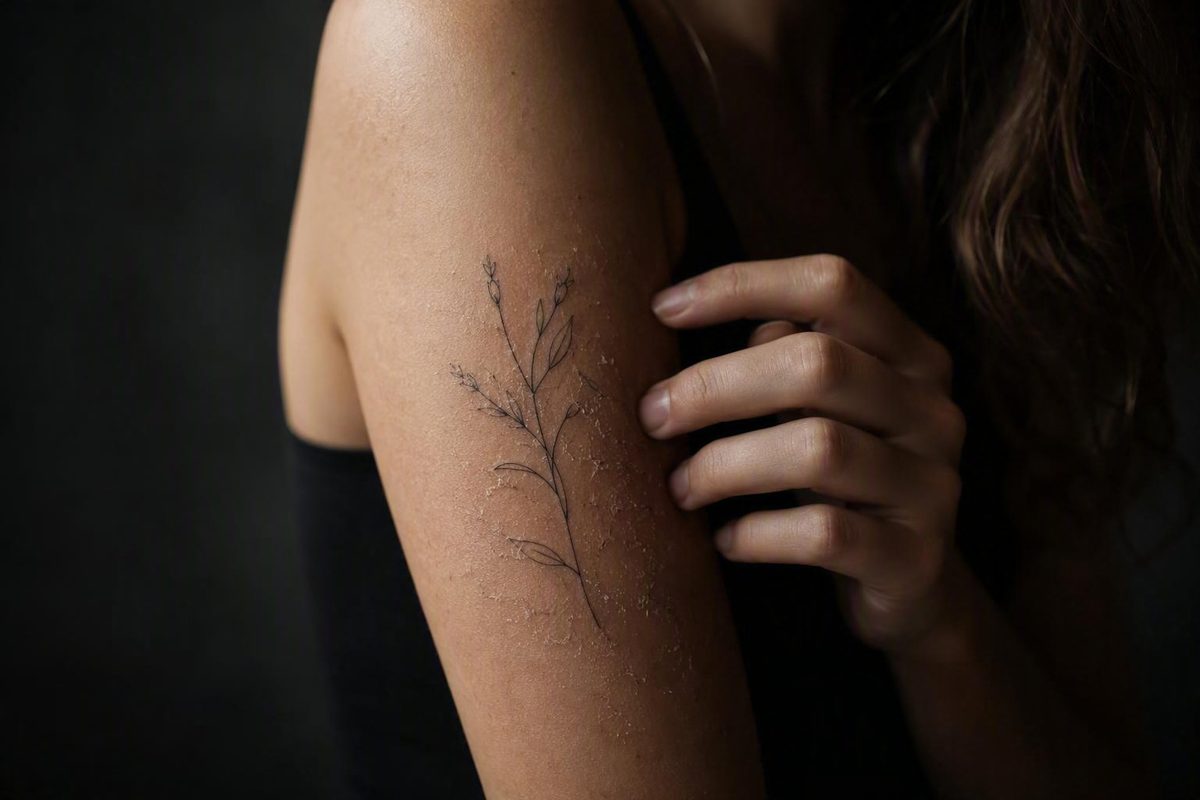
If your fine-line tattoo came away with a thick scab and left smooth, bare-looking skin, the pigment probably did not remain securely in the dermis; much of it may have been placed too close to the shedding epidermis. That is pigment dropout, not ordinary peeling, and aftercare cannot put the missing ink back. Let the skin heal completely, then ask the original artist about a touch-up—commonly reviewed around six to eight weeks, but later if the area is still shiny, rough, tender, scabbed, swollen, or irritated. Seek medical care instead if redness, heat, pain, swelling, or discharge is worsening.
Enter what came off, what remains, and how the skin feels; the result shows whether to wait, contact the artist, or seek care.
This checker separates visible healing from likely pigment dropout. It cannot determine who caused the loss or diagnose a wound complication.
At seven days, a heavy scab with visible ink raises concern for dropout, but the design cannot be judged while the skin remains scabbed, shiny, or rough. Ink in a released scab does not by itself prove that dermal pigment was lost.
How Each Pattern Changes the Result
| Pattern | Likely Reading | Action | Timing |
|---|---|---|---|
| Thin flakes; line remains | Normal shedding | Leave flakes alone and continue artist-directed care | Reassess after peeling |
| Cloudy or shiny skin; line visible | Still settling | Wait for smooth, calm skin | Often within weeks 2–4 |
| Heavy scab; result still covered | Uncertain | Do not lift the scab; photograph its natural progress | Judge only after release |
| Blank or broken line on calm skin | Likely dropout | Send healed photographs to the artist | Review around weeks 6–8 |
| Nearly complete disappearance | Major retention loss | Request a healed assessment and touch-up plan | Only after full healing |
| Fuzzy edge or blue-gray haze | Possible blowout | Ask an experienced artist to assess it | After the tattoo settles |
| Worsening redness, heat, swelling, or pain | Medical concern | Seek medical assessment, not a touch-up | Promptly |
| Pus, odor, streaks, fever, or chills | Medical concern | Obtain prompt medical care | Do not wait |
High-friction placement can make retention more difficult, but placement and pain level cannot prove whether the artist worked too shallowly.
Sources: Allure and Yahoo reporting with tattoo-artist and dermatologist commentary; six-to-eight-week review guidance and warning signs summarized from the accompanying article. Dates are planning aids, not medical clearance.
Ink-colored material in a naturally released flake does not by itself mean the tattoo fell out. A healing tattoo sheds damaged surface skin, dried fluid, light scabs, and excess ink that was never part of the lasting design. The decisive sign is what remains once the surface is smooth and calm.
Persistent blank spots, pale patches, nearly invisible sections, or broken lines indicate poor pigment retention. A fuzzy border or blue-gray shadow outside the intended line points instead to blowout. Cloudy or milky skin over an intact line is usually part of healing and may clear as the surface matures.
Shallow Pigment Can Leave With the Epidermis
The epidermis is the renewing outer layer of skin. Tattoo pigment intended to last must remain beneath it in the dermis. If pigment is deposited in or too close to the epidermis, a fine-line design can look complete when fresh and then become faint, broken, or nearly invisible as that layer sheds.
Artists interviewed for a syndicated account of an abruptly disappearing micro tattoo identified shallow or inconsistent depth as a leading explanation. That mechanism fits a tattoo that disappears with its scab, but a photograph cannot prove exactly how an individual tattoo was applied.
Depth can also be wrong in the opposite direction. Pigment placed too deeply may spread through surrounding tissue, producing the fuzzy extension or blue-gray haze tattooers call blowout. Dropout removes part of the design; blowout adds pigment beyond its border. One tattoo can contain both.
Fine-line work exposes small depth inconsistencies because each mark contains little visual redundancy. A small missing area in a broad, saturated shape may be difficult to notice. The same loss from a hair-thin line can interrupt the entire design.
“Fine line” describes the result and approach, not one mandatory needle configuration. Some artists use a single-point needle, while others use a small or larger grouping capable of creating a delicate mark. The available evidence does not establish a dependable failure rate comparing fine-line tattoos with bolder styles.
Tiny size alone does not explain near-total disappearance. A micro tattoo has little margin for pigment loss, but it still requires consistent placement at the appropriate depth.
Pain is not a depth test. A comfortable session does not prove that the artist worked too shallowly, just as a painful session does not prove correct depth. Pigment color also cannot adequately explain a tattoo becoming nearly invisible within several days. Gradual fading from light exposure is a different process.
Heavy Scabbing Raises Concern but Does Not Assign Blame
A light scab or colored flake can be part of normal tattoo peeling. Heavy scabbing followed by a bare section is more concerning because the pigment may have been shallow, the skin may have been heavily traumatized, or the healing surface may have been disrupted.
Tattoo artists sometimes associate repeated passes over a small area with overworked skin, increased inflammation, thick scabbing, and uneven retention. Heavy scabbing alone does not prove overworking, however. It can have several causes, and removing the scab to inspect the ink can make the outcome worse.
Aftercare has a real but limited role. Picking, scratching, premature scab removal, scrubbing, shaving, soaking, and repeated friction can disturb healing skin. Watchbands, shoes, clothing, equipment, or movement across a joint may rub the area even when the wearer is trying to follow instructions.
Those factors do not justify automatically blaming the wearer. Someone can follow the artist’s directions and still have pigment drop out. Conversely, a gap cannot always be attributed to shallow technique when healing was repeatedly disrupted. Application, skin trauma, placement, friction, and individual healing can overlap.
Claims that moisturizer pulls settled pigment out of the dermis should not be treated as established fact. Excess product can leave the surface overly wet or irritated, but properly deposited dermal pigment does not simply get drawn out by lotion.
The Skin’s Condition Matters More Than the Shed Scab
Use the appearance and texture of the skin beneath the released material to separate ordinary healing from likely fallout.
| Finding | What It Suggests | Next Step |
|---|---|---|
| Thin flakes, mild itching, temporary dullness | Normal surface shedding | Continue aftercare and leave flakes alone |
| Cloudy, shiny, or milky skin over a visible line | The surface is still maturing | Reassess after it becomes smooth and calm |
| Blank spots or broken lines on calm skin | Likely pigment dropout | Photograph it and contact the artist |
| Fuzzy edge or blue-gray haze | Possible blowout | Request an assessment after healing |
| Worsening redness, heat, swelling, pain, or discharge | Possible wound complication | Seek medical care |
Normal shedding can look dramatic. A flake may contain dried plasma, damaged epidermal skin, surface residue, and excess pigment. What matters is whether a recognizable line remains after the flake detaches naturally.
A healed tattoo will not retain its fresh, wet, high-contrast appearance. Fine lines commonly settle softer and may look dark gray rather than stark black. Allure’s overview of fine-line longevity and healing distinguishes this ordinary settling from inconsistent or nearly invisible pigment.
Take dated photographs every few days under similar lighting and from a similar distance. Do not stretch, scrape, press, or repeatedly rub the tattoo for a closer look. Comparable photographs give the artist more useful information than daily inspections under changing light.
Early Healing Can Temporarily Hide Fine Lines
Healing varies with the tattoo, placement, technique, skin, and any complications. The ranges below are practical guides rather than fixed deadlines.
Days 1 To 3
Mild tenderness, redness, swelling, and limited oozing of plasma, blood, or excess ink may occur during the first one to three days. Fluid trapped beneath a suitable dressing can look dark after mixing with surface ink. These effects should generally improve rather than intensify.
Roughly Days 3 To 14
Peeling, flaking, itching, and light scabbing commonly develop during this period. Let flakes release naturally. Uneven scab coverage and sections peeling at different speeds can create temporary apparent gaps.
An assessment made at this stage is provisional. Follow the treating artist’s instructions for the particular dressing rather than replacing them with a rigid online schedule. More detail is available in the tattoo peeling timeline.
Weeks 2 To 4
After visible flakes have gone, thin new surface skin may make the tattoo look cloudy, silvery, washed out, shiny, or muted. A line hidden by that surface can become clearer as it matures.
Actual dropout may also become easier to see. Do not retattoo the area while it remains shiny, rough, tender, irritated, rashy, swollen, or otherwise unsettled.
Around Six To Eight Weeks
A review around six to eight weeks is commonly suggested by tattoo businesses as a practical time to evaluate touch-up needs, provided the skin is fully calm. It is not automatic medical clearance. Smooth-looking skin can precede completion of the deeper remodeling process, and some tattoos need longer.
You can contact the artist earlier for aftercare guidance. The waiting period applies to putting a needle back into the skin, not to sending photographs or asking how the tattoo is progressing. See the stage-by-stage healing timeline for the distinction between visible surface healing and underlying recovery.
Placement Can Make Retention More Difficult
Fingers, hands, feet, inner wrists, knees, elbows, and other high-motion or high-contact locations can be technically demanding. Skin thickness varies, joints bend, and ordinary activity creates friction.
The artist must place enough pigment for the line to hold without going so deep that it spreads. That balance can be harder to maintain across body contours and frequently moving skin. Placement can therefore contribute to patchiness, but it does not identify the cause by itself.
Before a touch-up, tell the artist about watchbands, shoes, gloves, work equipment, exercise, or joint movement that repeatedly contacted the area. The artist may recommend a placement-specific adjustment, slightly greater line weight, or more space between delicate details.
Protect the Skin Until the Result Is Clear
While the tattoo remains flaky, cloudy, or mildly itchy, continue the treating artist’s routine care. Leave flakes and scabs attached until they release by themselves. Clean without scrubbing, pat the area dry, and apply only a light amount of the recommended fragrance-free moisturizer.
Avoid shaving the area, pulling peeling skin, and repeated rubbing from clothing or equipment. Keep it out of baths, pools, hot tubs, and other soaking situations during healing; the site’s swimming guidance explains when water exposure becomes less risky.
Do not cycle through ointments in an attempt to restore missing pigment. Topical aftercare supports the injured surface but cannot replace ink that failed to remain in the dermis.
Sun protection matters after the tattoo has healed because light contributes to gradual fading. It does not explain a design becoming almost invisible after one week. The American Academy of Dermatology provides guidance on caring for tattooed skin.
A Healed Gap Usually Needs an Artist’s Touch-Up
Once the skin is smooth, calm, and free of scabs, take clear photographs and contact the original artist. Include the tattoo date, body location, current symptoms, dressing used, and whether the area experienced soaking, rubbing, scratching, shaving, or premature scab removal.
Neutral wording keeps the discussion focused on the repair: These sections still look blank now that the skin has settled. Could you assess whether this is ordinary settling or whether the tattoo needs a touch-up?
A stable, patchy tattoo may be repairable by placing pigment in the missing sections. The artist may also recommend changing the line weight or simplifying tiny details if the original design had little tolerance for pigment loss.
Ask about the studio’s touch-up policy before booking. The draft evidence does not provide a dependable price or universal policy: some artists include qualifying touch-ups, while others set time limits or charge separately.
For future work, review healed portfolio photographs rather than relying only on fresh images. Look for healed examples in both the same style and the same body location. Fresh tattoos are naturally dark and crisp; healed examples show how an artist’s fine lines actually settle.
Worsening Symptoms Need Medical Assessment
Missing pigment on otherwise calm skin is generally a cosmetic matter. Increasing inflammation or illness is not.
Seek prompt medical assessment for spreading or intensifying redness, increasing warmth or swelling, pain that worsens instead of easing, thick yellow or green discharge, pus, foul odor, red streaks, fever, or chills. A severe or persistent itchy rash or unusual persistent bumps also warrants professional evaluation.
A photograph cannot distinguish infection, allergic reaction, irritant dermatitis, or another wound complication. It also cannot show temperature, tenderness, odor, progression, or how unwell someone feels.
Do not tattoo over skin that is inflamed, infected-looking, actively scabbed, rashy, painful, or otherwise unhealed. A cosmetic repair can wait. If the tattoo is still peeling and improving, protect it and document it. If clean gaps remain after complete healing, arrange an artist assessment. If symptoms are worsening or spreading, seek medical care rather than waiting for a touch-up.