
14 min read ·
What to Expect While Your New Tattoo Flakes and Heals
Active flaking often lasts a week, sometimes up to two. A black, blue, red, or otherwise colored flake may simply be pigment-stained dead surface skin.
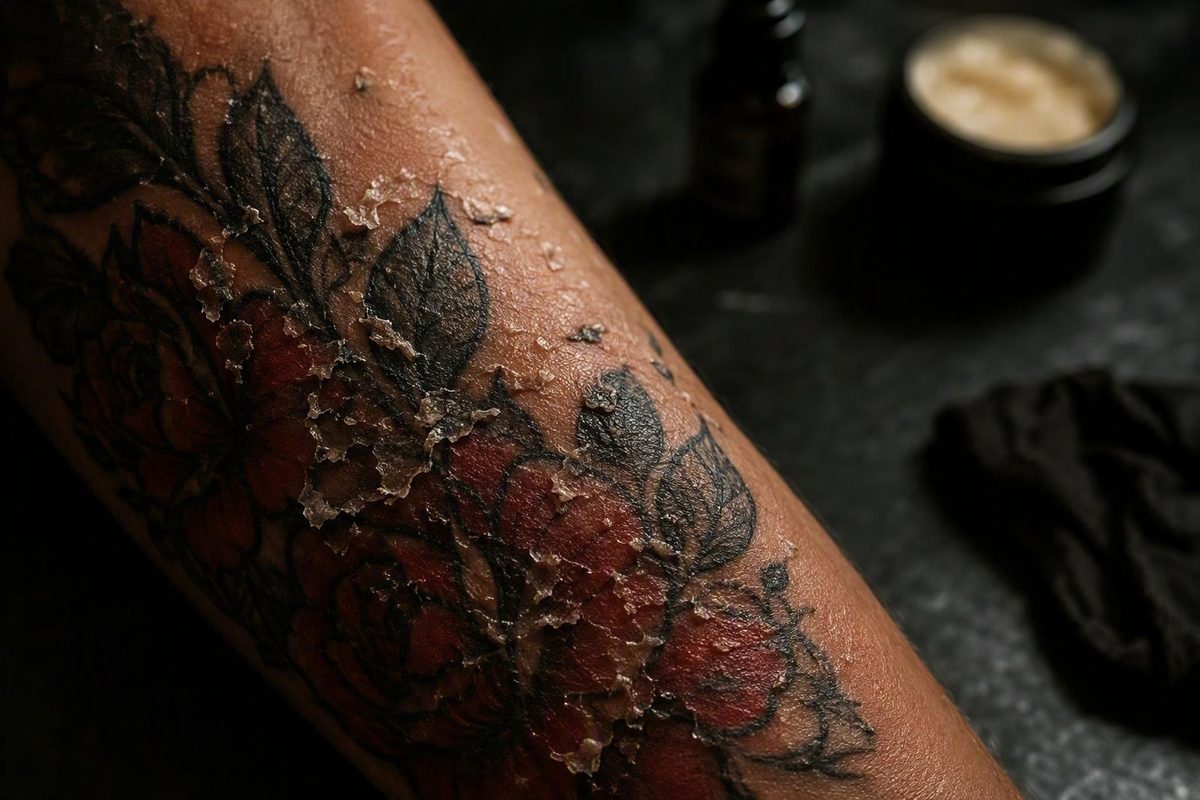
Tattoo peeling can look alarming, especially when the flakes appear to contain color. Light flaking, however, is commonly described as part of tattoo healing. The most useful question is not whether your tattoo follows an exact calendar, but whether the area is becoming calmer rather than more painful, red, hot, swollen, or irritated.
The short answer: most tattoos peel for about one week
Visible tattoo peeling commonly begins around three to seven days after tattooing. Active flaking often lasts about one week and may continue for up to two weeks. These are commonly reported estimates from tattoo studios and commercial aftercare guides, not clinically established deadlines that apply to every tattoo. Hustle Butter’s commercial aftercare guide gives a starting window of days three to seven and a duration of up to two weeks.
Some tattoos start flaking earlier or closer to the end of the first week. Others shed only fine, barely visible flakes, and some show little or no obvious peeling. Minimal flaking alone does not mean the tattoo is failing to heal.
As a practical summary:
- Commonly reported starting window: approximately days 3–7
- Commonly reported active stage: about one week
- Broader estimate: up to roughly two weeks
- Possible variation: earlier, later, lighter, patchier, or almost invisible peeling
The calendar is only part of the picture. Thin flakes, dryness, and mild itching that gradually ease are more reassuring than symptoms that become more intense.
The end of peeling is also not the end of healing. Once the flakes stop, the surface may look smoother and calmer, but it can remain delicate while repair continues below the visible surface.
This article provides general information, not a diagnosis or individualized medical advice. Consult a qualified healthcare professional if you are concerned about your symptoms or have a health condition that may affect healing.
A practical timeline for the first few weeks
No timeline can predict exactly how one tattoo will heal. Size, placement, technique, skin characteristics, friction, overall health, and aftercare can all affect the experience. The stages below are a practical framework rather than a schedule your tattoo must follow.
Days 1–3: peeling may not have started
During the first few days, visible flaking may be absent. That does not mean healing is delayed. Some tattoos begin shedding earlier, but the third through seventh days are more commonly reported as the starting window.
Follow the instructions supplied for your initial covering and tattooing technique. Do not remove, replace, or extend the use of a covering solely because a general timeline says peeling should begin on a particular day.
Days 3–7: thin flakes and itching commonly appear
During this period, people may begin to notice:
- Dry or tight-feeling skin
- Thin, papery flakes
- Whitish or translucent peeling
- Mild-to-moderate itching
- A temporarily dull or cloudy appearance
- Small flakes that appear stained with tattoo color
These descriptions and the three-to-seven-day estimate recur in commercial tattoo-aftercare guidance, although individual experiences vary. Clinikally’s commercial peeling-care overview describes a similar one-to-two-week course with dryness, flaking, itching, and temporary dullness.
The peeling may resemble skin shedding after a sunburn. It can affect the whole tattoo or appear only in selected areas.
Dry surface cells and newly forming skin can temporarily obscure the design. Avoid judging the final color or consistency while flakes remain attached.
Week 2: active peeling generally decreases
Ordinary flaking often slows substantially or finishes during the second week. Some areas may remain dry or itchy, and small flakes or firmly attached scabs may still release later.
It helps to distinguish four overlapping processes:
- Active peeling: broader shedding of thin surface flakes
- Scab shedding: release of thicker, more defined pieces
- Surface recovery: settling of the new outer skin
- Deeper healing: continued repair below a surface that may already look normal
These are not interchangeable timelines. Someone who says a tattoo peeled for one week may mean widespread flaking. Someone who reports peeling for longer may be including residual dryness or the final release of a few scabs.
Weeks 3–4: the surface may look more settled
By the third or fourth week, the surface often appears calmer, with less obvious flaking. It may still look slightly shiny, milky, cloudy, or uneven. That appearance can reflect thin new surface skin rather than continued active peeling.
A settled-looking surface does not prove that all repair is complete. Continue handling the tattoo gently rather than treating the disappearance of flakes as evidence that the skin has fully recovered.
Why tattoos peel—and why the flakes usually are not lost ink
Tattooing repeatedly punctures the skin to deposit pigment. As the affected skin repairs itself, damaged or dead cells are shed from the outer surface.
Visible peeling involves the epidermal surface, while tattoo pigment is placed more deeply in the dermis. That difference in depth is why routine surface flaking does not ordinarily mean the embedded design is falling out. A black, blue, red, or otherwise colored flake may simply be pigment-stained dead surface skin. HUSH’s commercial guide explains the distinction between the shedding epidermis and pigment placed in the deeper dermis.
Several temporary surface effects can make a peeling tattoo look less vivid:
- Dry skin changes how the surface reflects light.
- Attached flakes partially cover the design.
- Thin new skin may look cloudy or shiny.
- Different parts of the tattoo may shed at different rates.
- Pale flakes can be especially noticeable over dark or saturated areas.
These effects may become less prominent as the surface settles, but healing does not guarantee that every line or area of color will become perfectly even. The cosmetic result is easier to assess after the area has had more time to recover.
Leave attached flakes and scabs alone. Pulling, scratching, or deliberately peeling them can disturb fragile healing skin and may contribute to an uneven result. Even if a flake is mostly detached, allow the remaining edge to release naturally.
Mild itching can accompany peeling, but persistent, severe, spreading, or rash-like itching should not automatically be dismissed as routine healing.
Normal peeling, heavier scabbing, and signs of trouble
Routine peeling is generally described as light, dry, and thin. The flakes may be:
- Translucent or whitish
- Papery or sunburn-like
- Small and scattered
- More visible over dark or saturated pigment
Mild-to-moderate itching, dryness, tightness, and temporary dullness can accompany this stage. The overall trend should be toward improvement.
Scabbing is not identical to peeling. A scab is usually thicker, more defined, and more firmly attached than a fine surface flake. Leave the scab attached and reduce avoidable rubbing.
Symptoms that steadily settle are different from redness that spreads, pain that becomes more severe, or swelling and heat that increase.
| More consistent with routine peeling | Warning signs that warrant medical assessment |
|---|---|
| Thin, dry, sunburn-like flakes | Redness that spreads or worsens |
| Mild itching that gradually eases | Increasing heat or swelling |
| Temporary dryness or cloudiness | Severe or increasing pain |
| Small flakes releasing naturally | Pus or unusual yellow or green discharge |
| Surface tightness that improves | Foul or unusual odor |
| A few residual attached scabs | Red streaks extending from the area |
| Symptoms becoming less noticeable | Fever, chills, hives, or feeling unwell |
Tattoo-studio guidance identifies increasing pain, swelling, heat, pus, odor, red streaks, and fever as reasons to seek prompt professional evaluation rather than treating the changes as ordinary scab shedding. Evolve Tattoo Collective’s scabbing guide lists these warning signs.
Commercial aftercare guidance also lists persistent inflammation, discolored discharge, fever, chills, and hives among symptoms that should not be managed as routine peeling. Saniderm’s peeling guide describes these as possible signs of abnormal healing.
This evidence comes primarily from tattoo studios and commercial aftercare publishers rather than independent clinical studies. A checklist cannot diagnose or rule out infection, an allergic reaction, dermatitis, or another complication. Seek qualified healthcare evaluation when symptoms are worsening, severe, spreading, systemic, or otherwise concerning.
Why one tattoo may peel longer than another
Two tattoos on the same person can heal differently. The timeline may reflect how much skin was worked, where the tattoo is located, how the area is treated afterward, and individual characteristics.
Tattoo size and complexity
A small, lightly worked line tattoo does not affect the same amount of skin as a large piece with dense shading or extensive color. Larger, more detailed, or heavily saturated tattoos may have a more noticeable healing stage.
That does not create a reliable formula in which a particular size adds a fixed number of peeling days. Placement, technique, skin response, and aftercare still matter.
Placement and movement
Areas that bend or rub repeatedly may experience more mechanical stress. Elbows, knees, fingers, feet, waistlines, and other high-movement or high-friction locations can be stretched or rubbed during ordinary activity.
Clothing, footwear, straps, or equipment can also catch flakes and irritate attached scabs. The goal is not to immobilize the area, but to reduce avoidable friction where practical.
Shading and color saturation
Dense color or shading may flake differently from fine-line portions of the same design. Peeling can therefore occur in patches, with one section finishing before another. Uneven timing by itself is not proof of a complication.
Individual skin and health
Natural dryness, oiliness, sensitivity, previous skin reactions, and overall health may affect how healing looks and feels. These factors cannot be used to predict an individual result with certainty.
Anyone with a medical condition, medication-related concern, impaired healing, or history of significant skin reactions should seek individualized guidance from a qualified healthcare professional.
Aftercare and accidental disturbance
Picking, scratching, scrubbing, rubbing, and prolonged soaking do not reliably make peeling finish sooner. They can disturb the healing surface or remove material before it is ready to detach.
Tattoo-studio guidance commonly identifies skin type, tattoo size, placement, movement, friction, health, and aftercare as sources of variation. One such guide gives a broad estimate of approximately four to fourteen days, while presenting about a week as typical rather than guaranteed. Old Crow Tattoo outlines these timing estimates and sources of variation.
Good aftercare supports relatively undisturbed healing. It does not guarantee faster recovery, prevent every complication, or ensure a flawless cosmetic result.
Some commercial material uses “peeling” to describe changes lasting much longer than two weeks. That should not be treated as proof that widespread active peeling for up to a month is routinely normal. Later dryness, lingering scabs, and surface recovery may be grouped under the same term. Persistent changes should be considered alongside their extent, progression, and accompanying symptoms.
How to care for a tattoo while it is peeling
Begin with the technique-specific instructions provided by your tattoo artist. If those instructions conflict with medical advice you have received, follow the qualified healthcare professional’s guidance.
Product-neutral care focuses on gentle cleaning, minimal unnecessary contact, and allowing flakes to detach naturally.
Wash gently
Use clean hands and handle the tattoo carefully. Avoid washcloths, exfoliating tools, rough sponges, and scrubbing. Rinse cleanser away rather than repeatedly rubbing the surface.
Washing a peeling tattoo does not mean trying to remove all visible skin. Flakes that are ready may release during gentle cleaning; attached pieces should remain in place.
Pat rather than rub it dry
Pat or blot the tattoo gently instead of rubbing it. Friction can catch loose skin, irritate the area, or pull on attached scabs.
Use moisturizer modestly
If moisturizer is part of your aftercare instructions, use a suitable fragrance-free option in a modest, thin layer. There is no precise universal amount for every tattoo, skin type, or climate.
More is not necessarily better. The tattoo does not need to remain under a thick, constantly wet coating. Bay Ink Tattoo’s guidance likewise advises following the artist’s instructions, avoiding excessive moisturizer, and not disturbing peeling skin. Its studio guide describes peeling as commonly beginning around days three to six and lasting about a week.
Leave flakes and scabs attached
Do not pick, pull, scratch, shave over, or exfoliate the peeling area. Allow each flake or scab to release naturally, even when only a small edge remains attached.
Reduce friction
Wear loose, clean clothing where practical. Avoid garments, straps, footwear, or equipment that repeatedly scrape the tattoo. Pay attention to unconscious pressure, such as resting the area against a rough surface.
Avoid prolonged soaking and submersion
A brief, gentle wash is different from leaving the tattoo submerged. Avoid swimming, prolonged baths, and other extended soaking while the tattoo is healing. The available evidence does not establish one exact safe day for every tattoo, so ask your artist for routine, technique-specific timing and a healthcare professional if the skin remains broken or irritated.
Limit direct sun exposure during early healing
Use shade or loose protective clothing where practical. Do not assume a product intended for healed skin is suitable for fresh, broken, or irritated skin without checking its instructions or obtaining appropriate professional advice.
These care principles—gentle cleaning, a thin layer of unscented moisturizer, loose clothing, and avoiding picking, soaking, and sunlight—are recurring recommendations in tattoo-studio guidance. Old Crow Tattoo summarizes these product-neutral measures.
No branded balm, adhesive covering, numbing product, CBD preparation, or specialty ingredient has been established here as a universal way to accelerate peeling, guarantee healing, or prevent infection. Products are not substitutes for leaving the tattoo undisturbed or responding appropriately to warning signs.
What to do if peeling is delayed, prolonged, or interrupted
A tattoo that does not match the commonly reported timeline is not automatically in trouble. First identify what is happening: no visible flakes, a few residual scabs, widespread active shedding, recurrent irritation, and a worsening rash are different situations.
If your tattoo has not peeled
Some people experience little or no obvious flaking.
If the area is becoming calmer and no warning signs are present, the absence of visible peeling alone is not evidence of failed healing. Do not scrub, exfoliate, soak, or add extra products to force peeling.
If peeling begins later than expected
A later start can fall within ordinary variation. Continue gentle care and focus on progression. Light flaking near the end of the first week is different from a tattoo developing increasing redness, warmth, swelling, pain, or discharge.
If it is still peeling after two weeks
Active peeling beyond two weeks is not automatically an emergency, but the available evidence does not establish a precise day when prolonged peeling becomes abnormal. What appears to be continued peeling may instead be residual scab shedding or dry surface skin.
Consider the trajectory:
- Is the affected area becoming smaller?
- Is itching decreasing?
- Are the flakes becoming lighter or less frequent?
- Is the skin becoming calmer overall?
- Or are redness, pain, heat, swelling, discharge, or rash increasing?
If light peeling persists without warning signs, contact your tattoo artist for routine context about the design, placement, technique, and aftercare method. Consult a healthcare professional if the problem continues, repeatedly returns, or causes concern.
If you accidentally scratched it or removed a flake
Stop manipulating the area. Keep it gently clean according to your aftercare instructions and reduce further picking, rubbing, or clothing friction.
One accidental scratch or removed flake does not allow anyone to promise that the final appearance will or will not be affected. Let the area settle rather than repeatedly inspecting or peeling it. If concerning symptoms develop or intensify, seek medical advice.
If symptoms suggest a complication
Seek prompt healthcare evaluation for worsening or spreading redness, increasing heat or swelling, severe or escalating pain, pus or unusual discharge, foul odor, red streaks, fever, chills, hives, or other systemic symptoms.
The practical takeaway is straightforward: visible peeling commonly begins within the first week and settles within roughly one to two weeks, while healing continues afterward. Use gentle, product-neutral care and pay attention to whether symptoms are improving. Take routine covering and design-specific questions to the artist; take worsening, severe, spreading, or systemic symptoms to a qualified healthcare professional.
Frequently asked questions
Is it normal if my tattoo does not peel?
Yes, it can be. Some tattoos shed so lightly that peeling is difficult to notice, while others show little or no obvious flaking. The absence of visible peeling does not by itself mean that the tattoo is not healing.
Do not scrub or exfoliate the area to provoke peeling. Focus instead on whether it is becoming calmer and whether warning signs are absent.
Why does my tattoo look faded or cloudy while it is peeling?
Dry flakes, dead surface cells, and thin new skin can temporarily obscure the pigment below. Different sections may shed at different rates, making the design look uneven, muted, shiny, or cloudy.
This does not necessarily mean the embedded pigment is disappearing. Wait until the surface has settled before judging the final color, while recognizing that not every cosmetic irregularity is guaranteed to disappear.
Is it normal for a tattoo to keep peeling after two weeks?
It can happen, but the type of shedding and the direction of symptoms matter. A few residual flakes or scabs are different from widespread active peeling accompanied by increasing irritation.
There is no precise cutoff in the supplied evidence at which isolated peeling automatically becomes dangerous. Contact your artist for routine context if the area is otherwise improving. Consult a healthcare professional if peeling persists, repeatedly returns, causes concern, or occurs with worsening symptoms.
What should I do if I accidentally scratched my tattoo or pulled off a flake?
Stop touching it, clean it gently according to your aftercare instructions, pat it dry, and prevent further scratching, picking, rubbing, or pressure.
Do not repeatedly inspect the spot or apply extra products in an attempt to correct it. The cosmetic result will be easier to assess after healing. Seek medical advice if the area becomes increasingly painful, red, hot, swollen, or develops unusual discharge.
When should I contact my tattoo artist instead of a healthcare professional?
Contact your tattoo artist for routine, nonmedical questions such as:
- How to follow the covering instructions they supplied
- When to move to the next stage of their aftercare routine
- Whether shading or saturation may explain uneven flaking
- How to reduce ordinary clothing friction
- When the tattoo is settled enough for a cosmetic assessment
- Whether a healed area may need a touch-up
Contact a qualified healthcare professional for worsening, severe, spreading, or systemic symptoms that could indicate infection, an allergic reaction, or another medical complication. An artist can provide tattoo-specific context, but should not replace medical evaluation.