
13 min read ·
Why New Tattoos Flake—and How to Tell If Healing Is on Track
Thin flakes and mild itching are reassuring. Wash gently, moisturize sparingly and let flakes fall away. Spreading redness or worsening pain needs medical care.
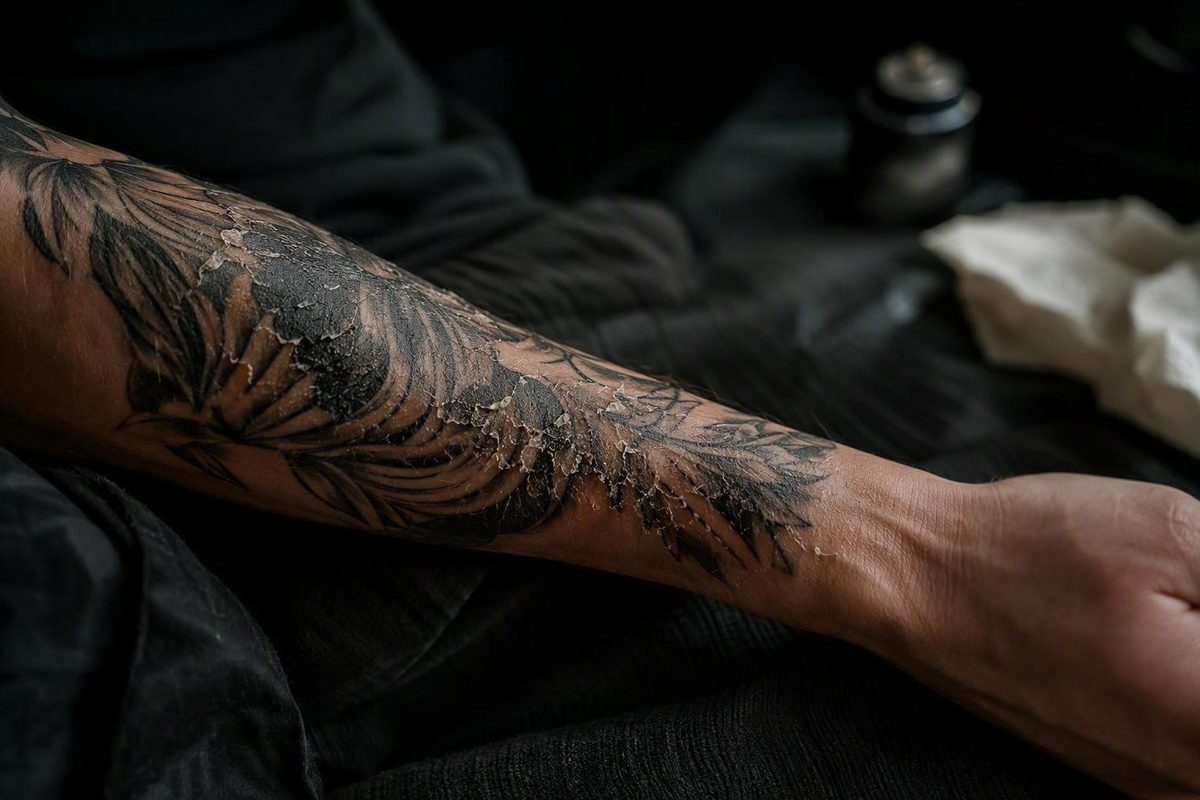
The short answer: mild peeling is usually normal
If you are wondering, “Is a tattoo supposed to peel?”, the direct answer is yes: mild peeling or flaking is generally an expected part of healing. Tattooing injures the skin, and damaged surface cells shed as the area repairs itself. Some tattoos peel noticeably, while others produce only fine flakes or no obvious peeling.
A generally reassuring pattern includes:
- Thin, dry, whitish, translucent, or lightly colored flakes
- Mild, manageable itching
- Temporary dullness or haziness over the design
- Tenderness, redness, and swelling that gradually decrease
- Flakes that loosen and fall away without being pulled
Peeling is not automatically harmless, however. What matters is the combination and direction of symptoms. Redness, swelling, pain, or heat that spreads or intensifies can indicate a complication. Thick yellow or green discharge, pus-filled bumps, a foul odor, red streaks, fever, or chills warrant prompt medical assessment. UPMC likewise distinguishes normal early flaking from symptoms that worsen and identifies spreading redness, increasing pain, pus, fever, and chills as possible infection signs (UPMC guidance on tattoo infection symptoms).
Timing is only a rough guide. Peeling commonly begins within the first week, but it may start earlier or later, remain barely noticeable, or not appear at all. The trend is more useful than an exact day: gradual improvement is reassuring, while rapidly worsening or spreading inflammation is not.
This article provides general educational information, not a diagnosis or a substitute for individualized medical care. A healthcare professional should assess rapidly worsening, spreading, or whole-body symptoms.
Why a healing tattoo peels
Tattoo needles repeatedly pass through the skin and deposit pigment, creating many small injuries. As the body repairs the area, damaged and dead cells in the outer layer dry out and shed. That shedding appears as flakes, peeling skin, or light scabbing.
Two skin layers help explain what you are seeing:
- The epidermis is the outer layer, where routine visible flaking primarily occurs.
- The dermis lies underneath, where most permanent tattoo pigment is deposited.
Because ordinary peeling occurs near the surface while most pigment sits deeper, routine flaking generally does not mean the tattoo itself is peeling away. A medically reviewed overview from Medical News Today similarly explains that tattooing affects the skin while visible peeling reflects the shedding of damaged surface cells during repair (how tattoo peeling occurs during healing).
You may still see black, gray, or colored material in a flake. Surface skin can be stained with pigment or mixed with dried fluid and residual ink. A colored flake therefore does not automatically establish that permanent pigment has been lost.
The more important distinction is how the flake came away:
- Natural shedding: A loose flake detaches during gentle washing, drying, or moisturizing.
- Forced removal: Attached skin or a scab is scratched, peeled, scrubbed, or pulled away before it is ready.
A healing tattoo may temporarily look:
- Duller than it did immediately after the session
- Slightly cloudy or milky
- Less sharply defined
- Uneven or patchy beneath the flakes
- Less vivid in heavily peeling areas
As that layer sheds and the new surface settles, the design may look clearer.
Do not use the peeling stage alone to decide that the artist missed a spot or that you need a touch-up. At the same time, do not assume every piece of attached skin is harmless to remove.
When peeling starts and how long it may last
Peeling commonly begins during the first week, often around days three to seven. Visible flaking may continue for roughly one to two weeks, although these are flexible ranges rather than deadlines. Healthline notes that peeling often becomes apparent by the end of the first week and that scabs may continue shedding naturally during the second week (Healthline’s overview of tattoo peeling).
A compact healing sequence often looks like this:
- Early stage: The tattoo may be tender, red, swollen, or produce a small amount of clear fluid. These changes should begin settling rather than expanding.
- Peeling stage: Dryness, thin flakes, light scabbing, and mild itching become more noticeable.
- Post-peeling surface stage: The obvious flakes stop, but the tattoo may remain shiny, cloudy, or slightly hazy while the surface continues to mature.
Not every tattoo follows this sequence on the same schedule. The amount and duration of peeling can vary with:
- The individual’s skin and healing response
- The tattoo’s size, style, and level of detail
- How extensively the skin was worked
- Placement on the body
- Movement and friction
- The dressing method
- Washing and moisturizing practices
- Repeated rubbing, scratching, or soaking
A large, heavily detailed tattoo should not be expected to look the same as a small linework piece. Tattoos under waistbands, socks, shoes, straps, or fitted sleeves may also experience more friction than tattoos in less obstructed areas.
A tattoo can peel later than expected, peel so lightly that you barely notice it, or show no obvious peeling and still heal normally. Conversely, dramatic peeling does not prove that everything is fine if pain, swelling, redness, or heat is escalating.
Use the timeline as context, then assess the trend:
- More reassuring: Tenderness decreases, redness recedes, swelling settles, and dry flakes release naturally.
- Less reassuring: Redness moves outward, pain increases, the area becomes persistently hotter, swelling grows, or new discharge appears.
Visible peeling can finish before the skin underneath has fully recovered. For a broader view of the process before and after flaking, see the stage-by-stage tattoo healing guide. Its timeline is a general framework, not a diagnostic deadline for an individual tattoo.
Normal peeling versus signs of a problem
Routine healing, irritation, infection, an allergic reaction, and a flare of an existing skin condition can overlap. Redness, itching, bumps, and swelling may occur in more than one of these situations, so an article or photograph cannot reliably determine the cause.
The table below summarizes general patterns. Cleveland Clinic identifies worsening pain, redness, swelling, pus-filled bumps, fever, and chills among possible tattoo-infection symptoms and recommends medical treatment when infection signs occur (Cleveland Clinic tattoo infection guidance).
| Feature | Generally expected during peeling | Reason for prompt medical assessment |
|---|---|---|
| Appearance | Thin whitish, translucent, or lightly colored flakes; mild dryness; temporary dullness or haze | Expanding redness; marked or increasing swelling; pus-filled bumps; red streaks; a persistent raised or intensely itchy rash |
| Sensation | Mild itching; tenderness that steadily decreases | Worsening or severe pain; persistent heat; extreme or escalating itching; increasing soreness |
| Progression | Symptoms remain localized and gradually improve | Symptoms spread, intensify, return after improving, or fail to settle |
| Discharge | A small amount of clear fluid may occur early | Thick yellow or green discharge, pus, or a foul odor |
| Whole-body symptoms | None | Fever, chills, or feeling acutely unwell |
Mild redness and swelling can occur early because tattooing injures the skin. The key distinction is progression: expected inflammation should generally become less noticeable, not wider, hotter, more painful, or more swollen.
A persistent raised or intensely itchy rash also deserves professional assessment. It could reflect irritation, a reaction to pigment or an aftercare product, infection, or another skin condition. Appearance alone is not enough to determine which one.
Consider the full pattern instead:
- Is the surface simply dry and shedding, or is it becoming raw?
- Is itching mild and manageable, or severe and escalating?
- Are redness and swelling shrinking, stable, or spreading?
- Is the area becoming hotter or more painful?
- Is there thick discharge, pus, odor, or streaking?
- Are fever, chills, or other whole-body symptoms present?
Do not manage systemic or rapidly worsening symptoms by repeatedly trying new ointments or relying only on an artist’s opinion. A tattoo artist can answer routine questions about the dressing, expected appearance, and the aftercare method used. Suspected infection, red streaks, spreading inflammation, fever, or chills should be assessed by a healthcare professional.
How to care for a tattoo while it is peeling
The goal is not to make the tattoo peel faster. It is to keep the area reasonably clean, minimize irritation, and allow loose skin to release naturally.
A basic, product-neutral routine is:
- Wash your hands. Use clean hands before touching the healing area.
- Clean the tattoo gently. Use cool or lukewarm water and a mild, fragrance-free cleanser unless your artist or clinician has instructed you otherwise.
- Use your fingertips. Do not scrub with a washcloth, sponge, brush, exfoliating glove, or body scrub.
- Rinse gently. Remove the cleanser without rubbing the surface.
- Pat dry. Use clean material and avoid rubbing.
- Moisturize sparingly when appropriate. Apply a thin layer of a suitable, nonirritating moisturizer—enough to ease excessive dryness without leaving the tattoo heavily coated or persistently wet.
Curology’s medically reviewed tattoo-peeling guidance likewise recommends gentle cleansing, allowing flakes to shed naturally, avoiding rubbing and exfoliation, and using an unperfumed moisturizer as directed (care practices for a peeling tattoo).
More moisturizer is not necessarily better. A tattoo should not remain heavily coated, sticky, or constantly wet. If a product causes burning, a new rash, or worsening redness, stop using it and seek advice appropriate to the severity of the reaction.
Choose loose, clean clothing when the tattoo must be covered. Minimize repeated rubbing from waistbands, socks, bras, shoes, backpack straps, or fitted sleeves. Do not pull fabric abruptly if it has adhered to fragile skin.
Avoid swimming, baths, hot tubs, and prolonged soaking while the tattoo remains open or actively peeling. A brief, gentle wash is different from leaving the area submerged. Keep an open or peeling tattoo out of direct sun, using shade or loose clothing rather than applying sunscreen directly to unhealed skin.
Dressing instructions are an important exception to generic aftercare. If your artist applied an adhesive film or another specialized dressing, follow the instructions for that dressing, including when and how it should be removed. Do not remove it simply to begin a generic washing or moisturizing schedule. Ask the artist or a qualified clinician for guidance if the dressing causes irritation or you are uncertain how to proceed.
Once the skin has closed and healed, sun protection becomes part of long-term tattoo care. That is separate from caring for raw, open, or actively peeling skin.
What not to do—and what to do after an accidental scratch
Let flakes and scabs detach naturally, including pieces that appear to be hanging by a small edge. “Almost loose” is not necessarily fully detached. If a flake is ready to release, it will usually come away without being pulled.
While the tattoo is peeling, avoid:
- Picking or pulling flakes
- Peeling off scabs
- Scratching with fingernails
- Scrubbing or exfoliating
- Shaving or waxing over the area
- Rubbing the tattoo dry
- Letting tight clothing repeatedly chafe it
Medical News Today similarly cautions that scratching, picking, and forced exfoliation can interfere with healing and increase the risks of infection and scarring (risks of interfering with tattoo peeling).
If you accidentally scratch the area or pull off a flake:
- Stop touching or inspecting it with your fingers.
- Wash your hands.
- Clean the tattoo gently according to your established aftercare routine.
- Pat it dry without rubbing.
- Do not add a heavy layer of product to compensate.
- Monitor the area for worsening redness, swelling, heat, pain, ongoing bleeding, or discharge.
A small irritated spot that settles is different from a wound that keeps bleeding, becomes increasingly painful, or develops spreading redness. Seek medical advice if bleeding continues, inflammation worsens, pain increases, the skin becomes persistently hot, or discharge appears.
For routine questions—such as dressing removal, mild patchiness, or adapting the artist’s aftercare method—contact the artist and provide a clear photograph if requested. For possible infection, severe inflammation, a persistent rash, or whole-body symptoms, contact a healthcare professional rather than relying on the artist alone.
What happens after the flakes are gone
The end of visible peeling does not necessarily mean every layer of skin has finished healing. The surface may look closed while the tissue remains delicate and continues to recover underneath.
After the flakes stop, the tattoo may appear:
- Shiny
- Slightly cloudy or milky
- Hazy over some colors
- Temporarily uneven in saturation
- More sensitive to friction than nearby skin
Continue gentle care while the surface settles. Do not treat the first flake-free day as automatic clearance for prolonged soaking, shaving, hard rubbing, direct sun, or activities that repeatedly stretch or chafe the area.
There is no universal date when swimming, shaving, strenuous exercise, direct sun exposure, or a touch-up becomes safe for every tattoo. Placement, tattoo size, the extent of the work, skin condition, and the presence of tenderness or open areas all matter. Ask the artist about routine return timing based on the tattoo and dressing method.
Patchiness during peeling can be temporary. Dry skin and a hazy new surface may make some areas look lighter or less saturated than others. Wait until the tattoo has healed and settled before making a final judgment about missing pigment or arranging a touch-up.
Persistent redness, a raised rash, discharge, increasing pain, or continuing inflammation should not be treated as a cosmetic touch-up issue. Those changes need clinical assessment. Ordinary flaking that steadily settles is expected; a tattoo that becomes hotter, redder, more painful, more swollen, or associated with whole-body symptoms is not something to monitor indefinitely.
Frequently asked questions
Is it normal if my tattoo does not peel at all?
Yes. Some tattoos peel so lightly that the flakes are difficult to notice, and some do not visibly peel. The amount of peeling varies with the individual, the tattoo’s size and detail, its placement, and the aftercare or dressing method.
Do not try to induce peeling with a scrub, exfoliant, washcloth, or extra washing. Continue the instructed care and judge healing by the overall trend. A comfortable tattoo with receding redness and no increasing pain, swelling, heat, or discharge is more reassuring than whether visible flakes appear.
Do colored flakes mean the tattoo ink is falling out?
Not necessarily. Dead surface skin may be stained by pigment or mixed with dried fluid and residual ink, making flakes look black, gray, or colored. Most permanent tattoo pigment lies deeper than the surface cells involved in ordinary peeling, so a colored flake does not automatically mean the tattoo is disappearing.
Allow the flake to fall away naturally. Do not pull colored skin or attached scabs. The finished result is difficult to assess while the tattoo remains flaky, dull, or hazy.
How itchy should a peeling tattoo be?
Mild, manageable itching is common during peeling and should generally improve as the surface settles. Avoid scratching. Gentle care, loose clothing, and a thin layer of an appropriate nonirritating moisturizer may ease dryness-related discomfort.
Severe, escalating, or persistent itching—especially when accompanied by a raised rash, painful bumps, spreading redness, marked swelling, persistent heat, or discharge—deserves professional assessment. Normal healing, irritation, allergy, infection, and skin-condition flares can overlap, so associated symptoms and progression matter more than itching alone.
What should I do if I accidentally picked or scratched my tattoo?
Stop manipulating the area, wash your hands, clean the tattoo gently according to your established aftercare routine, and pat it dry. Do not pull away any remaining edges or apply a heavy layer of ointment in an attempt to repair the spot.
One accidental scratch does not inevitably ruin the tattoo. Monitor the area for continued bleeding, increasing pain, heat, swelling, spreading redness, or discharge. Ask the tattoo artist about routine appearance concerns, but seek medical care if inflammation worsens or possible infection symptoms develop.
When should I see a doctor about a peeling tattoo?
Seek prompt medical assessment if peeling is accompanied by:
- Redness that spreads or becomes more intense
- Increasing swelling
- Persistent heat
- Worsening or severe pain
- Thick yellow or green discharge
- Pus-filled bumps
- A foul odor
- Red streaks extending from the tattoo
- Fever or chills
- A persistent raised or intensely itchy rash
- Rapid deterioration or feeling acutely unwell
Tattoo infections are often localized, but they can occasionally become severe. UPMC advises medical evaluation when symptoms worsen rather than improve, particularly when spreading redness, increasing pain, pus, fever, or chills occur (when tattoo symptoms require medical care).
The bottom line
Light peeling is usually part of normal tattoo healing. Let flakes and scabs shed naturally, follow the instructions for your specific dressing, and judge progress by the overall direction of symptoms rather than one day on the calendar.
Thin flakes, mild itching, and steadily decreasing discomfort are generally reassuring. Spreading redness, increasing heat, pain or swelling, pus, red streaks, fever, or chills require prompt medical assessment. Cleveland Clinic likewise recommends seeking treatment when tattoo-infection signs develop (medical guidance on tattoo infection).