
21 min read ·
How to Choose Ethical Aftercare Without Trusting the Label Alone
No product in the comparison had a named vegan certification that could be independently verified from the information available during the review.
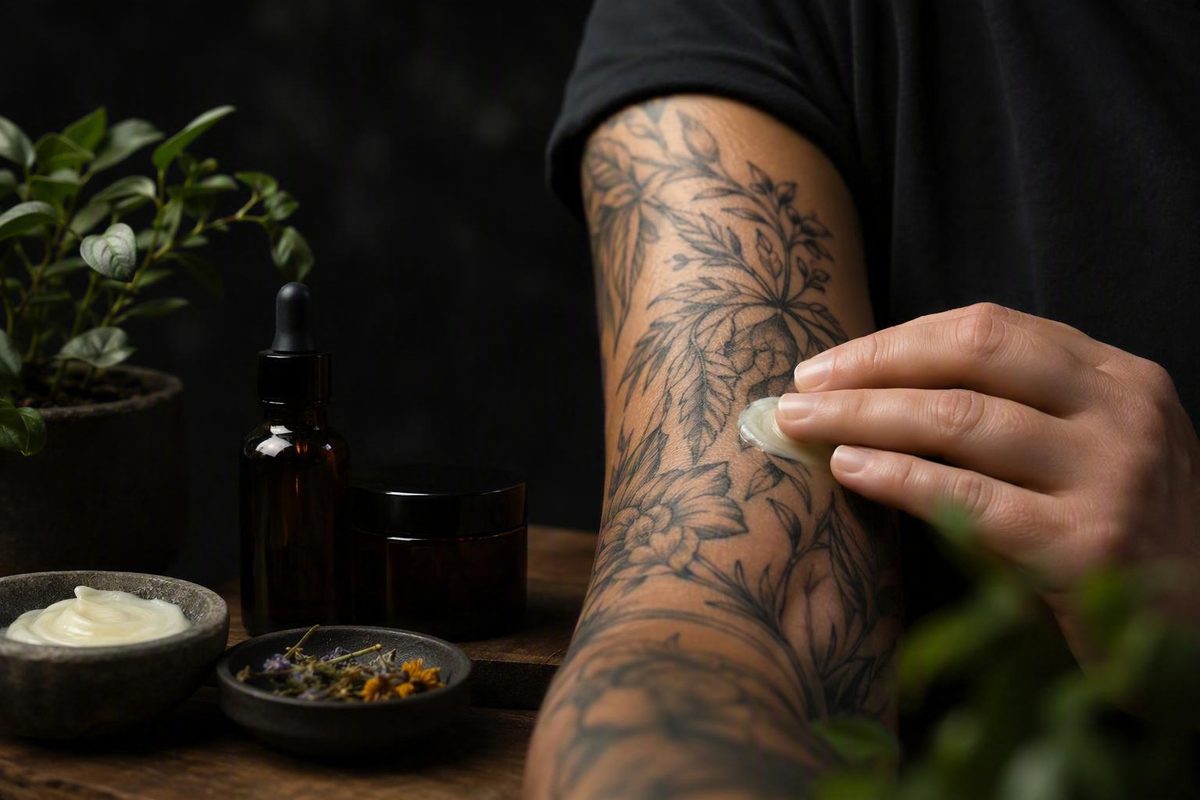
Shopping for vegan tattoo aftercare products involves more than searching for “vegan balm” and choosing the highest-rated jar. A vegan claim may describe the origin of ingredients, but it does not necessarily establish the product’s animal-testing policy, suitability for a fresh tattoo, fragrance content, or compatibility with your skin.
Start with the tattoo’s healing stage. Determine whether your artist wants you to use a cleanser, an early-stage moisturizer, or a lighter product for healed skin. Then verify the vegan formulation and cruelty-free policy separately, read the seller-published ingredient list, and treat healing or performance promises as marketing unless appropriate evidence supports them.
Above all, follow the individualized instructions provided by your tattoo artist. A product page can explain how its formula is intended to be used, but it cannot account for your dressing, tattoo placement, skin history, or artist’s protocol.
What “vegan tattoo aftercare” does—and does not—tell you
A vegan claim generally concerns whether a product contains animal-derived ingredients under the brand’s stated standard. A cruelty-free claim concerns animal testing. These attributes may overlap, but neither automatically establishes the other:
- A formula might contain no animal-derived ingredients while lacking a documented no-animal-testing policy.
- A cruelty-free product could still contain an animal-derived ingredient such as beeswax or lanolin.
- A company might describe one ingredient as not tested on animals without documenting its policy for suppliers or the finished formula.
The wording matters too. “Certified vegan,” “vegan,” and “vegan-friendly” should not be treated as interchangeable levels of proof.
- Certified vegan should identify the certifying organization, applicable standard, and exact covered product. The certification should be checked against the current formula.
- Vegan is often a direct manufacturer claim. It can be useful, but it is not independent verification unless a named certification is current and confirmable.
- Vegan-friendly is less precise. It may mean the manufacturer believes the formula avoids animal-derived ingredients, but shoppers should look for the company’s definition and supporting documentation.
Other front-label terms answer different questions. Plant-based may describe selected ingredients rather than the complete formula. Natural, organic, and petroleum-free do not establish vegan status. Dermatologist-tested does not, by itself, reveal the test design, outcome, animal-testing policy, or suitability for a particular person. None of these descriptions proves medical superiority.
The complete tattoo process can involve inks, cleansers, moisturizers, dressings, adhesives, transfer products, and other studio materials. H2Ocean’s brand-authored overview says bone char, gelatin, shellac, and unspecified animal-derived additives may occur in some tattoo products. Those are general examples, not evidence that they appear in any aftercare formula discussed here. The same article encourages customers to ask artists about inks and skincare products before an appointment (H2Ocean’s guide to vegan tattoo products).
This comparison concentrates primarily on aftercare cleansers and moisturizers. If you want the complete tattoo process to align with vegan standards, ask separately about the ink, dressing, adhesive, stencil or transfer products, and anything else that will contact your skin.
A practical verification hierarchy, from strongest to weakest, is:
- Named, current certification confirmed with the certifier for the exact product.
- A seller-published ingredient list plus a documented brand policy explaining the vegan standard.
- A manufacturer-stated vegan claim without independent certification.
- Retailer or marketplace wording that the manufacturer has not confirmed.
- Inference from botanical ingredients, product names, reviews, packaging, or search placement.
The final category is not verification. Appearance in a marketplace search for vegan aftercare does not prove that a product is vegan. One Amazon search capture returned 357 results and displayed a sponsored H2Ocean placement, but the visible listing did not explicitly verify vegan status (Amazon search results for “vegan tattoo aftercare”).
Match the product format to the healing stage
Cleansers, salves, balms, creams, lotions, and kits should not be treated as interchangeable. They have different functions, textures, and intended stages.
Cleanser
A cleanser is used to wash the area gently after the dressing is removed according to the artist’s instructions. The usual priority is a mild, fragrance-free product that can be used without scrubbing.
A vegan or vegan-friendly cleanser still requires the same scrutiny as a moisturizer. Look for:
- The seller-published ingredient list
- The exact vegan wording
- Fragrance disclosure
- The manufacturer’s animal-testing policy
- Directions for use on a healing tattoo
Balm or salve
Balms and salves are thicker moisturizers. Some are positioned for light application during early healing, while others are marketed for both fresh and older tattoos. A thicker texture does not mean that more should be applied. If your artist approves this type of product, follow the formula-specific directions rather than assuming that a heavy coating is better.
Wild Rose and Recovery both market their balms for new and older or healed tattoos. That positioning does not make either formula suitable for every person. Both seller-published lists disclose lavender oil, and Wild Rose also lists peppermint essential oil.
Cream
“Cream” describes a product format, not a level of verification or medical effectiveness. Ink Nurse, for example, calls its Tattoo Remedy Cream certified vegan and cruelty-free. The same verification questions still apply:
- Is the complete formula available?
- Is the certifier named?
- Is the product intended for a fresh tattoo?
- Does the formula contain anything you already avoid?
In this case, the available company material does not name the certifier or applicable standard.
Lotion
A lighter lotion may be intended for later-stage or fully healed skin. Do not assume that every vegan-labeled lotion belongs on a fresh tattoo.
Hustle Butter positions its Daily Rejuvenating Lotion for fully healed tattoos, while it presents its balm and foaming soap for other parts of the tattoo lifecycle. The company also describes the balm and lotion with a tropical scent.
Complete kit
A kit can make a staged routine easier to understand, but it is not inherently necessary, more economical, or more effective. VitaliTree’s range illustrates the staged concept by combining cleanse, salve, and lotion formats.
Before buying a kit, ask:
- Does each item have a distinct purpose?
- Is each product appropriate for the stage in which it will be used?
- Is a seller-published ingredient list available for every component?
- Will you realistically use all the included products?
- Does the kit duplicate anything your artist plans to supply?
Dressing type and removal timing vary. Plastic wrap or gauze may be managed differently from a medical-grade adhesive dressing, so the artist’s instructions take priority over a generic schedule. Healthline’s medically reviewed guidance, updated January 8, 2024, recommends following dressing instructions, washing with clean hands and a mild fragrance-free cleanser after removal, allowing the area to dry carefully, and then applying an artist-approved moisturizer (Healthline’s tattoo aftercare guidance).
Sunscreen belongs in long-term tattoo care rather than fresh-tattoo care. The available evidence does not support one universal starting date, so ask your artist or an appropriate healthcare professional when your tattoo is ready for it.
Comparison of vegan-labeled tattoo aftercare options
The information below was reviewed against the cited manufacturer and retailer pages on August 19, 2026. Prices, stock, formulas, packaging, and policies remain subject to change.
Inclusion documents available claims and disclosures; it is not an endorsement of effectiveness, safety, or suitability. No featured product has been assigned a best-overall, sensitive-skin, or clinical-performance ranking. None qualified as independently verified by a named vegan certifier on the information available for this review.
| Product | Format | Intended stage | Exact vegan wording | Stated cruelty-free status | Named certification | Ingredient disclosure | Fragrance or essential oils | Package size | Price reviewed Aug. 19, 2026 | Main evidence limitation |
|---|---|---|---|---|---|---|---|---|---|---|
| Wild Rose Vegan Ink Balm | Balm in amber glass jar | Fresh and older tattoos | “Vegan” | “Cruelty-free” | None identified | Seller-published ingredient list | Lavender and peppermint essential oils | 1 oz and 4 oz | $12 and $30 | Manufacturer-stated claims; no named independent certification (manufacturer product page) |
| Recovery Tattoo Salve | Salve in a tin | New and healed tattoos | “Vegan-friendly” | Synthetic beeswax described as not tested on animals; complete finished-product policy not documented | None identified | Seller-published ingredient list | Lavender oil | 0.75 oz | $6.99 regular price; volume pricing advertised as low as $5.99 | No named vegan certification; animal-testing statement is attached specifically to the synthetic wax (manufacturer product page) |
| H2Ocean Blue Green Foam Soap | Foaming cleanser | Healing tattoos | “Vegan-friendly” | Not established | None identified | No complete formula found in the reviewed article | Marketed as fragrance-free | 7 oz shown in marketplace listing | Not established | Brand article supplies the vegan wording but no independent verification or complete formula (brand article) |
| Hustle Butter Daily Moisturizing Tattoo Balm, Antimicrobial Foaming Tattoo Soap, and Daily Rejuvenating Lotion | Balm, foaming cleanser, and lotion | Balm across the tattoo lifecycle; soap before, during, and after tattooing; lotion for fully healed tattoos | “Vegan” | “Cruelty-free” | None established here | Complete formulas not provided in the reviewed article | Balm and lotion described with a tropical scent | Not established | Not established | Company claims; “antimicrobial” wording is not independent performance evidence (company product guide) |
| VitaliTree Tattoo Cleanse, Salve, Lotion, and Care Kit | Cleanser, salve, lotion, and three-product kit | Staged range; lotion imagery refers to healed-ink moisture | Displayed as “vegan” | Not established | None identified | Selected botanicals only | Not established | Cleanse: 2 or 7 oz; salve: 1 or 7 oz; lotion: 1.75 or 6.75 oz | Small items $12; large items $25; kit $35 | Collection page does not provide complete formulas, certification, or a complete allergen profile (brand collection page) |
| The Aftercare Company Vegan Tattoo Aftercare | Balm | New and older tattoos, according to retailer | “Vegan-friendly” | “Cruelty-free” | None identified | Retailer-published ingredient list | Lavender, niaouli, and tea tree oils | 10 ml, 24 × 10 ml, and a disputed large-tub size | £13.46 including VAT or £11.22 excluding VAT | “In Stock Soon”; large package inconsistently described as 100 g and 115 g (retailer listing) |
| Ink Nurse Vegan Tattoo Remedy Cream | Cream | Tattoo aftercare; exact stage should be confirmed from current directions | “Certified Vegan” | “Cruelty-Free” | Certifier and standard not named | Partial disclosure; jojoba and rosehip highlighted | Not established | Not established | Not established | Certification wording is manufacturer-stated and remains independently unverified (company article) |
Recheck before purchase: Confirm the formula, package, price, availability, vegan wording, named certification, fragrance disclosure, and animal-testing policy on the current product page and packaging. A dated comparison is a starting point, not a permanent guarantee.
Wild Rose publishes a list of coconut oil, sunflower wax, vitamin E, rosemary extract, lavender essential oil, and peppermint essential oil. Recovery lists olive fruit oil, synthetic beeswax, cocoa seed butter, lavender oil, wheat germ oil, tocopheryl acetate, and rosemary leaf extract. These disclosures make the products easier to evaluate, but publication by the seller does not independently confirm that a formula will suit every user.
VitaliTree highlights tepezcohuite and witch hazel in its cleanser imagery, tepezcohuite, calendula, and shea butter in its larger salve, and tepezcohuite, oat, and yarrow in its lotion. Highlighted botanicals do not reveal the rest of a formula.
The Aftercare Company presents the opposite problem: its retailer-published list is relatively detailed, but the listing contains conflicting large-package information. Ink Nurse uses the strongest certification wording in the group, yet the available company article does not identify the organization that supposedly issued the certification.
Ingredient disclosure matters more than botanical marketing
Coconut oil, shea or cocoa butter, aloe, jojoba, vitamin E, calendula, sunflower wax, rosehip, and other botanicals recur throughout vegan tattoo aftercare marketing. These ingredients may help you understand a product’s texture or composition, but their presence cannot verify the formula as a whole.
A mostly plant-derived product could still contain an ingredient or processing aid of unclear origin. Conversely, a synthetic ingredient does not automatically make a product non-vegan. Recovery’s synthetic alternative to animal-derived beeswax illustrates why origin and manufacturing policy matter more than whether an ingredient sounds “natural.”
Prioritize:
- The seller-published ingredient list for the formula being sold
- The brand’s definition of vegan
- A named certification, if claimed
- Fragrance and essential-oil disclosure
- Warnings, intended stage, and use directions
- Formula revision dates, where available
Treat “clean,” “nourishing,” “all-natural,” and “botanical” as marketing descriptions unless the seller defines them. These terms do not establish vegan status, cruelty-free testing, fragrance content, suitability for a fresh tattoo, or compatibility with your skin.
Sensitivity checklist
When examining a formula, look specifically for:
- Lavender oil
- Peppermint oil
- Tea tree oil
- Niaouli oil
- Tropical scent or parfum
- Other essential oils or fragrance components
- Ingredients you already know you avoid
- Incomplete fragrance disclosure
- A missing or partial ingredient list
A flag does not mean that every user will have a problem. It means the formula contains information that may be relevant to your product choice, especially if you already avoid fragrance or a particular ingredient.
Wild Rose illustrates why transparency and suitability are separate questions. Its seller-published list identifies lavender and peppermint essential oils, and its product page tells customers to discontinue use if irritation occurs. That warning is specific to the seller’s product; it is not a complete medical protocol.
Recovery also discloses lavender oil. The Aftercare Company retailer listing identifies lavender, niaouli, and tea tree oils. A shopper trying to avoid those ingredients can therefore exclude the products without relying on assumptions.
By contrast, H2Ocean describes Blue Green Foam Soap as fragrance-free but does not provide a complete formula in the reviewed brand article. Fragrance-free positioning may help someone trying to avoid added scent, but it does not verify every ingredient or guarantee compatibility. VitaliTree creates a similar limitation by emphasizing selected botanicals rather than publishing complete lists on its collection page.
Ink Nurse’s own article acknowledges the need to check for possible allergens and irritants even while promoting a plant-based cream. That is an important limit on the idea that “vegan,” “natural,” or “plant-based” automatically means suitable for everyone.
If you have a known allergy or a history of reacting to skincare, do not rely on front-label wording alone. Review the formula before the appointment and ask an appropriate professional for individualized guidance. This article does not provide a patch-testing protocol for use on freshly tattooed skin.
A practical checklist for verifying vegan and cruelty-free claims
Use this process before buying a cleanser, balm, salve, cream, lotion, or kit.
1. Find the seller-published ingredient list
Look beyond the front label and botanical highlights. If the formula is missing, ask the manufacturer for the full International Nomenclature of Cosmetic Ingredients list or the most complete current equivalent it can provide.
Do not infer the rest of a formula from product images, retailer bullet points, or phrases such as “made with aloe.”
2. Record the exact vegan wording
Write down whether the company says:
- Certified vegan
- Vegan
- Vegan-friendly
- Plant-based
- Made without animal-derived ingredients
These phrases may reflect different standards. If the company does not define its terminology, ask what the claim covers, including ingredients, processing aids, suppliers, and formula changes.
3. Verify any certification claim
A certification claim should identify the certifying organization and exact product. Check it directly with the certifier rather than relying on a logo-like graphic, retailer description, search snippet, or old blog post.
No product in this comparison qualified for the label named certification verified. Ink Nurse uses certification wording, but the available company material does not name the certifier or standard.
4. Check the animal-testing policy separately
Look for a policy that explains whether the company’s position covers:
- Individual ingredients
- Raw-material suppliers
- The finished product
- Third-party testing
- Sales markets in which requirements may differ
This does not imply that any compared company fails those criteria. It distinguishes a documented policy from a general badge or a statement about one ingredient.
5. Confirm the healing stage
A product for fully healed skin is not automatically appropriate for a fresh tattoo. Verify whether the product is intended for:
- Cleansing after dressing removal
- Early-stage moisturization
- Later moisturization
- Long-term care of healed tattooed skin
The product’s intended stage must also fit your artist’s protocol.
6. Check fragrance, warnings, and update dates
Search the ingredient list and description for fragrance, parfum, essential oils, scent descriptions, warnings, and directions to discontinue use. If an old recommendation points to a product still sold today, verify that the formula and policy have not changed.
Older recommendation lists can provide leads, but they cannot confirm a product’s present formulation, vegan status, or animal-testing policy. The same caution applies to older brand articles, especially when they provide no complete formula or named certification.
7. Ask the artist about the complete protocol
Before your appointment, ask:
- Which ink will be used?
- What dressing and adhesive will be applied?
- Which cleanser does the artist expect you to use?
- Which moisturizer fits the artist’s protocol?
- Can a vegan alternative be substituted without changing the routine?
Do not replace the artist’s recommended product solely because a marketplace result contains vegan keywords. Bring the proposed alternative’s formula and directions to the discussion.
8. Ignore weak proxies for verification
Sponsored marketplace placement, affiliate links, seller-hosted reviews, star ratings, and “artist recommended” wording do not independently establish formulation, animal-testing policy, safety, or effectiveness.
Use simple evidence labels when building a shortlist:
- Named certification verified
- Manufacturer-stated
- Retailer-stated
- Incomplete disclosure
- Not established
A product can carry more than one label. Its vegan status might be manufacturer-stated while its ingredient disclosure remains incomplete.
How to use aftercare products without overcomplicating the routine
Begin with your tattoo artist’s directions for dressing removal, washing, and product choice. The appropriate sequence depends partly on the covering used and how the artist expects it to be managed.
A general routine after instructed dressing removal is:
- Wash your hands.
- Clean the tattoo gently with the approved mild cleanser and water.
- Do not scrub or use an abrasive tool.
- Let the area dry carefully as directed.
- Apply a thin layer of the appropriate moisturizer, if instructed.
Healthline’s medically reviewed article recommends washing once or twice daily after dressing removal, while also emphasizing that dressing timing should follow the tattoo artist’s instructions. It advises against picking scabs and recommends professional consultation if redness and swelling persist during later healing (Healthline’s medically reviewed routine).
The once-or-twice-daily figure is general editorial guidance, not a universal prescription for every tattoo, dressing, climate, or skin type.
Product directions also differ:
- Wild Rose tells customers to wash and dry the tattoo gently and apply a very thin layer with clean hands.
- Recovery directs users to apply a thin layer to a clean, dry new tattoo three to four times daily for seven to ten days.
Those are seller-specific schedules. They should not be combined or treated as a standard routine for every balm, tattoo, or person.
More product is not necessarily better. If your artist approves a moisturizer, use the amount and frequency appropriate to that formula rather than layering several balms, creams, and lotions or applying one brand according to another brand’s directions.
Once the initial healing stage has passed, care can shift toward ordinary hydration and sun protection. The transition should reflect the tattoo’s condition and individualized guidance rather than a universal calendar date. For a broader explanation of how surface and underlying healing differ, see the site’s stage-by-stage tattoo-healing timeline.
Do not treat product terms such as “antimicrobial,” “healing,” “color-preserving,” or “reduces scabbing” as established outcomes. This comparison does not demonstrate that any featured cleanser or moisturizer prevents infection, accelerates healing, reduces scabbing, or preserves ink.
Price, package size, kits, and the limits of value comparisons
The prices below were reviewed on August 19, 2026 and are snapshots rather than permanent offers. Confirm the current price, size, currency, tax treatment, shipping charge, and stock status before ordering.
Where both US price and package size were unambiguous:
- Wild Rose’s 1-ounce jar was listed at $12 per ounce.
- Wild Rose’s 4-ounce jar was listed at $7.50 per ounce.
- Recovery’s regular price of $6.99 for 0.75 ounce works out to approximately $9.32 per ounce.
Those calculations use the listed package sizes and prices on the Wild Rose and Recovery product pages (Wild Rose pricing; Recovery pricing appears below).
The larger Wild Rose jar had the lowest listed price per ounce among those directly comparable entries. That does not establish better ingredients, compatibility, stage suitability, certification, or effectiveness. A lower unit price is useful only if the product fits the routine and the quantity is practical.
Recovery’s 0.75-ounce salve was listed at $6.99, with volume pricing advertised as low as $5.99. The lower advertised figure should not be used for a standard unit-price comparison unless the corresponding purchase conditions and quantity are included (Recovery pricing).
VitaliTree’s listed prices were:
- 2-ounce cleanse: $12
- 7-ounce cleanse: $25
- 1-ounce salve: $12
- 7-ounce salve: $25
- 1.75-ounce lotion: $12
- 6.75-ounce lotion: $25
- Three-product care kit: $35
The collection page also displayed bulk cases priced from $75 to $120 (VitaliTree’s listed sizes and prices).
Those figures are not enough to declare the kit a saving. A fair comparison would require the exact sizes inside the kit and a realistic assessment of whether the buyer needs every component.
Studio-size cases may be relevant to professionals who repeatedly use or retail the products. They are unlikely to be necessary for someone caring for one tattoo. Bulk purchasing can also be poor value if the formula is unsuitable or intended for a stage that passes quickly.
The Aftercare Company balm should not be placed in a direct US price ranking. Its listing used pounds, displayed £13.46 including VAT and £11.22 excluding VAT, reported “In Stock Soon,” and contained an unresolved 100-gram versus 115-gram package discrepancy (The Aftercare Company listing).
Package format is still a practical consideration. Products may come in jars, tins, pumps, tubes, or foam bottles. Consider how easily the package lets you dispense the directed amount and whether its size is convenient. Do not assume that one format is clinically more hygienic than another without appropriate evidence.
Buy the products required by your artist’s stage-specific routine. A three-step kit is not automatically better than one suitable cleanser and one suitable moisturizer.
Know when the problem is the product—and when it may be more serious
A localized problem that appears after introducing a product may justify stopping that product and seeking advice, but a comparison article cannot diagnose whether the cause is the moisturizer, fragrance, adhesive, pigment, expected healing, or a complication.
Wild Rose specifically tells users to discontinue its balm if irritation occurs. That is the seller’s warning for its own formula, not a universal medical protocol.
Do not assume that a product is suitable simply because it is described as vegan, natural, botanical, organic, or fragrance-free. Those labels do not rule out a product-related problem or an unrelated tattoo complication.
Healthline advises contacting a tattoo artist or healthcare professional when redness and swelling persist during later healing. If symptoms are worsening, you suspect an infection, or you are uncertain whether healing is proceeding normally, seek individualized healthcare advice rather than repeatedly switching products.
Do not delay assessment while shopping for another balm. A product table cannot determine the cause or severity of a worsening problem.
Tattoo Aftercare Guide provides general information rather than medical advice, as explained in the site’s terms of use. Individualized aftercare should come from your tattoo artist, while concerning or worsening symptoms should be assessed by an appropriate healthcare professional.
Frequently asked questions
Are vegan and cruelty-free tattoo aftercare products the same thing?
No. A vegan claim concerns animal-derived content under the company’s stated standard. A cruelty-free claim concerns animal testing. A product can be vegan without a documented cruelty-free policy, or cruelty-free while containing an animal-derived ingredient.
Verify the claims separately. For vegan status, look for a seller-published formula, a documented standard, and any named certification. For cruelty-free status, examine what the policy says about ingredients, suppliers, finished products, third-party testing, and sales markets.
Can one vegan balm be used on both a fresh and a healed tattoo?
Sometimes, but only if the manufacturer positions it for both stages and your tattoo artist agrees that it fits the routine.
Wild Rose and Recovery market their balms for both new and older or healed tattoos. Hustle Butter describes its balm more broadly across the tattoo lifecycle while positioning its Daily Rejuvenating Lotion specifically for fully healed tattoos.
A dual-stage claim does not guarantee that the formula will suit every person. Confirm the directions, review the ingredient list, and discuss any substitution with your artist.
Are essential oils safe to use on a new tattoo?
This comparison cannot give one universal answer for every essential oil, concentration, formula, tattoo, and user.
Several vegan-labeled products disclose essential oils: Wild Rose lists lavender and peppermint; Recovery lists lavender; and The Aftercare Company lists lavender, niaouli, and tea tree. These disclosures let shoppers who already avoid particular ingredients make a more informed choice.
If you have known sensitivities or uncertainty about a formula, ask your artist or an appropriate healthcare professional before using it. Do not treat “natural” as a safety guarantee.
How much tattoo aftercare moisturizer should I apply?
Use the amount directed by your artist and the specific product instructions. The recurring general principle in the reviewed directions is a thin layer, not a heavy coating.
Wild Rose tells customers to apply a very thin layer with clean hands after gentle washing and drying. Recovery also calls for a thin layer but provides its own application schedule. Because schedules differ, do not combine them or assume that applying more product more often will produce a better result.
Does an Amazon result or high customer rating prove that a tattoo product is vegan?
No. Search inclusion reflects marketplace matching, not ingredient verification. A result may appear because of keywords, advertising, category data, or seller-supplied attributes. Sponsored placement is advertising, not independent review.
Customer ratings describe buyer experiences but do not verify the current formula, vegan status, certification, animal-testing policy, safety, or effectiveness. Confirm the claim through current manufacturer documentation and, where applicable, a named certifier.
The final decision does not require a universal winner. Follow your tattoo artist’s stage-specific instructions, choose only the necessary format, verify vegan formulation and cruelty-free policy separately, and favor dated, detailed ingredient disclosure. Scrutinize fragrance and essential oils if they concern you, and ignore unsupported healing promises. A vegan label can align a product with your values, but it does not make the formula universally suitable—and worsening symptoms call for professional attention, not another product comparison.