
3 min read ·
Tattoo Ink Bleeding: Fresh Leakage or a Blowout?
Learn how to tell normal ink-containing fluid from tattoo blowout, what to do about each, and which changes need medical attention.
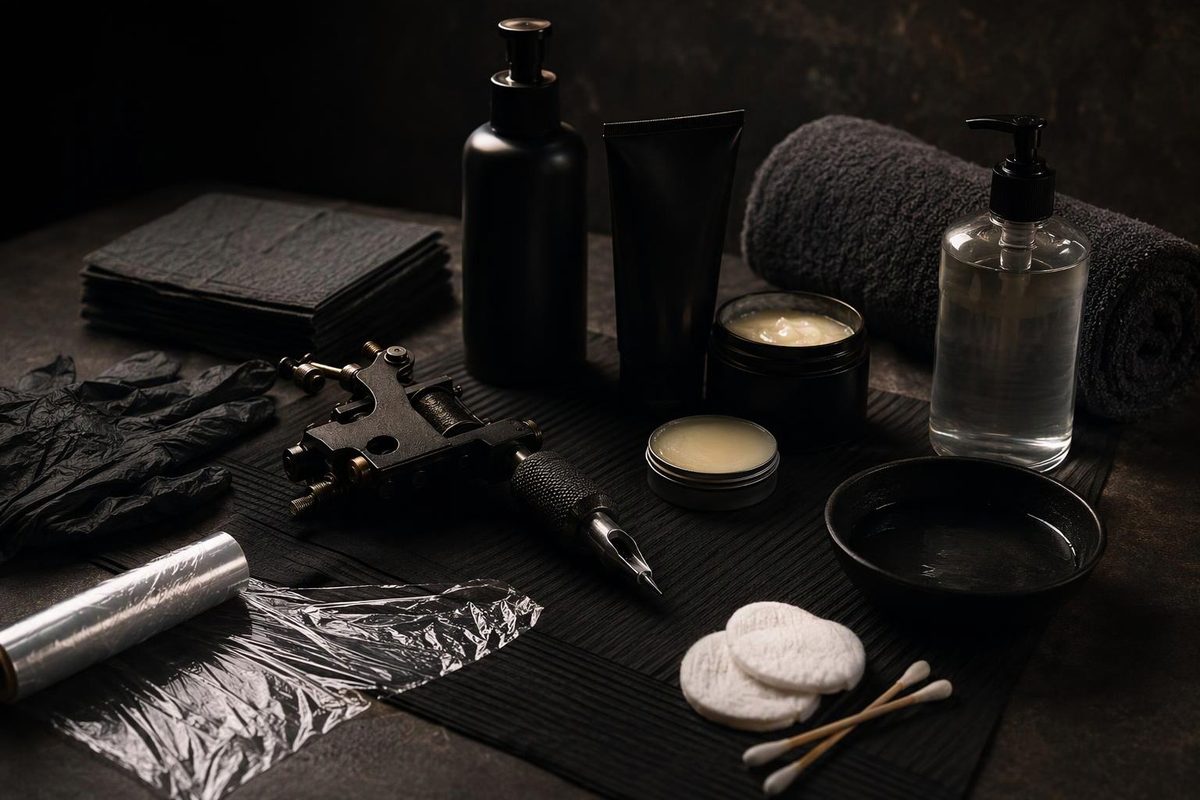
“Tattoo ink bleeding” can mean two different things: colored fluid coming out of a fresh tattoo, or pigment spreading beneath the skin beyond the intended lines, called a blowout. The useful first question is whether you’re seeing something on the surface or a blurred area underneath it.
If ink is collecting under the bandage or coming off during washing
A fresh tattoo is a wound. A little oozing can include blood, clear wound fluid and excess ink; this does not automatically mean the tattoo is losing its design. Cleveland Clinic describes small amounts of blood-and-ink ooze as part of healing, while the American Academy of Dermatology notes that clear fluid can also be normal.
Under an adhesive dressing, that mixture can form a dark pocket and temporarily obscure the lines. Saniderm’s instructions describe pooling of blood, plasma and excess ink beneath its bandage during early healing. A dark fluid pocket is not, by itself, evidence of a blowout. Saniderm’s care guide
What to do:
- Follow the instructions for your particular dressing. Don’t remove it early just to check whether the lines are still sharp, but do keep to its scheduled removal or change. Saniderm’s guide specifies up to 24 hours for the first bandage; wear times differ by product and application. Saniderm directions
- Act if the dressing’s protection is compromised. For Saniderm, the manufacturer advises removal and replacement if pooling becomes excessive or compromises adhesion, and prompt removal if water gets underneath. Follow its cleaning and replacement directions rather than leaving a compromised dressing in place. Other brands may have different instructions. Saniderm directions
- Once the dressing is off, wash gently. Use warm water and mild, fragrance-free soap, then pat dry with a clean paper towel. Don’t scrub to remove every trace of color. Avoid picking, scratching and soaking while healing. Cleveland Clinic aftercare guidance
For dressing removal steps, see how to take off second skin.
If the lines look blurred beneath the skin
A blowout is pigment extending outside the tattoo’s intended border, often appearing as a blurry rim or halo. It can become visible within hours or days, including during healing. Unlike surface leakage, it remains beneath the skin after gentle cleaning. Clinical description of tattoo blowout
Placement that is too deep is a recognized explanation: ink can enter the fatty layer below the dermis and spread beyond the intended area. A published foot-tattoo case confirmed pigment in both the dermis and subcutaneous fat on biopsy. However, the mechanism is not fully understood in every case, so appearance alone cannot establish exactly what happened—or prove that you caused it through aftercare. Biopsy-confirmed case; clinical discussion
Take a clear photo and ask your artist to assess the area. Continue normal care while it heals; scrubbing or applying more lotion cannot move pigment beneath the skin back into its original line. Don’t judge the result through pooled dressing fluid or attempt immediate corrective tattooing on healing skin.
If the blur persists once healed, discuss options rather than expecting washing to fix it. Cover-up tattooing and laser treatment are reported approaches. A dermatologist experienced in tattoo lasers can assess suitability; published successes are individual cases, not a guarantee of complete correction. Treatment discussion
Not every change in a tattoo’s outline is a blowout:
- Colored flakes: ink retained in the outer skin can shed as that layer peels. Review of tattoo healing
- Missing sections of a healed line: this is pigment loss rather than pigment spreading outside the line. See fine-line pigment loss.
- Gradual blurring of an older tattoo: natural aging can soften its outer lines; this is distinct from the usually rapid appearance of a blowout. Review of cosmetic complications
When it needs medical attention
Seek prompt medical care for spreading or darkening redness, worsening pain, pus, fever, chills, red streaks, or significant or foul-smelling drainage. Don’t dismiss these as “ink bleeding” or wait for an artist’s reply. These are warning signs identified by the American Academy of Dermatology and Cleveland Clinic.