
6 min read ·
A Cautious Flight Plan for a Newly Tattooed Traveler
Follow artist-specific dressing care, pack permitted supplies in your carry-on, minimize rubbing and handling, and check that symptoms are improving.
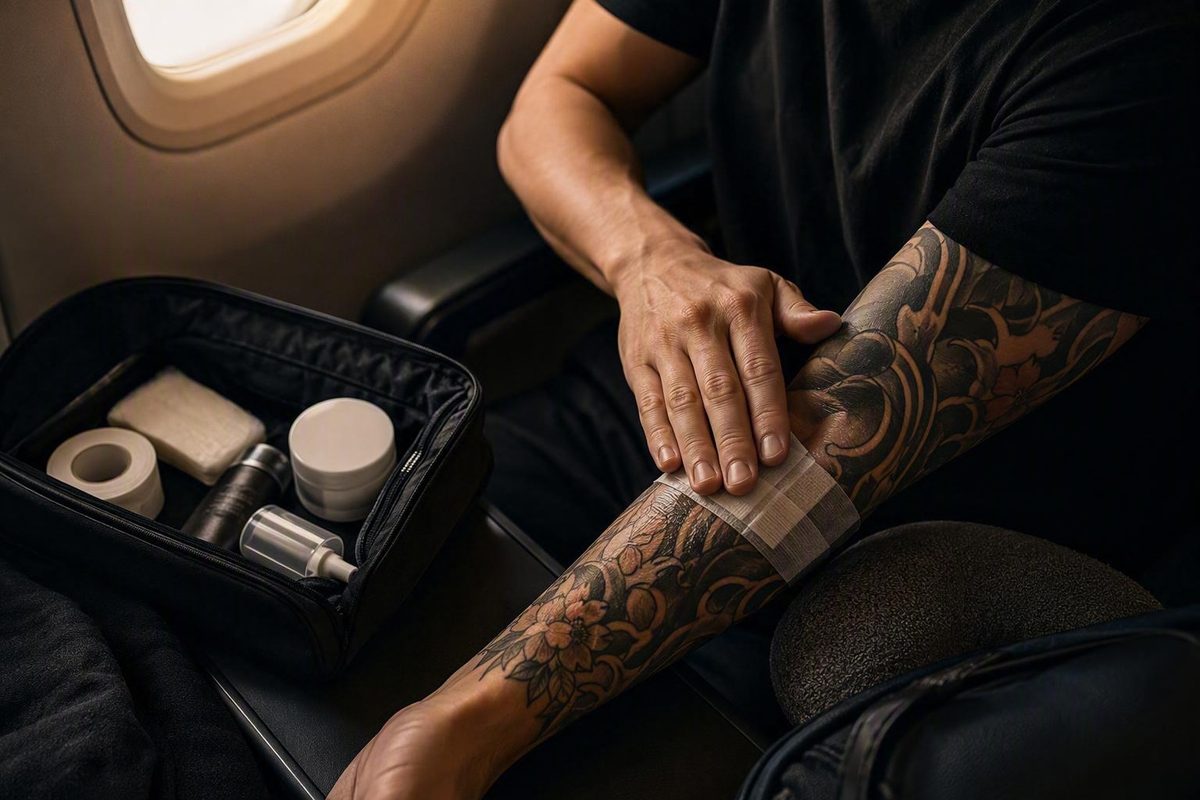
There is no well-supported universal countdown for how long to wait between getting a tattoo and boarding a plane, and the available evidence does not establish that flying immediately is harmless. The cautious approach is to check that healing is improving, follow your tattoo artist’s instructions for the specific dressing, keep essential supplies in your carry-on, reduce unnecessary rubbing and handling, and seek medical care rather than relying on travel tips if symptoms worsen or you feel systemically unwell.
Can you fly with a fresh tattoo?
No single waiting period can determine whether an individual with a fresh tattoo should fly. The available tattoo-care source does not address air travel, aircraft conditions, or fitness to fly.
For context, Tattoo Aftercare Guide characterizes days 1–3 as an open-wound stage in which plasma, excess ink, redness, and swelling may occur. It estimates surface healing at two to four weeks and deeper remodeling at three to six months. Those estimates describe healing stages; they are not prescribed waiting periods before a flight. The source also says early redness and swelling should decrease rather than grow (Tattoo Aftercare Guide’s healing timeline).
| What you observe | Travel-day response |
|---|---|
| Healing appears stable or improving | Continue artist-directed care. This alone does not establish that you are fit to fly; seek individualized advice if your medical risk is uncertain. |
| Symptoms are worsening | Obtain prompt professional assessment rather than trying to manage the problem with travel tips. |
| Fever or other systemic symptoms are present | Seek same-day medical care and reassess the trip with a healthcare professional. |
If healing appears to be progressing normally, concentrate on practical care rather than an unsupported number of hours or days. If you are uncertain about your symptoms or personal medical risk, consult a qualified healthcare professional before departure.
Prepare before leaving for the airport
Ask your tattoo artist how to manage the exact dressing already applied to the tattoo. Confirm:
- How that dressing should be managed.
- What to do if it loosens, leaks, rolls at the edges, or becomes damaged.
- Which supplies to use after removal.
- When to contact the studio about a dressing problem or change in the tattoo.
Do not adopt a universal schedule for removing or replacing a dressing. Do not uncover, replace, or remove the dressing solely because you are flying.
Plan around obvious sources of friction. Choose clean clothing and arrange your seat area to reduce avoidable contact where practical. This is a general healing precaution, not proof that a particular outfit, seat, or posture improves healing.
Keep essential supplies in your carry-on rather than relying on access to checked baggage. A compact packing checklist is:
- Spare clean clothing that will not unnecessarily rub the area.
- Baby wipes permitted under the applicable checkpoint rules, if useful for general travel hygiene.
- Dressing supplies specifically directed by your artist.
- Eligible travel-size liquids in securely closed containers.
Security screening and airline baggage requirements are separate from tattoo care. If the itinerary includes checkpoints outside the United States or international connections, check the rules of every relevant security authority and airline rather than assuming one country’s requirements apply throughout the trip.
Pack tattoo-care supplies for a U.S. checkpoint
For U.S. screening, the TSA list identifies baby wipes, clothing, blankets, and carry-on liquids in containers of 3.4 ounces or 100 milliliters or less as permitted categories. If a cream, soap, ointment, dressing, or other item is not listed, the page directs travelers to AskTSA through social media or by texting “Travel” to 275-872. It lists live assistance from 8 a.m. to 6 p.m. Eastern Time. TSA also states that an otherwise permitted item may undergo additional screening or be refused if it triggers an alarm, appears tampered with, or raises another security concern; the checkpoint officer makes the final decision. These are U.S. security-screening rules, not worldwide airport policy or airline baggage rules (TSA’s official “What Can I Bring?” list).
When asking about an unlisted item, describe its exact form and container size—for example, whether it is a liquid, gel, cream, aerosol, soap, ointment, or dressing. Recheck the official information shortly before departure because contact details and screening rules may change.
Permission to pass through security does not establish that a product is medically suitable for a fresh tattoo. Use only supplies that are consistent with your artist’s instructions or individualized professional advice.
Follow a low-handling care plan during the journey
The aim is not to invent a special in-flight treatment routine. Continue the existing care plan while avoiding unnecessary touching, scratching, picking, pressure, and rubbing.
Before boarding
- Check that the dressing is in the condition anticipated by your artist’s instructions.
- Keep supplies together and accessible instead of repeatedly unpacking them.
- Do not remove or change the dressing merely because you are about to board.
- If it has loosened, leaked, or rolled at the edges, follow the artist’s specific contingency instructions rather than improvising a new schedule.
- Arrange clothing, straps, and belongings so they do not repeatedly press against the area.
During the flight
- Leave the tattoo alone unless care is necessary under the instructions you already have.
- Avoid repeatedly touching or inspecting it.
- Do not pick peeling skin or scabs, and do not scratch the area.
- Reduce obvious rubbing where practical, particularly around waistbands, footwear, armrests, seat backs, and bent joints.
- Do not assume that boarding a plane requires the tattoo to be uncovered, washed, moisturized, or redressed.
Tattoo Aftercare Guide recommends washing with unscented antibacterial soap, patting dry, and applying a thin ointment layer during days 1–3. During peeling and scabbing, it recommends fragrance-free lotion and advises against picking or scratching. These are the website’s general recommendations, not clinician-reviewed instructions tailored to your tattoo, dressing, or medical history.
After arrival
- Resume the artist-directed routine in a suitable setting.
- Check whether redness and swelling are continuing to decrease.
- Keep the healing tattoo out of pools and chlorine.
- Avoid direct sunlight while it is healing.
- Avoid long baths during the first month.
- Contact the artist about dressing-specific problems, but obtain medical care for possible infection or systemic illness.
Following these steps does not prove that flying is harmless to a fresh tattoo. They are practical measures for maintaining the existing care routine while traveling.
Check for warning signs before you fly
Early plasma, excess ink, limited redness, and limited swelling may occur. What matters is the direction of change: according to the cited aftercare source, redness and swelling should shrink rather than spread or intensify.
| May occur initially | Concerning change |
|---|---|
| Plasma weeping | Increasing redness after day three |
| Excess ink at the surface | Noticeable heat |
| Limited redness that decreases | Swelling that spreads |
| Limited swelling that decreases | Fever |
| Peeling or scabbing without picking | Red streaks or thick yellow discharge |
General online aftercare information cannot diagnose an infection or determine whether an individual is fit to fly. Tattoo Aftercare Guide also states that its articles are general guidance rather than medical advice (the site’s medical-information limitation).
The travel-day rule is simple: do not rely on an unsupported countdown after tattooing. Follow the artist’s instructions for the specific dressing, carry permitted supplies, minimize avoidable rubbing and handling, and check that redness and swelling are improving. If redness increases after day three or you develop heat, spreading swelling, fever, red streaks, or thick yellow discharge, seek same-day medical care instead of trying to solve the problem during the flight (Tattoo Aftercare Guide’s warning signs).