
15 min read ·
When Your New Tattoo Is Ready for the Heat
Peeling, scabs, drainage, marked redness, swelling, unusual warmth, pain or tenderness mean your tattoo is not ready for a sauna.
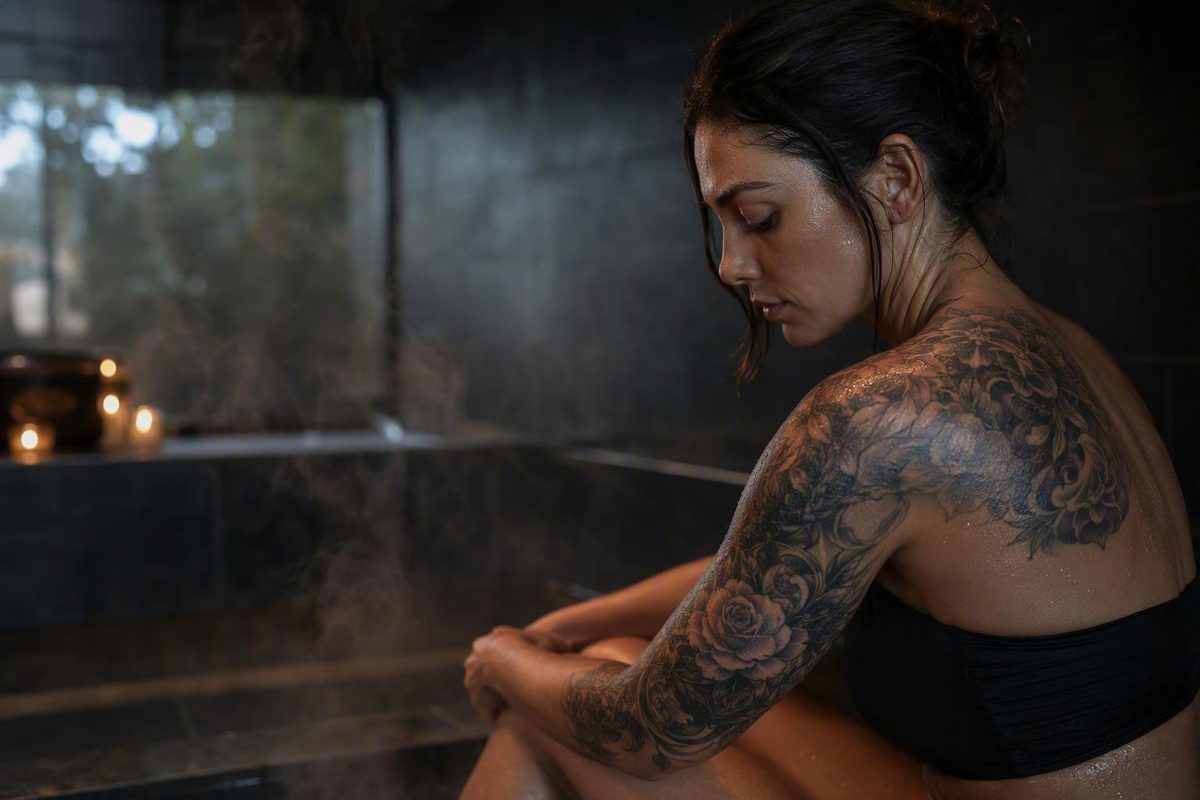
The short answer: wait for complete surface healing
Skip dry saunas, infrared saunas, and steam rooms while your tattoo is visibly or physically healing. If the area is open, draining, scabbed, peeling, markedly red, swollen, unusually warm, painful, or tender, it is not ready for sauna use.
A useful planning range is two to four weeks, sometimes longer, but this is a conservative convention rather than a guaranteed clearance date or medically validated deadline. Sun Home Saunas recommends waiting at least two to four weeks and until the tattoo is fully healed, while noting that tattoo size, location, and individual healing can change the timeline in its sauna and tattoo guidance.
Some practical recommendations are shorter. Tattooist Olivia Moonchild recommends waiting two weeks and, more importantly, until the skin surface has healed. The same interview contains variable descriptions of how quickly surface closure can occur, illustrating why the calendar alone is unreliable. It is one tattooist’s advice, not a clinical trial or universal medical rule, as the World of Sauna interview makes clear.
Use this cautious decision rule:
- Not ready: There are raw or open areas, drainage, scabs, active peeling, marked redness, swelling, unusual warmth, pain, stinging, or tenderness.
- Potentially ready: The entire surface is closed and smooth, scabbing and peeling have ended naturally, there is no drainage, and the area is free of marked redness, swelling, warmth, pain, and tenderness.
- Uncertain: Wait longer. Ask your tattoo artist whether the appearance matches the expected healing pattern for that particular work. Seek healthcare guidance when healing is worsening, spreading, delayed, or otherwise abnormal.
A tattoo showing any no-go sign is not ready merely because two or four weeks have passed. An intact, symptom-free surface may support a cautious return, but it cannot guarantee that a session will cause no irritation.
The evidence has important limits. Most available sauna-specific guidance comes from commercial sauna retailers, installers, and bathhouse operators, plus one tattooist interview—not independent clinical guidelines or direct studies comparing tattoo outcomes. This article therefore offers a conservative practical screen, not medical clearance: wait for complete, symptom-free surface healing instead of treating a date as automatic permission.
Why a sauna and a healing tattoo are a poor combination
A fresh tattoo is wounded or broken skin that needs time to close and recover. A sauna deliberately adds substantial heat and sweating, while a steam room also adds sustained humidity. Commercial bathhouse guidance consequently advises avoiding sauna use until the tattoo has fully healed and distinguishes quick washing from prolonged heat, sweat, or immersion in its fresh-tattoo bathhouse guidance.
Several practical exposures occur together:
- Heat may aggravate discomfort in already-sensitive skin.
- Heavy sweating keeps the area wet and can complicate the established washing and drying routine.
- Humidity adds prolonged moisture exposure.
- Friction from rubbing, scratching, towels, clothing, or facility surfaces may disturb peeling skin or scabs.
- Shared environments add contamination concerns while the surface remains vulnerable.
These are reasons for caution, not proof that one sauna session will produce a complication. The supplied commercial guidance identifies irritation, inflammation, delayed healing, and possible contamination or infection as concerns, but it does not establish how often those outcomes occur or quantify the risk.
Routine gentle washing is not equivalent to sitting in a sauna. Artist-directed washing is brief and followed by gentle drying. Sauna use creates prolonged heat and sweating; a steam room adds very high humidity. Pools, baths, hot tubs, and cold plunges involve immersion and must be considered separately.
There is also no adequate support in the supplied evidence for claims that sweat flushes pigment from the skin, heat breaks tattoo ink down, or sauna exposure makes ink migrate. Those explanations should not be used as established mechanisms.
Postponement is the preferred precaution. None of the following turns actively healing skin into sauna-ready skin:
- Applying extra moisturizer
- Covering the tattoo with an ordinary bandage
- Leaving a healing film in place
- Choosing a lower bench
- Slightly reducing the temperature
- Taking a shorter session
- Switching from a traditional sauna to infrared
These measures may alter the exposure, but they do not close open skin or end drainage, scabbing, peeling, swelling, warmth, pain, or tenderness. Coverings are also not established as providing complete protection. If the tattoo is still healing, skip the session.
A healing-stage guide and sauna readiness checklist
Tattoo healing is a continuum, and the stages can overlap. Commercial sauna guidance commonly describes early open-skin, peeling, surface-recovery, and deeper-healing phases, but the timelines vary and should not be treated as automatic sauna-clearance dates. Haven of Heat, for example, places fresh-wound healing around days 1–6, itching and peeling around days 7–14, and surface recovery around days 15–30 while expressly acknowledging individual variation in its stage-based sauna guidance.
Fresh and open skin
During the early days, the tattoo may be sore, swollen, or weeping. The surface has recently been worked and is still recovering. Sauna use is inappropriate at this stage, even if the tattoo is small or covered.
Follow the artist’s intended washing, drying, and dressing routine. Do not use sauna exposure as a test of whether the surface has closed.
Peeling or scabbing
Peeling and scabbing may occur during roughly the following week or two. The area may itch, flake, or look temporarily dull. Scabs and loose skin should be allowed to separate naturally rather than being picked, scratched, rubbed, or deliberately softened in a hot, humid setting.
A day-seven tattoo with flakes or scabs is not ready for a sauna. Neither is a tattoo that looks closed in some places but remains raw or damp in others.
Surface recovery
Surface recovery is often placed within an approximate two-to-four-week range, though it can take longer. During this stage, peeling ends, scabs detach naturally, and the surface becomes smoother and more comfortable. Sauna Experts describes early healing, peeling and scabbing, and later recovery while recommending at least two to three weeks and preferably complete healing before sauna use in its fresh-tattoo sauna article.
A tattoo that remains tender at week two is not ready, even if it looks mostly closed. A later tattoo with a completely intact, smooth, symptom-free surface may be suitable for a cautious return, but this is a practical screen rather than proof of safety.
Deeper remodeling
Surface healing and deeper skin remodeling are not the same process. The surface may look recovered while deeper repair continues for longer.
That distinction does not establish that everyone must avoid saunas throughout the entire deeper-remodeling period. For this decision, the cautious practical threshold is complete, symptom-free surface healing, followed by a gradual return and attention to how the area responds.
No-go checklist
Do not use a sauna if any of the following is present:
- Open, raw, cracked, or weeping skin
- Blood, plasma, or other drainage
- Scabs
- Active flaking or peeling
- Marked or spreading redness
- Increasing or spreading swelling
- Unusual warmth
- Pain, stinging, or persistent soreness
- Tenderness when the area is lightly touched
- A healing pattern that is worsening rather than settling
One item is enough to postpone the session. Covering the symptom does not resolve it.
Readiness checklist
A tattoo may be ready for a cautious return when all of the following are true:
- The entire surface is closed and intact.
- The skin is smooth rather than raw or cracked.
- Scabs have detached naturally.
- Peeling has completely ended.
- There is no drainage.
- There is no marked redness or swelling.
- The area does not feel unusually warm.
- There is no pain, stinging, or tenderness.
- The appearance fits the healing pattern your artist told you to expect.
This checklist is not medical clearance or a validated clinical test. If you cannot confidently check every box, wait longer and ask your artist rather than testing the tattoo in a sauna.
Why some tattoos need more than two to four weeks
Healing time varies because tattoos, skin, and aftercare circumstances vary. The two-to-four-week range is best understood as a planning estimate for surface recovery, not a promise.
Factors identified in the supplied guidance include:
- Tattoo size
- Location
- Complexity and density
- How extensively the skin was worked
- Skin sensitivity
- Aftercare
- Individual healing speed
- Repeated bending, rubbing, or clothing contact at the site
A large or heavily worked tattoo may warrant more caution than a small, minimally worked piece. That does not support assigning either one an exact extra waiting period. The condition of the entire surface remains more useful than an invented size-based timetable.
Location matters in practical ways. A tattoo near a joint may bend repeatedly, while one beneath a waistband or inside footwear may experience recurring friction. These circumstances can affect how the surface settles, but the supplied evidence does not establish placement-specific sauna deadlines.
Sauna Experts identifies size, location, sensitivity, and individual healing as timeline modifiers and acknowledges that a covering cannot ensure protection. Its recommendation remains general rather than a validated clinical timetable.
Assess that area for open spots, drainage, scabs, peeling, redness, swelling, warmth, pain, and tenderness. The supplied evidence does not establish a separate universal waiting period for touch-ups.
If healing is taking longer than expected, do not manage the uncertainty by covering the tattoo and entering the sauna. Ask the artist whether the appearance is typical for the work performed. If symptoms worsen, spread, persist, or otherwise appear abnormal—or if personal health circumstances make healing a concern—seek healthcare guidance rather than relying on a generic online schedule.
Dry, infrared, and steam saunas: none is a fresh-tattoo workaround
No supplied comparative evidence establishes a dry sauna, infrared sauna, or steam room as safe while a tattoo is actively healing. Differences in temperature and humidity do not change the central requirement: first wait until the skin is closed, intact, and free of active warning signs.
Traditional dry sauna
A traditional sauna has lower humidity than a steam room, but it still combines substantial heat with sweating. “Dry” describes the environment relative to steam; it does not mean the tattoo remains dry.
Lower humidity therefore does not make a traditional sauna appropriate for skin that is open, draining, scabbed, peeling, markedly red, swollen, warm, painful, or tender.
Infrared sauna
Infrared saunas may operate at lower air temperatures than many traditional saunas. That product characteristic does not establish a lower tattoo-healing risk or justify returning earlier.
An infrared session can still produce heat and sweating. During active healing, use the same rule as for other sauna types: wait until complete, symptom-free surface recovery.
Steam room
A steam room combines heat with very high humidity. It should not be treated as a gentler substitute for a sauna while a tattoo is healing.
Some commercial publishers rank dry, infrared, and steam environments by presumed tattoo risk. The reasoning may be plausible, but the supplied evidence contains no direct comparative tattoo-outcome studies establishing a clinically safest or most dangerous type. The supportable conclusion is narrower: none is a workaround for active healing.
After the surface has recovered, you may return to your usual sauna type, but the first session should still be cautious and guided by the tattoo’s response.
Sauna readiness also does not automatically mean clearance for pools, baths, hot tubs, or cold plunges. Those activities add immersion, prolonged water contact, chemicals, or other environmental factors. Treat each as a separate aftercare decision.
How to return to the sauna after the tattoo has healed
Begin only after the entire surface is closed and smooth, scabbing and peeling have ended, there is no drainage, and the tattoo is free of marked redness, swelling, unusual warmth, pain, and tenderness.
Commercial sauna guidance generally recommends restarting with a short session, staying hydrated, minimizing rubbing, monitoring the skin, and using fragrance-free moisturizer afterward if it fits the person’s normal aftercare. Sun Home Saunas also mentions approximately 20 minutes as a common post-healing convention, not a medically established tattoo-specific limit, in its post-healing recommendations.
For the first session:
- Choose a brief, moderate exposure. Do not immediately resume your longest or hottest routine.
- Hydrate normally. Follow your usual general sauna-hydration practices.
- Minimize friction. Do not rub, scratch, or drag a towel across the tattoo.
- Watch for discomfort. Leave if the area begins to sting, hurt, or feel unusually irritated.
- Handle the area gently afterward. Once it is clean and dry, use a fragrance-free moisturizer only if that fits your established aftercare.
- Monitor the tattoo later. An immediate lack of discomfort does not establish that irritation cannot appear afterward.
Moisturizer has not been established as protecting a tattoo from sauna heat or sweat. No special protective film is established as necessary or beneficial for routine sauna use once the tattoo is fully healed.
Stop if the tattoo becomes painful, sharply stinging, or unusually irritated. If redness, warmth, swelling, or discomfort persists, spreads, or worsens, postpone further sessions and obtain appropriate advice.
What to do if you used a sauna too soon
Accidental early exposure does not prove that your tattoo has been permanently damaged. Do not assume that fading, blurring, pigment loss, or another lasting outcome has occurred; the supplied evidence does not support predicting those results from an isolated session.
Use a calm sequence:
- Leave the heat.
- Allow the skin to cool without adding another heated activity.
- Gently wash the tattoo using the method already approved by your artist.
- Pat it dry rather than rubbing.
- Resume the existing artist-approved aftercare routine.
- Do not pick softened scabs or rub peeling skin.
- Do not repeat the sauna session while active healing continues.
- Observe the area over the following hours and days.
This sequence reflects the practical after-exposure guidance from Haven of Heat, which recommends gentle washing, patting the area dry, resuming the recommended aftercare, and monitoring for worsening symptoms. It also identifies spreading redness, unusual warmth, pus, foul odor, and fever as concerns in its sauna-after-tattoo guidance.
The supplied evidence supports returning to the established aftercare routine rather than attempting to make another sauna session possible.
Watch for:
- Redness that spreads or becomes more intense
- Increasing warmth
- Worsening pain
- Increasing or spreading swelling
- Pus or other concerning drainage
- Foul odor
- Red streaking
- Fever or feeling systemically unwell
Brief flushing that settles after leaving the heat is not the same observation as redness that persists, spreads, or becomes increasingly painful. However, that distinction is not a reliable self-diagnostic test. Possible infection or abnormal wound healing requires healthcare assessment.
Contact the tattoo artist for questions about the intended dressing, washing routine, moisturizer, or expected appearance of the work. Use a healthcare professional—not the artist alone—for possible infection, significant inflammation, or abnormal healing.
Warning signs, professional help, and the limits of the evidence
Stop sauna use while a possible infection or abnormal healing problem is being assessed. Concerning signs identified in the supplied material include spreading redness, worsening pain or swelling, unusual warmth, pus or other concerning discharge, foul odor, red streaking, and fever.
Tattoo Aftercare Guide’s terms advise seeking medical care the same day for spreading redness, fever, streaking, or pus—not trying a different ointment. The page also states that its articles are general information rather than medical advice in its informational-use and medical notice.
Seek prompt healthcare guidance when symptoms:
- Spread beyond the tattooed area
- Become increasingly painful, warm, or swollen
- Produce pus or other concerning discharge
- Develop a foul odor
- Include red streaks
- Persist or worsen instead of settling
- Occur with fever or systemic illness
This article cannot diagnose an infection or determine whether a reaction is due to heat, friction, a product, an allergy, or another condition. The supplied evidence does not include an independent clinical guideline, so the symptom list should be treated as a reason to obtain professional assessment—not as a diagnostic tool or complete triage protocol.
The artist and clinician have different roles. Your artist can explain the intended aftercare plan and whether the tattoo’s appearance seems typical for the work performed. A healthcare professional should evaluate suspected infection, significant inflammation, delayed healing, or other medical symptoms.
The sauna-specific evidence is limited. The available publishers are largely sauna retailers, installers, and bathhouse operators, plus one tattooist interview. Their recommendations differ: some mention several days or one week, one recommends two weeks, and others suggest two to four weeks or longer. Most return to the same controlling condition—wait until the surface is fully healed.
That evidence supports a conservative precaution: avoid sauna use while the skin is visibly healing. It does not support confident claims that sauna heat directly breaks tattoo ink down, makes ink migrate, flushes pigment out through sweat, or inevitably fades a tattoo.
Frequently asked questions
Is two weeks long enough to use a sauna after a tattoo?
Sometimes, but not automatically. Two weeks appears in one tattooist interview, while other commercial guidance recommends two to four weeks or longer. None of the supplied sources establishes two weeks as a universal medical threshold.
At two weeks, assess the tattoo rather than relying on the date. If it is open, draining, scabbed, peeling, markedly red, swollen, warm, painful, or tender, wait. If the entire surface is closed, smooth, and symptom-free, ask your artist whether the appearance matches the expected recovery for that tattoo.
Can I use an infrared sauna sooner than a traditional sauna?
There is no reliable comparative evidence that an infrared sauna permits an earlier return. Although infrared models may operate at lower air temperatures, a session still involves heat and sweating.
Use the same practical threshold for infrared, traditional, and steam facilities: complete, symptom-free surface healing first.
Can a waterproof tattoo bandage make early sauna use safe?
No waterproof bandage or healing film has been established as making early sauna use safe. A covering does not eliminate heat, sweating, friction, or vulnerable skin, and the supplied commercial guidance acknowledges that coverings do not ensure protection.
If the tattoo remains open, draining, scabbed, peeling, markedly red, swollen, warm, painful, or tender, postponement is the more conservative choice.
Will sauna use fade a fully healed tattoo?
The supplied evidence does not establish that routine sauna use either definitively fades or cannot fade a fully healed tattoo. Claims about direct heat-induced ink breakdown, pigment migration, or inevitable fading are not adequately supported.
Once the tattoo is fully healed, return gradually and respond to skin irritation rather than assuming a permanent pigment effect. The stronger reason to wait is to avoid exposing visibly healing skin to prolonged heat, sweating, moisture, friction, and shared environments.
Should I ask my tattoo artist or a doctor before returning to the sauna?
Ask your tattoo artist about the intended aftercare, whether the surface appears to be healing as expected, and how the size, location, or extent of the work may affect recovery. If the tattoo is closed and symptom-free but you remain uncertain, the artist is a sensible contact for routine aftercare questions.
Use a healthcare professional for delayed or abnormal healing, spreading redness, worsening pain or swelling, unusual warmth, pus, foul odor, red streaking, fever, or other medical concerns. Artist guidance should not replace healthcare assessment of possible infection.
The final rule is simple: if the tattoo is still peeling, scabbed, draining, markedly red, swollen, warm, painful, or tender, skip the sauna. Two to four weeks is a useful planning range, not automatic clearance. Once the surface is fully closed and symptom-free, return gradually, monitor the area, and follow your artist’s individualized aftercare guidance. If redness spreads or fever, streaking, pus, worsening pain, or swelling develops, stop sauna use and seek prompt medical care.