
13 min read ·
When Is It Reasonable to Have a Drink After Getting Inked?
The cautious rule is to wait at least 48 hours, then reassess how the tattoo is healing instead of treating the cutoff as automatic clearance.
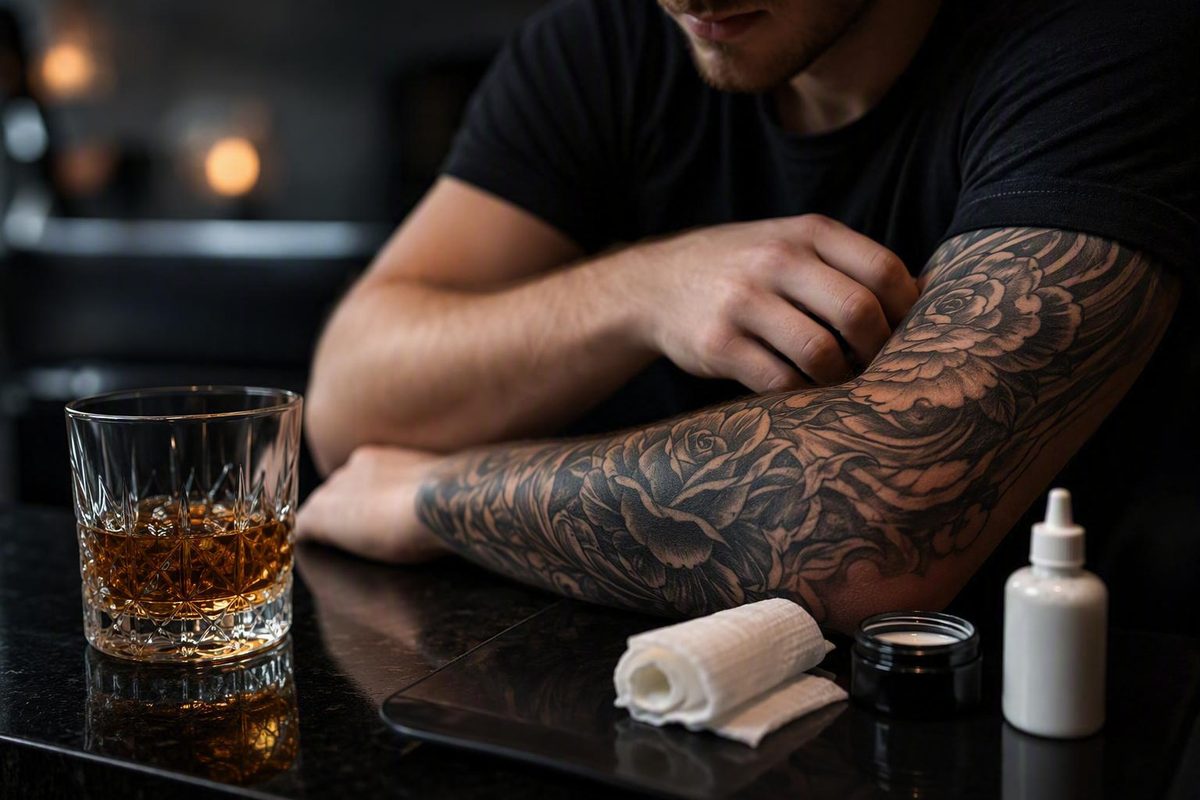
The short answer: skip alcohol for now and use 48 hours as a cautious baseline
Commercial tattoo-industry sources consistently advise avoiding alcohol immediately after a tattoo. If you want a simple, conservative rule, wait at least 48 hours, then reassess how the tattoo is healing. Kingpin Tattoo Supply describes the first 24–48 hours as an important initial precautionary period, while acknowledging that individual healing varies and no single waiting period fits everyone. This is commercial industry guidance—not a clinically established point at which drinking becomes safe. Kingpin explains its 24–48-hour recommendation and its limitations.
The clock is only one part of the decision. If the tattoo is still bleeding, actively oozing, markedly tender, unusually swollen, or getting worse, waiting longer is more sensible than treating the 48-hour mark as permission to drink.
There is also no established number of drinks that is safe for every healing tattoo. What matters includes when the tattoo was completed, how it looks and feels now, how much you intend to drink, whether alcohol could interfere with aftercare, and whether medication or a health condition changes your personal risk.
| Time since the session | Practical approach |
|---|---|
| Within 24 hours | Follow the conservative studio practice of skipping alcohol. Rest, hydrate normally, and follow your artist’s dressing and cleaning instructions. |
| Between 24 and 48 hours | Waiting remains the cautious choice because this is still within the initial window identified by commercial tattoo sources. |
| After 48 hours, with normal improvement | Limited drinking may be less concerning if bleeding and active oozing have stopped and the tattoo is settling. This is not an automatic clearance or proven safety threshold. |
| At any time with worsening symptoms | Do not rely on elapsed time. Continue monitoring the tattoo and obtain appropriate advice if symptoms are spreading or intensifying. |
Hon Tattoo Studio likewise recommends avoiding alcohol for at least 48 hours, while distinguishing limited drinking from heavier consumption and noting that timing and quantity matter. Its recommendation is studio advice rather than a tattoo-specific clinical standard. Hon Tattoo Studio describes its 48-hour guideline.
The practical answer is therefore to combine time with symptoms. A tattoo that is steadily improving presents a different situation from one that is still bleeding heavily, increasingly painful, or surrounded by expanding redness. One planned drink is also different from becoming intoxicated immediately after the appointment.
Why drinking soon after a tattoo raises practical concerns
A fresh tattoo is injured skin that needs consistent protection, cleaning, rest, and observation. Your artist may have applied a particular dressing and supplied instructions for when to remove it, how to clean the area, and what products to use. Drinking does not replace or modify those instructions.
The clearest practical concern is behavioral: intoxication can make reliable aftercare harder.
That concern does not depend on proving that alcohol has a direct, predictable effect on tattoo ink. The more drinking affects attention, coordination, and judgment, the greater the chance that aftercare will become inconsistent.
Commercial tattoo sources also associate drinking soon after a session with dehydration and continued bleeding. Those concerns help explain why studios recommend waiting, but the supplied tattoo-specific evidence does not quantify how much a given amount of alcohol changes bleeding, hydration, healing time, or the final appearance of a tattoo.
Claims that alcohol necessarily pushes out ink, fades color, blurs lines, suppresses immunity, creates scars, or directly causes infection should be treated cautiously. Some commercial sources make those claims, but the available evidence does not demonstrate them according to alcohol dose or timing. General ideas about wound healing also cannot establish that one drink will alter a particular tattoo or validate an exact waiting period.
The evidence supports a narrower conclusion:
- Early healing deserves consistent care and observation.
- Intoxication can make that care less reliable.
- Studios commonly cite hydration and continued bleeding as additional reasons to wait.
- One drink is not proven to cause fading, infection, scarring, or another specific outcome.
- No tattoo-specific clinical boundary separates “unsafe” drinking from “safe” drinking.
This avoids two unsupported extremes. It is too confident to say that drinking immediately after tattooing has no possible downside. It is equally too confident to say that one drink will necessarily ruin the work.
A time-and-symptom decision guide
A sensible decision begins with elapsed time, but it should also account for current symptoms, the amount you plan to drink, and any medication or health concerns.
During the initial day, follow the conservative industry practice of skipping alcohol. Prioritize rest, normal hydration, and the dressing and cleaning instructions supplied by your artist. Do not remove or replace a dressing early simply because you are going out, and do not invent a different routine in response to social plans.
During the following day, waiting remains the cautious choice. If a celebration can be postponed or enjoyed without alcohol, doing so removes an avoidable variable while the tattoo settles.
Continued bleeding or active oozing is a straightforward reason to keep waiting. The same applies if the area remains markedly tender, appears unusually swollen, or is not beginning to improve. Reaching a particular hour does not override what the tattoo is doing.
Once the 48-hour baseline has passed, limited drinking may be less concerning when:
- Bleeding and active oozing have stopped.
- Redness and swelling are not spreading or intensifying.
- Pain and tenderness are settling.
- You can continue the prescribed aftercare normally.
- You do not intend to drink enough to impair your judgment.
- No medication or personal health concern makes alcohol inappropriate.
Cast & Brand Tattoo Company recommends 48–72 hours as a general studio interval and sometimes suggests longer for large, heavily worked, or slower-settling tattoos. Those periods illustrate the variation in commercial advice; they are not medically validated formulas. Cast & Brand describes its variable post-tattoo waiting periods.
During peeling or other visible surface healing, heavy or repeated drinking is best discouraged as a precaution—particularly if intoxication could lead to scratching, picking, pressure on the tattoo, or inconsistent care. This does not mean that avoiding alcohol throughout visible healing is a clinically proven requirement.
Use this compact decision sequence:
- Check the elapsed time. If you are still within the initial precautionary period, waiting is the conservative choice.
- Check for bleeding or oozing. If either remains active, keep waiting.
- Check the direction of symptoms. Settling symptoms are more reassuring than symptoms that are spreading or intensifying.
- Consider the planned quantity. One limited drink and intended intoxication are not equivalent.
- Check medication and health factors. Ask a clinician or pharmacist if alcohol could be inappropriate independently of the tattoo.
- Choose between waiting and seeking advice. An artist can clarify routine aftercare; worsening physical symptoms call for medical assessment.
Do not interpret a calm-looking surface as proof that all healing is complete. For the immediate alcohol decision, symptom improvement is useful, but appearance alone cannot provide a medical guarantee.
One drink is not the same as heavy or repeated drinking
Hon Tattoo Studio says one drink is unlikely to ruin a tattoo. That is reassuring, but it is not a universal promise. The available evidence does not establish a tattoo-specific safe amount, so no exact number of drinks can be declared harmless for every person and every tattoo. The studio distinguishes one drink from heavier consumption.
Timing and drinking pattern matter. Consider the difference between:
- One drink after the initial precautionary period while the tattoo is improving.
- Several drinks immediately after the appointment.
- Heavy or repeated drinking while the tattoo remains tender, wet, or actively peeling.
These are not equivalent situations. A limited amount is less likely to impair aftercare than becoming intoxicated, but “less concerning” does not mean “clinically proven safe.”
The strongest distinction is practical. As impairment increases, it becomes easier to forget cleaning, mishandle a dressing, touch or scratch the tattoo, sleep against it, or miss changes that would otherwise attract attention.
Avoid assuming that a single drink necessarily:
- Delays healing.
- Removes ink from the skin.
- Changes line quality.
- Causes fading or patchiness.
- Produces an infection.
- Creates a scar.
The supplied tattoo-specific evidence does not prove any of those outcomes from one drink. If you already had one, there is no basis for immediately concluding that the tattoo has been damaged.
If you choose to drink after the initial precautionary period, keep the amount limited enough that you can still care for and monitor the tattoo. Maintain normal hydration, eat as you ordinarily would, and follow your artist’s instructions. Do not compensate by washing more often, applying extra moisturizer, or adding antiseptics or other unrequested products.
When it is sensible to wait longer
The cautious baseline is most useful when the tattoo is improving normally. Waiting longer is reasonable when the tattoo is large or heavily worked, remains actively wet, or appears slow to settle.
Studios sometimes advise longer waits for large, detailed, color-packed, or sensitive-area tattoos. These recommendations reflect commercial studio experience and caution. They are not evidence-based formulas assigning extra hours or days according to tattoo size, color, shading, placement, or sensitivity.
It would therefore be unjustified to say that every large tattoo requires a specific additional wait or that a small line tattoo is automatically ready once the baseline has passed. The extent of the work may be a reason to examine healing progress more carefully, but it does not create a precise timetable.
Consider waiting longer when:
- Bleeding has not stopped.
- The tattoo continues to ooze actively.
- Tenderness remains pronounced.
- Swelling is substantial or worsening.
- The area is not beginning to settle.
- Peeling or itching makes scratching more likely if you become intoxicated.
- Drinking would interfere with cleaning, sleep, or protection.
- You are uncertain whether the symptoms are routine.
Medication creates a separate safety question. If you take pain medicine, sedatives, antibiotics, anticoagulants, or any other medication, ask a clinician or pharmacist whether alcohol is appropriate. Do not assume that tattoo timing resolves medication safety.
Likewise, readers with a bleeding disorder, liver disease, diabetes, immune suppression, poor wound healing, or another potentially relevant condition should seek individualized professional guidance. This article cannot determine how a particular condition affects personal risk.
Medication and medical history can matter independently of the tattoo. Conversely, someone without medication concerns may still need to wait because the tattoo remains wet, painful, or increasingly irritated.
When requesting advice, provide useful details. Tell the clinician or pharmacist when the tattoo was completed, which medicine you use, and how much alcohol you are considering. If you are asking the artist about routine care, describe the dressing, current symptoms, and whether the area is improving.
What to do if you already drank
First, do not panic. Drinking once after a tattoo does not establish that it has been ruined. You cannot reverse the drink, and aggressive attempts to “fix” the tattoo may create new problems.
Take these practical steps:
- Stop or limit further alcohol. Avoid turning one drink into a prolonged period of intoxication.
- Drink water normally. There is no need to force excessive quantities.
- Rest and protect the tattoo. Avoid unnecessary pressure, rubbing, and touching.
- Return to the standard routine. Follow the cleaning, drying, dressing, and moisturizing instructions supplied by your artist.
- Monitor the area. Pay attention to whether redness, swelling, pain, bleeding, or discharge is settling or worsening.
Do not over-clean, scrub, pick, or scratch the tattoo. Do not add thick layers of ointment or improvise with antiseptics, alcohol wipes, or other treatments unless an appropriate professional has instructed you to do so.
Cast & Brand’s studio guidance similarly recommends returning to aftercare, resting, hydrating normally, avoiding further alcohol, and monitoring the tattoo after alcohol has already been consumed. These are precautionary steps, not evidence that damage has occurred. See the studio’s guidance for someone who has already been drinking.
If you are uncertain about the dressing or routine, contact the tattoo artist or studio. The artist can explain how their chosen dressing should be managed and restate the aftercare they intended you to follow.
An artist’s role has limits. Routine aftercare questions belong naturally with the studio, but suspected infection or broader illness requires medical assessment.
Normal early changes versus signs that need medical attention
This evidence pack does not contain an authoritative clinical guideline defining normal tattoo healing or diagnosing complications. For that reason, this article should not be used to decide whether a symptom is harmless.
The site’s published safety policy identifies spreading redness, fever, red streaking, and pus as signs that warrant prompt medical attention rather than experimentation with another ointment. Tattoo Aftercare Guide’s terms describe this content as general information, not medical advice.
Commercial tattoo sources also advise monitoring redness, swelling, pain, and discharge and obtaining medical attention when symptoms worsen. Because those sources are studio or supplier guidance rather than clinical evidence, they should be treated as conservative prompts to seek qualified assessment—not as diagnostic criteria.
In practical terms:
- Contact the artist for routine questions about the dressing, cleaning schedule, or products they instructed you to use.
- Contact a qualified medical professional if redness is spreading, red streaks appear, pus is present, or you develop a fever.
- Seek professional assessment rather than relying on this article if pain, swelling, discharge, or your general condition is worsening.
- Do not wait for a particular alcohol-related deadline before seeking help.
Nor can the fact that only one drink was consumed. If symptoms are concerning, the priority is assessment of the tattoo—not determining whether alcohol caused the change.
This article provides general information and is not medical advice. It cannot examine your tattoo, diagnose a complication, or account for your medical history.
Alcohol before a tattoo is a separate concern
Drinking before an appointment is a separate issue from drinking during healing. Commercial tattoo sources commonly advise avoiding alcohol for at least 24 hours before tattooing, but this is another industry practice rather than a medically proven cutoff. Kingpin presents the 24-hour interval as general pre-appointment guidance.
The practical concerns cited by studios include impaired judgment, dehydration, poor sleep, and possible additional bleeding during the session.
That does not mean one drink the previous evening necessarily damages tattoo quality. The supplied evidence does not establish that outcome. Quantity, timing, whether you slept adequately, and whether you remain impaired are relevant distinctions.
If you drank heavily, feel unwell, slept poorly, or remain impaired, tell the tattoo artist before the session. Do not conceal it to avoid a postponement. The artist needs accurate information to decide whether they are comfortable proceeding.
Preparation should otherwise remain straightforward: sleep, eat appropriately, hydrate normally, and arrive able to participate in the process. Alcohol should not substitute for discussing anxiety, expected discomfort, or the need for breaks.
Frequently asked questions
Can I have one drink 24 hours after getting a tattoo?
Waiting until the cautious 48-hour industry baseline has passed is the more conservative choice. At the earlier point named in the question, the tattoo remains within the initial precautionary period described by commercial tattoo sources.
One drink is not proven to ruin the tattoo, but it is also not established as safe for everyone. Keep waiting if the area remains actively wet, notably tender, unusually swollen, or is getting worse.
If you take medication or have a relevant health concern, ask a clinician or pharmacist rather than relying on tattoo timing.
Is 48 hours after a tattoo guaranteed to be safe for drinking?
No. It is a tattoo-industry rule of thumb, not a clinically established safety boundary.
Once that baseline has passed, limited drinking may be less concerning if bleeding and active oozing have stopped, the tattoo is settling, and you can maintain aftercare. Medication, health conditions, and the amount you intend to drink can still matter.
Use elapsed time as the first check, not the only check.
Will one night of drinking ruin a new tattoo?
Not necessarily. The supplied evidence does not show that one night of drinking automatically causes fading, ink loss, scarring, infection, or poor line quality.
The practical concern increases if the night involves intoxication, missed aftercare, scratching, picking, dirty contact, pressure on the tattoo, or failure to notice worsening symptoms. Heavy drinking immediately after the session is not equivalent to one limited drink after the initial precautionary period.
If you have already been drinking, limit further alcohol, return to normal hydration and aftercare, and monitor the tattoo without assuming that damage has occurred.
What should I do if I drank immediately after getting tattooed?
Do not panic or scrub the tattoo. Limit further alcohol, drink water normally, rest, and follow the cleaning, dressing, and moisturizing instructions supplied by your artist.
Avoid picking, scratching, excessive washing, thick layers of unrequested products, and improvised treatments. Ask the artist if you need clarification about the dressing or routine.
If symptoms are spreading or worsening—or you develop fever, red streaking, or pus—seek medical assessment rather than relying solely on studio advice.
When should I see a doctor about a healing tattoo?
Seek prompt medical attention for spreading redness, fever, red streaking, or pus. If pain, swelling, discharge, or your general condition is worsening, obtaining qualified medical assessment is more appropriate than changing products repeatedly or waiting for an alcohol-related deadline.
A tattoo artist can discuss routine aftercare but cannot diagnose or rule out an infection. When in doubt about a potentially worsening physical problem, prioritize medical assessment.