
6 min read ·
A Practical Safety Check Before Using Ibuprofen for Tattoo Soreness
Reviewed drug references give no universal 24- or 48-hour wait; active bleeding, pregnancy, health conditions and interactions can change the answer.
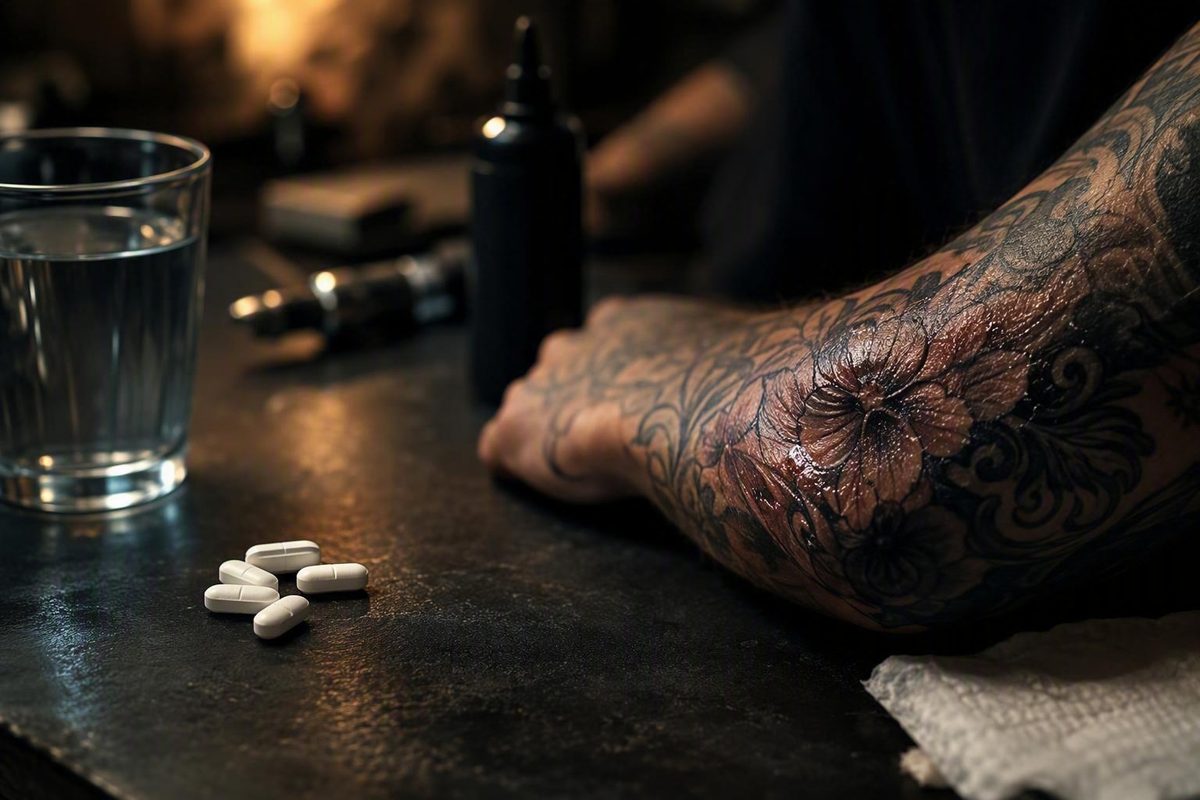
You may be able to take ibuprofen after a tattoo if you normally tolerate it, but studio aftercare advice is not medical clearance. The clinical drug references reviewed for this article do not give a tattoo-specific waiting period, so they do not support a universal rule to wait exactly 24 or 48 hours. MedlinePlus lists the principal precautions and interactions to check.
That is different from the plasma and excess ink commonly seen during early healing. If the area is continuing to lose blood, rather than merely weeping routine healing fluid, ask a pharmacist or clinician before using ibuprofen.
The short answer: sometimes, but there is no proven waiting period
Tattoo-studio practice is not uniform. Tattoo Workshop’s aftercare guidance says people who are able to take ibuprofen may use it to ease swelling after tattooing. It separately mentions paracetamol—called acetaminophen in the United States—for pain.
Another studio is more specific about timing. Vanity Tattoo discusses an NSAID such as ibuprofen when next-day swelling or redness is uncomfortable, particularly after a larger tattoo. Neither studio provides a complete medical screening process, dosage schedule, or assessment of pregnancy, bleeding risk, kidney disease, ulcers, allergies, or medicine interactions.
These pages show that some studios permit ibuprofen after tattooing. They do not establish that it is safe for every person or that next-day use is the only appropriate approach.
The official drug references reviewed here explain ibuprofen’s general uses, contraindications, and risks, but they do not address fresh tattoos, immediate post-session use, or a mandatory waiting period. The evidence therefore does not justify telling everyone to wait exactly 24 or 48 hours—or assuring everyone that immediate use is safe.
If your tattoo is bleeding substantially, the dressing is repeatedly filling with blood, or bleeding is not settling, do not use a generic online timing rule. Ask a pharmacist or clinician whether ibuprofen is appropriate, especially if you take an anticoagulant or have a bleeding disorder.
Use this decision checklist before taking ibuprofen
The clinical checks below reflect the general ibuprofen precautions in MedlinePlus drug information. They are not tattoo-specific dosing instructions.
| Situation | Practical action | Reason |
|---|---|---|
| You normally tolerate ibuprofen and have routine next-day soreness or swelling | Check the exact OTC label and your other medicines, then use only as directed | Some studios permit it for swelling, but that is not personal medical clearance |
| The tattoo is bleeding substantially or persistently | Ask a pharmacist or clinician instead of relying on a waiting period | The reviewed sources do not establish safe tattoo-specific timing in this situation |
| You have had a stomach ulcer or gastrointestinal bleed, kidney disease, significant heart disease, a bleeding disorder, NSAID-sensitive asthma, or a reaction to aspirin or another NSAID | Obtain professional advice before taking ibuprofen | These conditions can make ibuprofen unsuitable or increase the risk of serious adverse effects |
| You are pregnant | Check with a clinician or pharmacist before use; do not use ibuprofen at or after 20 weeks unless a clinician directs you to | Pregnancy changes the medicine’s risk profile, and the stronger restriction from 20 weeks should not be interpreted as automatic clearance earlier in pregnancy |
| You take an anticoagulant, aspirin, naproxen or another NSAID, an oral corticosteroid, an SSRI, or an SNRI | Check with a pharmacist or clinician before adding ibuprofen | These combinations can increase gastrointestinal bleeding or other adverse-effect risks |
| A cold, flu, headache, menstrual, or combination pain product already contains ibuprofen | Do not add a separate ibuprofen product | Duplicate ingredients can lead to accidental overuse |
| Redness, pain, heat, or swelling is worsening or spreading, or you have pus, fever, swollen lymph nodes, or red streaks | Seek medical assessment rather than treating only the discomfort | These changes may indicate a complication that requires diagnosis and treatment |
Follow the package directions on the exact over-the-counter product you have. Do not adapt a prescription-strength schedule for tattoo soreness, and do not assume that instructions for somebody else’s product apply to yours.
Use the lowest effective dose for the shortest necessary time while remaining within the package directions. Ibuprofen can reduce pain, fever, and inflammation, potentially making those signs less noticeable without addressing their cause; the official prescribing information describes both that masking concern and the lowest-effective-dose principle.
Will ibuprofen make the tattoo bleed or affect the ink?
Ibuprofen is a nonsteroidal anti-inflammatory drug, or NSAID. It relieves pain and reduces inflammation. It can also inhibit platelet aggregation, temporarily affecting one part of the process the body uses to stop bleeding.
Calling ibuprofen simply a “blood thinner” is misleading. Its effect on platelet function is reversible, less pronounced, and shorter-lasting than aspirin’s, according to the official ibuprofen prescribing information. That effect warrants extra caution for someone with substantial active bleeding, a bleeding disorder, or anticoagulant use. It does not prove that ibuprofen will make every fresh tattoo bleed.
The sources reviewed for this article do not establish that ibuprofen causes clinically significant bleeding from a tattoo site. They also do not establish that immediate use is safe when a tattoo is actively bleeding. Both claims would go beyond the available evidence.
Warnings about ulcers and gastrointestinal bleeding refer to bleeding in the digestive tract. Those risks are important when deciding whether to take ibuprofen, but they do not demonstrate that a tattoo itself will bleed.
The reviewed sources likewise do not establish that ibuprofen causes tattoo pigment to fall out, worsens scabbing, delays healing, increases fading, or produces a worse final result. This is a limit of the available evidence, not a guarantee that no effect is possible under any circumstances.
If you notice ordinary plasma mixed with excess ink during early healing, that is not automatically the same as uncontrolled bleeding. Follow your artist’s dressing and washing instructions, but seek medical advice if blood loss is substantial, persistent, or otherwise concerning.
Ibuprofen for swelling versus other options for pain
Ibuprofen has pain-relieving and anti-inflammatory effects, which helps explain why the studio sources mention it when swelling is uncomfortable. Tattoo Workshop separately mentions paracetamol, or acetaminophen, for pain.
That does not prove acetaminophen is categorically safer or better for a fresh tattoo. The medicines have different risks, and the reviewed evidence contains no direct clinical comparison involving people with new tattoos. If ibuprofen may be unsuitable, ask a pharmacist which option fits your health history, current medicines, pregnancy status, and alcohol use.
Avoid taking two ibuprofen-containing products at the same time. Also avoid combining ibuprofen with naproxen or another NSAID unless the applicable labels or a healthcare professional expressly direct you to do so.
Do not assume that all pain-reliever combinations are interchangeable. Some may be appropriate under label or clinician instructions, but the safe choice depends on the active ingredients, doses, timing, and your personal risk factors.
Ibuprofen may make pain, fever, swelling, or inflammation less obvious for a time, but feeling better after a dose does not show that the underlying problem has resolved. Continue to judge the tattoo by its overall appearance and whether the symptoms are improving or worsening.
Know when soreness is no longer routine healing
Some redness, swelling, soreness, plasma, and excess ink can occur during the first few days. The useful distinction is the trend: routine early changes should settle rather than spread or become more severe. The site’s stage-by-stage tattoo healing guide provides general context for early weeping, peeling, scabbing, and surface healing, but it cannot determine whether ibuprofen is medically appropriate for you.
Seek prompt medical assessment for:
-
increasing or spreading redness;
-
unusual or increasing heat;
- pus or thick yellow discharge;
- red streaks extending from the tattoo;
- fever; or
These signs do not diagnose an infection by themselves, but they should not be managed solely by taking pain relief. Do not wait for an arbitrary 48-hour point when symptoms are already severe, spreading, or worsening.
Reduced discomfort after ibuprofen does not rule out infection. A tattoo artist can clarify the dressing, washing, and moisturizing instructions provided for your particular tattoo. A pharmacist can assess medicine interactions, duplicate ingredients, and common contraindications.