
18 min read ·
What Your Tattoo’s Scabs Can Tell You About Healing
Light scabbing can occur during the first two weeks. If redness spreads or pain, heat, swelling, drainage or odor worsen, seek medical care.
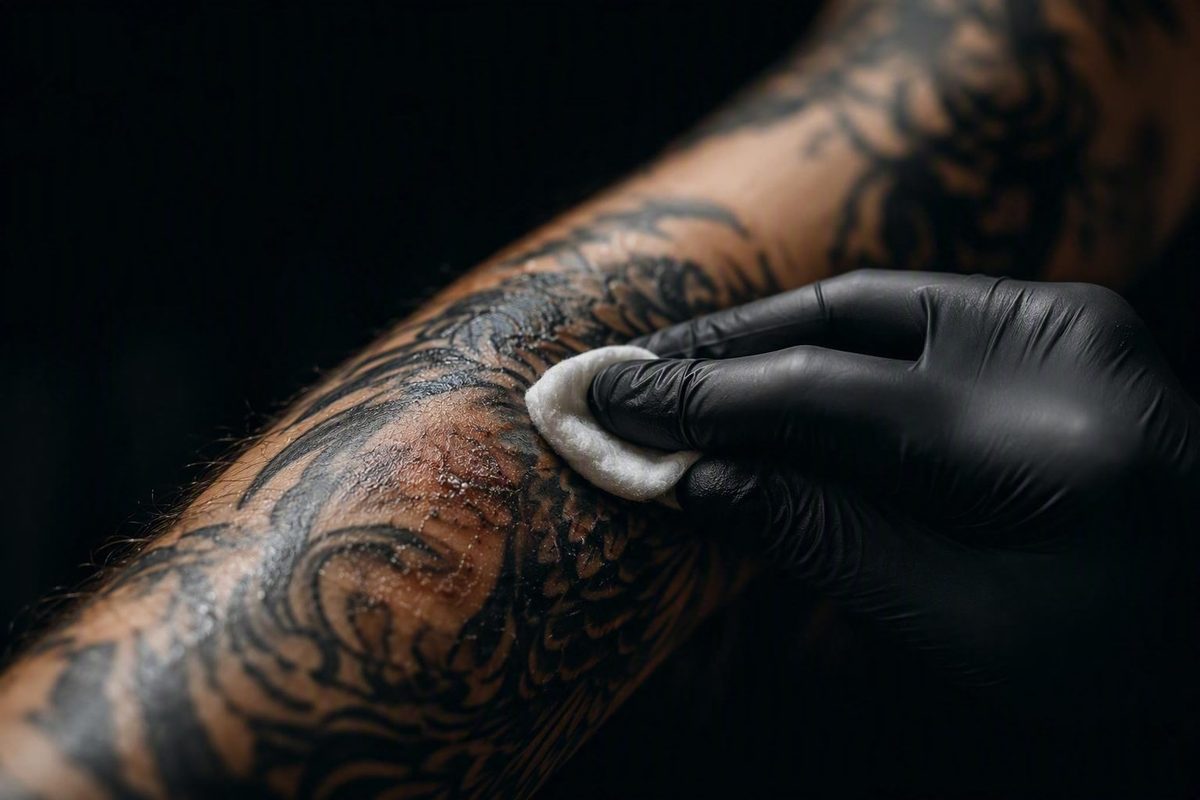
The short answer: light tattoo scabbing is usually normal
Yes. Light tattoo scabbing can be normal during early healing, particularly within the first two weeks. A reassuring scab is usually thin, dry, and relatively even. The skin may feel mildly itchy or tight, but those sensations should gradually settle rather than intensify. UPMC includes itching, flaking, clear oozing, and scabbing among the responses that can occur during the first two weeks after tattooing (UPMC’s guidance on tattoo healing and infection signs).
Not every healthy tattoo develops noticeable scabs. Some move from early tenderness and slight weeping directly into light flaking or peeling. Others form distinct dry patches, especially where the artist applied dense shading or saturated color. Either pattern can be compatible with routine healing.
Scabbing by itself does not establish that a tattoo is infected. The more useful question is whether the tattoo is becoming calmer or moving in the opposite direction.
Signs of an improving pattern include:
- Soreness that decreases from day to day
- Redness that fades instead of expanding
- Swelling that settles
- A surface that becomes drier
- No unusual odor or thick discharge
- Feeling otherwise well
A thin, dry scab on a tattoo that feels calmer each day is generally more reassuring than a wet crust on an increasingly painful tattoo. Likewise, a thicker patch is not automatically infected if it remains dry while tenderness, redness, and swelling steadily improve.
This article provides general information, not a diagnosis. If symptoms are worsening, spreading, or making you feel unwell, seek assessment from a healthcare professional.
Why tattoos scab—and when it commonly happens
Tattooing repeatedly punctures the skin to place pigment. That process causes minor skin trauma, and the body begins repairing the affected area. Clear fluid, excess ink, and a small amount of blood may reach the surface during the earliest stage. As that moisture dries and the skin underneath begins rebuilding, the tattoo may develop flakes, peeling, or an attached crust.
The broad sequence often looks like this:
- Early inflammation: The tattoo may be tender, red, mildly swollen, or warm.
- Early weeping: Small amounts of clear fluid, excess ink, and a little blood may appear on the surface.
- Drying: The surface becomes tighter and less wet.
- Peeling or scabbing: Flakes, thin crusts, and itching may develop.
- Calming: Scabs detach naturally while redness, swelling, and soreness decrease.
These stages can overlap, and a tattoo does not have to form a visible scab to be healing normally. Early warmth, tenderness, localized redness, swelling, and clear weeping may be followed by dryness, itching, and peeling (Club Tattoo’s comparison of healing and infected tattoos).
Scabbing often begins within several days of tattooing and may remain during the first one to two weeks. Published estimates are not entirely consistent: one tattoo studio places typical onset around days three to five and says scabbing may last up to two weeks, while also allowing longer for every scab to finish shedding (Evolve Tattoo Collective’s overview of tattoo scabbing). These are practical estimates rather than universal biological deadlines.
That variation is why a single calendar date cannot determine whether a tattoo is healing well. A dry patch that remains after two weeks but is shrinking and becoming less tender is different from a wet crust accompanied by spreading redness and increasing pain. Direction and severity are more informative than whether every flake disappeared on schedule.
Several factors may affect how much scabbing appears:
- Placement: Bending, pressure, clothing, and repetitive movement may disturb the surface.
- Shading and saturation: Densely worked areas may scab more noticeably than fine linework.
- Technique: The amount and concentration of work in one area can affect irritation.
- Skin characteristics: Dryness, sensitivity, and individual healing responses vary.
- Friction and moisture: Tight clothing, sweating, soaking, and heavy product use can alter the surface.
- Aftercare: Scrubbing, picking, or repeatedly handling the tattoo can interfere with healing.
A thicker dry patch over solid color or dense shading does not automatically indicate a complication. What matters more is whether it remains dry and becomes less inflamed or instead turns wet, painful, foul-smelling, or increasingly swollen.
For a broader view of surface and underlying healing, see the stage-by-stage tattoo healing timeline. Use a timeline for orientation, not as a diagnostic clock.
Normal peeling, dry scabs, and concerning crusts compared
Peeling is not quite the same as scabbing. Peeling usually resembles light, flaky shedding, sometimes similar to skin flaking after a mild sunburn. A scab is more cohesive and attached, forming a distinct crust or raised patch.
A typical healing scab is more likely to be thin, dry, relatively even, and firmly attached. It may temporarily make the tattoo look dull, cloudy, or patchy. Mild itching and tightness can occur, but pain, heat, swelling, and redness should generally be decreasing.
Color alone can be misleading. A dry, pale, or slightly yellow crust may represent dried plasma, particularly early in healing. It should not automatically be labeled pus. By contrast, wet, thick yellow or green material is more concerning when it appears with an unpleasant odor, increasing pain or heat, spreading redness, or worsening swelling. Because visual appearance cannot confirm the cause, treat this as an observational distinction rather than a home diagnostic test (comparison of normal scabbing and possible infection).
| Type of surface change | Appearance | Sensation | Discharge | Trend | Appropriate next step |
|---|---|---|---|---|---|
| Light peeling | Small, thin flakes that resemble dry skin rather than a raised crust | Mild itching or tightness | None, apart from possible minimal clear fluid early on | Flaking decreases while redness and soreness fade | Continue gentle care and let flakes release naturally |
| Typical dry scab | Thin, dry, relatively even, and attached; the tattoo may look temporarily dull | Mild itching, tightness, or low-level tenderness | No active drainage | Becomes less tender and eventually lifts at the edges without force | Protect it from rubbing, wash gently, and do not pick |
| Thicker but improving dry patch | More noticeable crust, often over dense shading or a heavily worked area | Tenderness is stable or decreasing | None | Remains dry and becomes less inflamed | Leave it attached, reduce friction, and monitor the overall trend |
| Possible excess-moisture problem | Soft, swollen, wrinkled, soggy, or gooey surface | May feel overly damp or irritated | Moisture may collect around softened crust | Appears after soaking, heavy product use, or prolonged dampness | Stop soaking, avoid another heavy product layer, and return to light care |
| Concerning crust or drainage | Thick wet crust or white, yellow, or green material, possibly with expanding redness | Increasing pain, heat, throbbing, or swelling | Thick, pus-like, or foul-smelling fluid | Symptoms spread or become more intense | Obtain prompt medical assessment |
Words such as light, heavy, thick, and excessive are subjective. Scab thickness alone cannot establish infection. Surrounding symptoms, drainage, odor, and the direction of change carry more weight.
Consider four practical examples:
1. Thin flakes on day five with fading redness
The tattoo has small dry flakes, feels mildly itchy, and is less sore than it was two days earlier. Redness remains close to the tattoo and is fading. Because scabbing and peeling commonly begin within several days, this pattern is generally compatible with routine healing (Evolve Tattoo Collective’s timing guidance). Continue gentle care and do not help the flakes come away.
2. A thicker patch over dense shading that is becoming less tender
One section has a more substantial dry crust than the surrounding linework. It is not wet or foul-smelling, and the area becomes less tender each day. The patch deserves protection from friction, but its thickness alone does not prove infection. Leave it attached and continue monitoring.
3. Soft or gooey skin after excessive moisture
A previously dry scab becomes swollen and soft after a bath, prolonged sweating, or a heavy layer of lotion. Excess moisture can make scabs swell and appear soft or gooey. Stop soaking the area, do not add another heavy product layer, and return to appropriately light care (Saniderm’s general guidance on tattoo scabbing and excess moisture).
4. Expanding redness with heat and discharge
The red area extends beyond its previous border, the tattoo feels hotter and more painful, and thick discharge appears. This is not a situation in which to wait for the scab to fall off. Obtain prompt healthcare assessment.
A visual check cannot reliably determine whether an inflamed crust or rash is caused by infection, friction, an adhesive, an aftercare product, or a reaction to pigment. If the pattern persists or worsens, professional evaluation is safer than trying to identify the cause at home.
How to care for a scabbing tattoo without disturbing it
Follow the routine aftercare instructions provided by your tattoo artist unless medical warning signs develop or a healthcare professional gives you different advice. The artist knows which dressing was used and can clarify ordinary questions about the tattooing technique and initial care. An artist’s instructions are not a substitute for medical assessment when symptoms suggest infection or a significant reaction.
A simple routine centers on clean hands, gentle washing, careful drying, light moisturizing when needed, and minimal interference.
Wash your hands before touching the tattoo. Avoid repeatedly pressing or testing a scab to see whether it is loose. Unnecessary handling adds friction and may contaminate the area.
Wash gently with lukewarm water and mild, fragrance-free soap. Do not scrub with a washcloth, brush, exfoliating product, or fingernails. Rinse away cleanser without trying to dislodge attached crust.
Pat the tattoo dry. Do not rub it back and forth with a towel. Use clean material that will not snag raised areas, and handle the tattoo as little as possible.
Apply only a light layer of suitable fragrance-free moisturizer when needed. The aim is to reduce uncomfortable dryness without leaving the surface wet, greasy, or smothered. Gentle washing, patting dry, light moisturizing, and allowing scabs to release naturally are widely recommended practical measures (wikiHow’s tattoo-scab care overview).
If product remains visibly thick or the tattoo stays slick for a prolonged period, adding more is unlikely to help. A heavy layer may hold excess moisture against the surface and soften attached crusts. Temporary dullness is common while healing skin and flakes cover the pigment; it is not a reason to keep applying lotion.
Most importantly, allow scabs to detach naturally. Avoid:
- Picking at lifted edges
- Peeling a loose-looking section
- Scratching an itch
- Scrubbing away flakes in the shower
- Rubbing the area with towels
- Deliberately soaking or softening a persistent scab
- Shaving across the healing surface
None of these outcomes is inevitable, but there is no benefit to forcing attached tissue away.
While the tattoo is healing, avoid baths, pools, hot tubs, natural bodies of water, and other prolonged immersion. A brief gentle wash is different from soaking. Also avoid direct sunlight and unnecessary friction; loose physical coverage can help protect the area from sun and rubbing. Studio guidance consistently recommends light moisturizing, loose clothing, and avoiding soaking, friction, and direct sunlight while scabs remain attached (Studio Aureo’s tattoo-scab care guidance).
Loose, breathable clothing can reduce rubbing and make it less likely that a raised scab will catch. Pay attention to seams, waistbands, bra straps, shoes, work equipment, and repetitive movement. Use clean bedding and towels, and handle garments carefully around the tattoo.
They cannot treat an infection. Changing cleanser, lotion, balm, or dressing is not an adequate response to spreading redness, increasing heat or pain, pus-like drainage, red streaks, fever, chills, or feeling systemically unwell.
What to do about thick, wet, cracked, or accidentally removed scabs
An unusual-looking scab does not always require the same response. First consider whether it is dry or wet, whether it was recently soaked or caught on something, and whether the surrounding symptoms are improving.
If the scab is dry but thicker than the others: Leave it alone. Reduce rubbing from clothing and avoid resting pressure on it when practical. Monitor tenderness, redness, swelling, and warmth. A thick patch that remains dry and becomes less tender is generally more reassuring than one that grows wetter or more painful.
If the scab is soft, swollen, or gooey after excess lotion or moisture: Stop soaking the tattoo and do not apply another heavy product layer. Allow the surface to return to an appropriately dry condition while following your artist’s routine instructions. Excess moisture can contribute to a bubbled or softened appearance, but this observation does not rule out a complication if other symptoms are worsening.
If the scab catches on clothing or bedding: Do not deliberately pull it free. Stop dragging the material across the tattoo and carefully remove the source of friction when possible. If the fabric cannot be separated without pulling attached tissue, ask the artist or a healthcare professional for situation-specific advice rather than yanking it away.
If a scab is accidentally removed: With clean hands, gently wash the area using lukewarm water and mild fragrance-free soap, then pat it dry. Do not pick at the exposed area or repeatedly inspect it by touch. Seek professional advice if bleeding persists or the area develops increasing pain, spreading redness, heat, swelling, unusual drainage, or odor. Guidance on tattoo scabs also warns that premature removal may disturb healing skin or pigment and increase infection risk (Saniderm’s general tattoo-scabbing guidance).
Do not assume that accidental removal has permanently damaged the tattoo. It may heal without an obvious problem, or the pigment may eventually look uneven. The final appearance cannot be judged accurately while the surface remains inflamed, scabbed, or peeling.
If scabbing remains beyond roughly two weeks but is dry, shrinking, and clearly improving, ask the tattoo artist whether it appears consistent with ordinary variation for that tattoo. Timing estimates vary, and scabbing lasting longer than an estimate is not automatically evidence of infection. Do not soak, massage, peel, or mechanically remove a persistent scab.
Persistent scabbing needs medical assessment when it is painful, repeatedly bleeding, wet, foul-smelling, or accompanied by worsening redness, swelling, heat, or discharge. The concern is not merely that the scab has lasted longer than expected; it is that the overall pattern is failing to improve.
Scabbing beneath Saniderm or another adhesive film is a separate situation
Guidance for an uncovered tattoo should not automatically be applied to a tattoo beneath adhesive film.
Saniderm distinguishes flaky peeling from raised, heavy scabbing and says that scabbing beneath its tattoo bandage is not expected. Its manufacturer guidance also cautions that removing film across attached scabs may pull them off prematurely and disturb healing tissue or pigment (Saniderm’s guidance on scabbing beneath its bandage).
That statement is specific to Saniderm. It should not be generalized to every transparent adhesive dressing, and it does not mean that ordinary light scabbing on an uncovered tattoo is abnormal.
Follow the instructions for the exact dressing used and the routine guidance provided by your artist. Do not adopt a removal or replacement schedule from another brand or from someone whose tattoo was covered with a different product. Product instructions may also depend on whether the tattoo is still leaking fluid, whether the seal remains intact, and whether the skin shows signs of contamination or a reaction.
If film is attached across a scab, do not abruptly pull it back over the healing tissue. Ask the artist or manufacturer for product-specific removal guidance if routine removal is due and the dressing appears stuck.
Seek professional guidance if:
- The seal breaks or fluid leaks out
- Water or debris appears to have entered
- The dressing looks contaminated
- An expanding rash develops around or beneath the adhesive
- Pain, heat, redness, swelling, odor, or drainage worsens
A compromised dressing may require practical input from the artist or manufacturer. Suspected infection or a significant allergic reaction requires healthcare assessment, not simply a different bandage, balm, or lotion.
When to keep monitoring, contact the artist, or seek medical care
Use three levels of response: continue routine care, contact the tattoo artist about a nonmedical healing question, or obtain prompt medical assessment.
Continue routine care and monitor
Routine monitoring is reasonable when the tattoo has:
- Thin, dry scabs or light peeling
- Mild itching or tightness
- Redness that is fading
- Soreness that is decreasing
- Swelling that is settling
- No unusual odor
- No thick white, yellow, or green discharge
- No new systemic symptoms
Keep the tattoo clean, use moisturizer lightly when needed, avoid soaking and friction, and let attached material release naturally. Compare the tattoo with how it looked and felt the previous day rather than repeatedly inspecting it.
Contact the tattoo artist for nonmedical questions
An artist can help when:
- Dry scabbing is slow but clearly improving
- A heavily shaded area has more crust than the linework
- You are unsure about routine instructions for the dressing used
- Clothing or work conditions are creating friction
- You want to know whether a section was worked more densely
- You are concerned about possible pigment loss after healing
The artist may be able to explain technique-related variation or clarify routine aftercare. Wait until active scabbing and peeling have ended before judging whether the tattoo has lost pigment or may eventually need a touch-up.
Do not ask an artist to diagnose an infection or determine whether a rash is allergic. Those are medical questions for a healthcare professional.
Obtain prompt medical assessment
Seek prompt medical care for:
- Redness that spreads or becomes more intense
- Increasing heat or swelling
- Severe or worsening pain
- Thick white, yellow, or green discharge
- Pus-like fluid or foul odor
- Red streaks extending away from the tattoo
- Fever, chills, sweating, or feeling systemically ill
UPMC advises medical evaluation when tattoo symptoms worsen rather than improve and notes that infection and allergic reactions can have overlapping symptoms. It also identifies trouble breathing, widespread hives, extreme swelling, chest tightness, dizziness, or a rapid heartbeat as possible signs of a severe allergic reaction requiring emergency care (UPMC’s medical guidance on infection and allergic reactions).
Because these conditions may resemble infection, seek professional assessment if the rash persists, expands, becomes painful, or occurs with increasing heat, swelling, or drainage.
A tattoo artist can comment on ordinary healing and product use but cannot replace a clinician when infection, allergy, or systemic illness is suspected.
For a concise daily check, compare these seven features with the previous day:
- Pain: Less, unchanged, or worse?
- Heat: Settling or increasing?
- Redness: Fading, stable, or spreading?
- Swelling: Decreasing or expanding?
- Drainage: Becoming clearer and less abundant, or thicker and more colored?
- Odor: None, or newly unpleasant?
- Overall well-being: Normal, or feverish, chilled, sweaty, dizzy, or unwell?
The reassuring pattern is a tattoo that becomes calmer and drier. The concerning pattern is one that becomes hotter, wetter, more painful, more swollen, or more widespread.
Frequently asked questions
Is it normal if my tattoo does not scab?
Yes. Some normally healing tattoos produce noticeable dry scabs, while others mainly flake or peel. The amount of scabbing can vary with tattoo size, placement, shading, technique, skin characteristics, moisture, friction, aftercare, and individual healing response.
A lack of scabbing is not automatically evidence that the tattoo is healing incorrectly. Focus on the overall direction: decreasing tenderness, fading redness, settling swelling, and no unusual drainage are more useful indicators.
Do not try to make a tattoo scab by drying it excessively or withholding routine care. Follow the instructions for your tattoo and dressing.
How long should tattoo scabs last?
Tattoo scabbing often begins within several days and may be present during the first one to two weeks. Some dry patches can take longer to detach, particularly over densely worked areas or placements exposed to repeated movement and friction. Commercial studio estimates vary, which is why these ranges should be treated as guides rather than deadlines (Studio Aureo’s overview of tattoo-scabbing duration).
A persistent scab that is dry, shrinking, and becoming less tender is less concerning than one that is wet, painful, foul-smelling, or surrounded by worsening inflammation.
If dry scabbing continues beyond roughly two weeks but is clearly improving, ask the tattoo artist about routine variation. Seek medical assessment if it is worsening or accompanied by spreading redness, increasing heat or swelling, unusual discharge, repeated bleeding, fever, chills, or feeling unwell.
Can picking a tattoo scab pull out ink?
Prematurely picking or peeling a scab can disturb healing tissue and may contribute to bleeding, pigment disruption, patchy healing, scarring, or infection. It will not inevitably ruin the tattoo, but there is no benefit to forcing attached material off.
If an edge begins lifting, leave it alone. Do not trim, scratch, or peel it, and handle clothing and towels carefully so they do not catch.
If a scab comes off accidentally, clean the area gently, pat it dry, and monitor it. Do not immediately conclude that the tattoo needs a touch-up; wait until the surface has healed before assessing the result.
Is yellow material on a tattoo dried plasma or pus?
It can be either, and color alone is not enough to tell.
A thin, dry, pale or slightly yellow crust may be dried plasma, particularly early in healing. That interpretation is more reassuring when the tattoo is becoming less sore, less red, and less swollen.
Wet, thick yellow or green discharge is more concerning, especially if it has an unpleasant odor or appears with increasing pain, heat, swelling, or spreading redness. Because appearance alone cannot confirm infection, seek prompt healthcare assessment when those accompanying symptoms occur.
Do not squeeze the area, scrape away the material, or cover possible pus with a heavy layer of aftercare product.
Should I ask my tattoo artist or see a doctor about scabbing?
Ask the tattoo artist about ordinary aftercare, dressing instructions, technique-related differences, dry scabbing that is slow but improving, or possible pigment loss after the tattoo has healed.
See a healthcare professional when symptoms suggest a medical complication: spreading redness, increasing heat or swelling, worsening pain, thick discharge, pus, foul odor, red streaks, persistent bleeding, fever, chills, sweating, or feeling unwell. A persistent or worsening raised rash also deserves clinical assessment because infection, irritation, and allergy can look similar.
For trouble breathing, widespread hives, extreme swelling, chest tightness, dizziness, or a rapid heartbeat, seek emergency care. An artist can help protect a normally healing tattoo but cannot replace a clinician when infection, allergy, or systemic illness is suspected.
A thin, dry scab on a tattoo that feels calmer each day is usually compatible with routine healing. Clean gently, pat dry, moisturize lightly when needed, minimize prolonged moisture and friction, and never force a scab off. If redness spreads or pain, heat, swelling, drainage, odor, or systemic symptoms worsen, obtain prompt healthcare assessment rather than trying additional home aftercare.