
15 min read ·
When to Take Your First Shower Without Soaking a New Tattoo
With artist-approved waterproof film and an intact seal, a brief same-day shower may be permitted. Cling film and gauze use the artist's removal time.
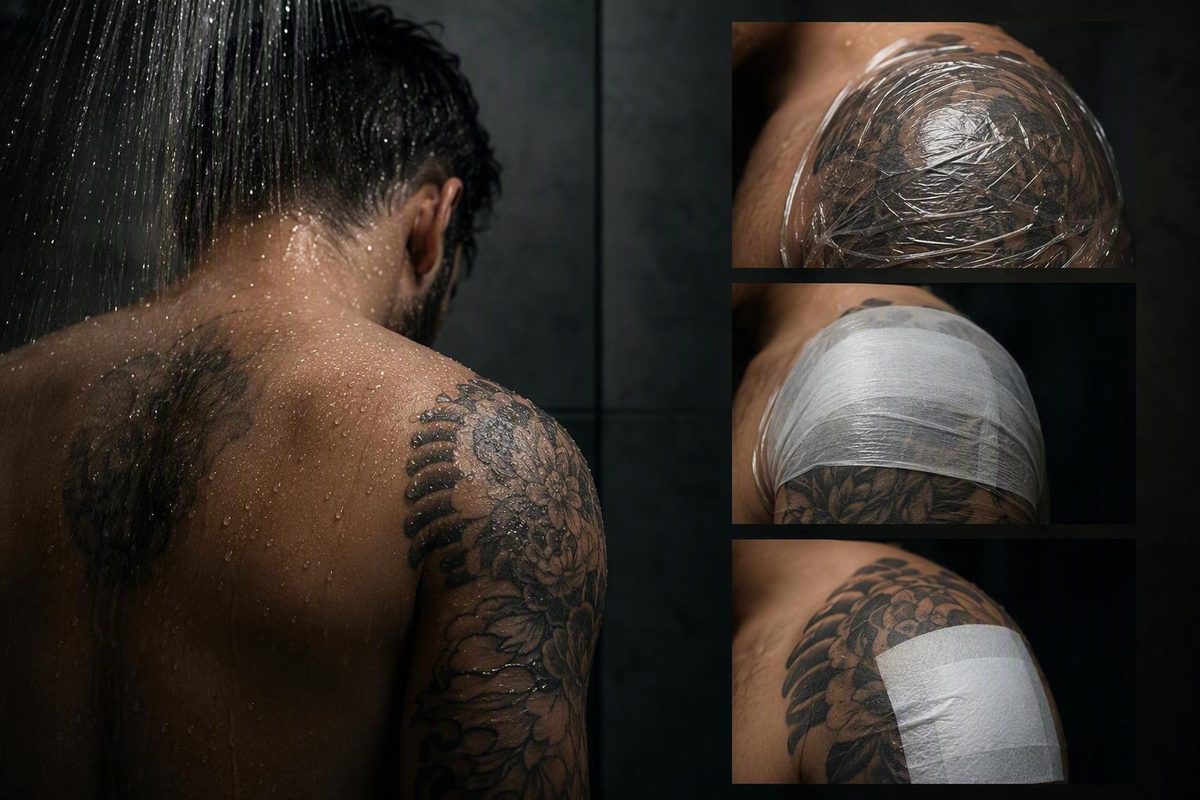
The short answer: base the timing on the covering
How long after a tattoo can you shower? The answer depends on what is covering it:
- Intact waterproof adhesive film: A brief same-day shower may be permitted if your artist identified the film as waterproof, said it could remain on, and the seal is intact.
- Cling film, gauze, or a conventional bandage: Leave it on until the removal time your artist gave you. Remove it as directed, then gently wash the tattoo.
- Uncovered tattoo: Wash it at the time and in the manner your artist specified, using clean hands, lukewarm water, and a mild, fragrance-free cleanser.
There is no well-supported waiting time that applies to every tattoo. The studio and commercial aftercare sources available for this article range from immediate showering with sealed waterproof film to waits of several hours, 12–24 hours, or at least 24 hours. These are practice-based recommendations, not a clinically established universal rule. One studio, for example, allows immediate showering with its specified adhesive film but advises removing a traditional bandage after 1–4 hours before washing in its dressing-specific instructions.
Your artist’s instructions take priority because they know which covering was applied and which removal, washing, or replacement method they intended. Do not substitute a timetable from another studio for the directions attached to your own dressing.
| Tattoo’s current covering | Leave it on? | When showering or washing may begin | Primary precaution |
|---|---|---|---|
| Intact waterproof adhesive film | Yes, if your artist said it should remain in place | A brief same-day shower may be permitted when the specific film is identified as waterproof and remains sealed under studio film guidance | Do not soak it |
| Cling film or plastic wrap | Only for the artist-directed period | Remove it when instructed, then gently wash the tattoo | Do not assume ordinary plastic wrap is a waterproof shower dressing |
| Gauze or another conventional bandage | Keep it on until the artist-directed removal time | Wash after removal unless your artist gave a different method | Do not choose your own removal time or deliberately wet the bandage |
| Uncovered tattoo | Not applicable | At the time your artist instructed | Use clean hands, lukewarm water, and no scrubbing |
Published conventional-bandage schedules vary from a few hours to overnight or longer. Said & Done Tattoo, for example, directs clients to leave a conventional bandage on for the period recommended by the artist—anywhere from several hours to overnight—before removing it and washing gently in its two-method aftercare guide. That variation is why a generic article should not override the schedule you were given.
Permission to shower does not mean permission to soak. A brief shower is short, flowing-water exposure. A bath, pool, hot tub, lake, or ocean involves prolonged or repeated submersion and should be treated as a separate decision.
If you do not know what covering you have, contact the artist before getting it wet. Do not identify it solely by its transparent appearance.
Waterproof film versus conventional wraps
An adhesive “second-skin” style film and an ordinary wrap are not interchangeable.
Tattoo studios commonly allow showering when the particular adhesive film has been identified as waterproof, was applied as intended, and remains sealed. This is studio aftercare practice rather than a universal medical standard. It also does not establish that every transparent film or every application is shower-safe.
Before leaving a covering on in the shower, confirm:
- What your artist called the covering.
- Whether the artist specifically said it could remain on while showering.
- Whether you received product-specific directions.
- How long that particular layer is intended to remain in place.
If an edge has lifted enough to create a path toward the tattoo, the dressing is leaking, or water has entered beneath it, stop treating the film as reliably waterproof. Ask the artist how to handle the specific product rather than improvising a patch, trimming the film, or applying an unapproved replacement.
Cling film, gauze, absorbent pads, and ordinary bandages should not be assumed waterproof. Keep a conventional covering in place only for the artist-directed period. When removal is due, remove it as instructed and gently clean the exposed tattoo.
The amount of time a film is worn is separate from permission to shower while wearing it. Studio schedules differ on when an initial film should be removed, whether it should be replaced, and how long a later layer should stay on. Those schedules cannot be combined into one universal timetable.
Even when a film is described as waterproof, keep shower exposure brief and do not deliberately hold it beneath the spray. Sacred Nine’s instructions permit showering with its specified film but warn that soaking can weaken the adhesive and cause premature detachment under its film aftercare method. In this context, “waterproof” means the properly sealed dressing may tolerate limited shower exposure—not that it is suitable for immersion.
How to take the first shower step by step
A commonly recommended first-shower approach is short, gentle, and consistent with the dressing instructions.
1. Check whether the covering stays on
Before turning on the water, confirm whether your artist told you to:
- Shower with a waterproof film in place.
- Remove a conventional covering before washing.
- Wait until a later removal time.
- Clean the tattoo without taking a full shower.
If the directions are unclear, contact the studio. This is particularly important with adhesive film because removal and replacement routines vary.
2. Prepare clean drying materials
Place a clean disposable paper towel or a freshly cleaned, soft towel within reach. Avoid using a damp, shared household towel that has already been left beside the sink.
If the tattoo will be exposed, wash your hands before touching it. Use your fingertips rather than your fingernails.
3. Use lukewarm water
Choose comfortably lukewarm rather than hot water. A new tattoo may be tender, and hot water can sting or increase irritation. There is no need to rely on claims that hot water “opens pores” or pulls pigment from a tattoo; those explanations are not established by the supplied evidence.
4. Keep the shower brief
Several commercial aftercare sources suggest approximately 5–10 minutes or less than 10 minutes for an early shower. This is a practical studio-style limit, not a medically validated cutoff in Red Baron Ink’s first-shower guidance.
You do not need to rush. The goal is to wash and leave rather than linger in water and steam.
5. Keep strong spray off the tattoo
Do not place an exposed tattoo directly beneath a high-pressure showerhead. Turn your body so the spray lands elsewhere first and water flows gently across the tattoo.
Use the same cautious approach with a covered tattoo. Do not direct a continuous jet at the film or its edges.
6. Clean an exposed tattoo with your fingertips
If the covering is off and your artist’s method calls for washing:
- Wet the tattoo indirectly.
- Apply a small amount of mild, fragrance-free cleanser with clean fingertips.
- Pass your fingertips gently over the area.
- Do not scrub, scratch, or pull at attached skin.
- Rinse away the cleanser thoroughly without prolonged exposure.
The supplied evidence does not establish that antibacterial soap is necessary or superior for every tattoo. Unless your artist or a healthcare professional has told you otherwise, the broader recommendation is a mild, fragrance-free cleanser.
Avoid:
- Washcloths
- Loofahs
- Bath sponges
- Exfoliating gloves
- Scrub brushes
- Body scrubs and exfoliating cleansers
Studio and commercial aftercare instructions discourage these tools because they can be abrasive and may not be clean.
7. Keep other products from sitting on it
Try to prevent shampoo, conditioner, shaving products, hair dye, and fragranced body wash from collecting on the tattoo. If accidental contact occurs, rinse the area gently with lukewarm water. Do not respond by scrubbing or repeatedly washing it.
Where practical, wash your hair first while keeping the tattoo out of the runoff, then clean the tattoo last.
8. Rinse and leave the shower
Rinse away cleanser without keeping the tattoo under the water longer than needed. Once it is clean, finish the shower instead of standing in steam or repeatedly wetting the area.
Recovery Aftercare gives the same general combination of a shower under about 10 minutes, lukewarm water, indirect flow, mild fragrance-free soap, and gentle drying, while describing the timing as artist-dependent rather than universal in its showering instructions.
First-shower checklist
Immediately before getting in, confirm:
- [ ] I know whether the covering stays on or comes off.
- [ ] If it stays on, the specific film was identified as waterproof.
- [ ] The film remains sealed, with no water already underneath it.
- [ ] My hands are clean before touching an exposed tattoo.
- [ ] The water is lukewarm.
- [ ] I will keep the shower brief.
- [ ] Strong spray will not hit the tattoo directly.
- [ ] I have a mild, fragrance-free cleanser if washing is required.
- [ ] I will not use a washcloth, loofah, sponge, or brush.
- [ ] A clean paper towel or clean soft towel is ready.
- [ ] I will not bathe, swim, or otherwise submerge the tattoo.
Drying and caring for the tattoo afterward
For an exposed tattoo, gently pat the area with a clean disposable paper towel or a clean, soft towel. Do not rub it back and forth. If you use a reusable towel, it should be freshly cleaned rather than a shared towel that has been hanging in the bathroom.
After patting, allow the surface to air-dry briefly. It should be dry before you follow the next step in your artist’s routine.
If your artist’s method calls for moisturizer, apply only a thin layer of a mild, fragrance-free product after the skin is dry. Do not assume moisturizer belongs at every stage. Some film-replacement routines require clean, completely dry skin without lotion or ointment beneath the next layer, while traditional uncovered routines may direct clients to use a small amount of moisturizer.
There is no evidence here that a branded cleanser, balm, ointment, or dressing is medically superior. Product-neutral descriptions—such as mild, fragrance-free cleanser or moisturizer—are more useful unless you have been given product-specific directions.
Do not automatically re-bandage an exposed tattoo. Some traditional routines specifically direct clients not to cover it again, while some adhesive-film routines provide for an approved replacement. Reapply a dressing only when that step is part of the artist’s method and consistent with the product instructions.
What to do if the dressing leaks, peels, or gets water underneath it
A waterproof film depends on its seal. If it develops an opening, leaks, or admits shower water, it should no longer be treated as reliably waterproof.
Contact the artist promptly and follow the directions for the particular dressing. Because the evidence pack does not include first-party manufacturer instructions, this article cannot establish a universal removal, patching, or replacement procedure for adhesive films.
Do not simply ignore outside water trapped beneath a compromised dressing. If the artist or applicable product instructions tell you to remove the film, a commonly published studio approach is to:
- Wash your hands.
- Remove the film by the instructed method.
- Clean the tattoo gently with clean fingertips and mild, fragrance-free cleanser.
- Rinse with lukewarm water.
- Pat the tattoo dry.
- Let it dry completely.
- Apply another dressing only if the specified routine permits it.
Do not assume another adhesive film is interchangeable with the one your artist applied.
Fluid beneath a newly applied film does not automatically mean shower water entered. Tattoo Lounge Helsinki’s studio instructions describe blood, plasma, and excess ink collecting beneath an otherwise closed initial film. The same guide advises responding if fluid becomes excessive or the film begins peeling and emphasizes complete drying before any replacement allowed by that studio’s method in its film aftercare instructions.
If an uncovered tattoo receives a brief accidental splash, do not panic or scrub it aggressively. Rinse off any unwanted product gently if necessary, then pat the area dry. Brief wetting is not the same exposure as prolonged submersion.
Ask the artist about:
- Whether the film has lost its seal.
- Whether and when it should be removed.
- Whether the studio’s method allows replacement.
- Whether fluid beneath a sealed film is expected.
- Routine washing, drying, and moisturizing technique.
An artist is the appropriate person for questions about the studio’s dressing method. Symptoms such as worsening or spreading redness, increasing pain or swelling, pus, red streaks, fever, or feeling generally unwell require healthcare assessment rather than repeated changes to soap or dressing technique.
Showering is not the same as soaking or swimming
A short shower and full submersion expose a healing tattoo differently. Even if a dressing is described as waterproof, that should not be interpreted as permission to take a bath, swim, or use a hot tub.
| Activity | Type of exposure | Common aftercare approach during early healing | Main distinction |
|---|---|---|---|
| Brief shower | Short, flowing-water exposure | Often permitted when the dressing instructions allow it | Keep it brief and avoid soaking |
| Long bath | Prolonged submersion | Commonly discouraged while the tattoo is healing | The tattoo or film remains immersed |
| Swimming | Repeated submersion in a pool, lake, or ocean | Commonly discouraged until healing has progressed and the artist’s restriction has passed | Longer exposure in an uncontrolled water environment |
| Hot tub | Prolonged submersion in heated communal water | Commonly discouraged while healing | Combines immersion, heat, and communal water exposure |
The supplied studio and commercial sources recommend waits ranging from about one week to four weeks, while others say to wait until the tattoo is fully healed. The sources are not consistent enough to support one medically established interval. Tattoo Lounge Helsinki’s page, for example, gives different minimum swimming periods in different parts of the same guide, although it consistently distinguishes showering from soaking.
Visible surface healing and the artist’s restriction can be used as conservative practical considerations, but they are not a validated safety test. Do not submerge a tattoo that still has raw areas, drainage, attached scabs, or active peeling. If those changes remain after a generic waiting period has passed, ask the artist or a healthcare professional before returning to the water.
Tattoo-care sources commonly describe surface healing in terms of weeks and deeper skin changes as taking longer. That does not mean ordinary brief showers must be avoided throughout deeper remodeling. For related context—not a rule for determining the hour of your first shower—see the site’s stage-by-stage tattoo healing timeline.
Normal early changes and signs that need medical attention
Studio and artist guidance commonly describes mild early redness, tenderness, swelling, and a small amount of clear fluid. These changes should generally settle rather than spread or intensify.
Arrange prompt healthcare assessment if you develop:
- Redness that is worsening or spreading.
- Increasing pain, heat, or swelling.
- Pus or thick discharge.
- A foul odor.
- Red streaks extending from the tattoo.
- Fever or chills.
- A general feeling of illness.
- A rapidly worsening reaction beneath or around an adhesive film.
Red Baron Ink’s studio guidance lists worsening redness or swelling, unusual pain, pus, streaking, fever, and foul odor as reasons to seek professional help in its aftercare discussion.
Urgent: Spreading redness, fever, red streaks, or pus should not be managed merely by changing soap, balm, moisturizer, or ointment. Seek prompt medical assessment.
Ask the artist about routine dressing use, film replacement, washing technique, and whether fluid beneath a sealed film is typical for the method used. Contact a healthcare professional when infection, a substantial skin reaction, or systemic illness is suspected. An artist can explain aftercare but should not replace medical assessment.
This article provides general information and is not a substitute for individualized medical advice. Tattoo Aftercare Guide also characterizes its aftercare articles as general guidance rather than medical advice in its terms of use.
Frequently asked questions
Can I shower the same day I get a tattoo?
Possibly. A brief same-day shower may be permitted when a film specifically identified as waterproof remains fully sealed and your artist says it can stay on in the shower. This is practice-based advice, not a universal medical rule.
If you have cling film, gauze, or another conventional bandage, keep it on until the artist-directed removal time. Remove it as instructed, then gently wash the tattoo. If the tattoo is uncovered, follow the washing time your artist provided.
Do not assume everyone can shower immediately or that everyone must wait exactly 24 hours.
Can I shower with Saniderm, Second Skin, or another waterproof film on?
You may be able to take a short shower if your artist identified the particular film as waterproof, said it should remain on, and its seal is intact. Keep the exposure brief and do not soak it.
The supplied evidence does not include current first-party instructions from the named manufacturers. Brand recognition alone therefore cannot establish that a particular application is shower-safe. Follow the directions for the product actually used.
What should I do if water gets under the tattoo film?
Treat the seal as compromised and contact the artist. Do not improvise a patch or replacement schedule, and do not assume that every adhesive dressing can be reapplied.
If you are instructed to remove the film, use clean hands, wash the tattoo gently, pat it dry, and allow it to dry completely. Apply another film only when the artist’s method and the applicable product instructions permit it.
How long should my first shower be, and can I use soap?
Several aftercare sources suggest keeping the first shower to approximately 5–10 minutes or less than 10 minutes, but this is a practical recommendation rather than a medically proven cutoff in published commercial aftercare guidance.
Use lukewarm water and keep the tattoo away from strong direct spray. Once the tattoo is meant to be exposed and washed, use clean fingertips and a small amount of mild, fragrance-free cleanser. Rinse thoroughly and do not scrub.
When can I bathe, swim, or use a hot tub after a tattoo?
Do not use a waterproof film as permission to swim, bathe, or use a hot tub. Published studio and commercial recommendations range from roughly one to four weeks or until the tattoo is healed, so the available evidence does not support one universal interval.
As a conservative practical approach, wait until the artist’s restriction has passed and the tattoo no longer has raw areas, drainage, attached scabs, or active peeling. If healing is delayed or you are uncertain, ask a healthcare professional before submerging the area.
Final decision rule: Keep an intact waterproof film on for a brief shower only if the artist and the applicable product instructions permit it. Otherwise, wait until the conventional covering is due to come off, remove it as directed, and wash gently with clean hands, lukewarm water, mild fragrance-free cleanser, and indirect spray before pat-drying. Do not confuse showering with soaking. If redness, pain, swelling, discharge, streaking, fever, or general illness is worsening, seek prompt medical assessment.