
8 min read ·
Why Light Moisturizing Usually Beats Dry Healing a Tattoo
Compare dry healing with light moisturizing, understand how second-skin dressings differ, and recognize tattoo symptoms that need prompt medical attention.
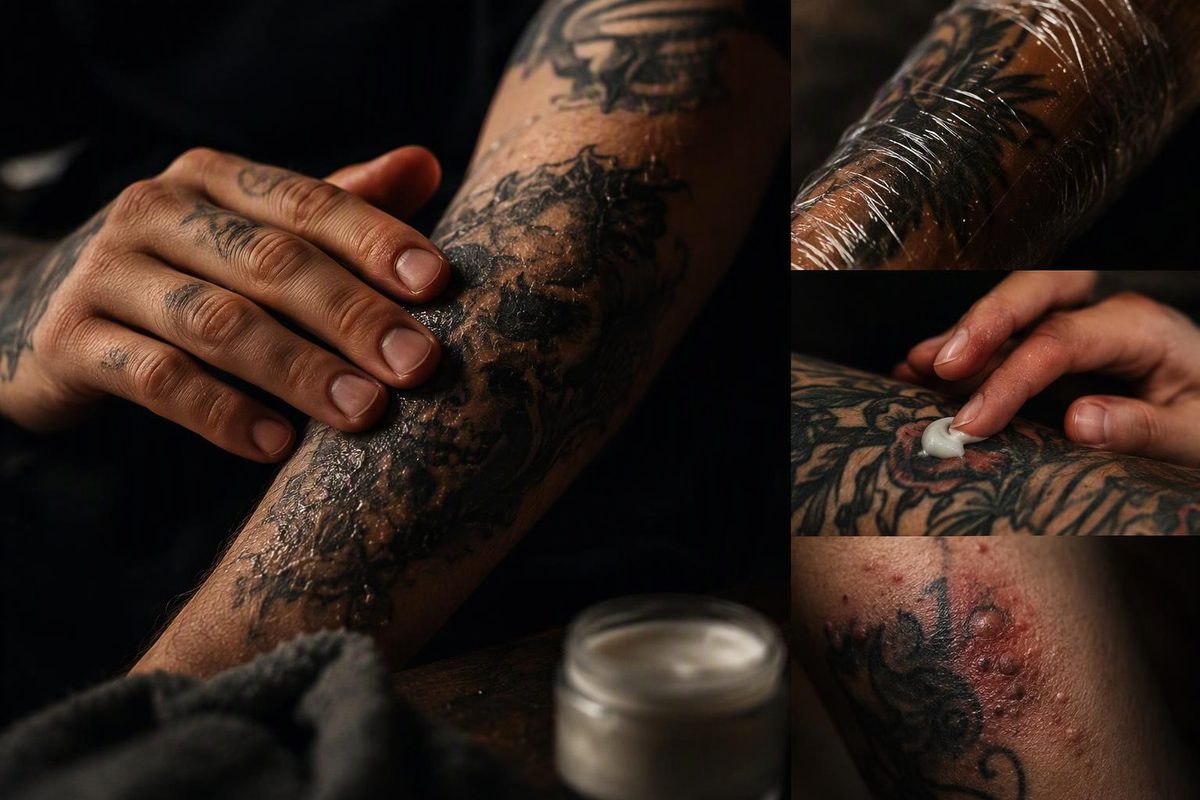
For most people, gentle washing and light moisturizing are a better default than dry healing a tattoo. Dry healing means skipping lotion, cream and ointment after the initial dressing comes off—not skipping washing or protection. Cleveland Clinic’s dermatologist-led guidance recommends a simple moisturizer or recommended ointment twice daily to prevent drying, cracking and bleeding. Follow your particular dressing’s instructions before starting an uncovered-skin routine. Cleveland Clinic’s tattoo aftercare guidance supports this approach.
The choice is not between leaving the tattoo completely alone and keeping it coated in ointment. You can wash gently, use a small amount of a suitable product and leave peeling skin untouched. An adhesive dressing is a separate situation: not putting lotion underneath it does not mean you are dry healing exposed skin.
Choose your dressing status and symptoms to see the appropriate next step.
Choose Your Next Aftercare Step
Wash gently, pat dry and apply a small amount of a suitable fragrance-free moisturizer. Leave flakes alone. Mild peeling does not mean you need thicker layers.
This guide cannot diagnose a tattoo reaction or infection.
How This Decision Works
Possible infection signs take priority over dressing status: seek medical care promptly, ideally the same day. Burning or a new rash after a product calls for stopping that product and asking a healthcare professional for advice.
With an adhesive dressing still on, follow that product’s instructions and your artist’s removal plan. No lotion beneath a dressing is not the same as exposed dry healing. Painful tightness or cracking warrants reviewing the plan rather than deliberately keeping the skin very dry.
If you are unsure when to remove a dressing, confirm the instructions before switching to uncovered care.
Sources: Cleveland Clinic tattoo aftercare; American Academy of Dermatology tattoo-reaction guidance; Saniderm bandage instructions. These support care decisions, not a diagnosis or a universal dressing wear time.
Dry Healing Still Requires Washing and Protection
Healthline describes dry healing as tattoo aftercare without the moisturizing products normally used during healing. The meaningful distinction is what you apply after washing, not whether the tattoo ever gets wet.
Brief, gentle washing is part of caring for the tattoo. Avoiding baths, swimming and hot tubs is different from avoiding all water. Likewise, leaving the tattoo unmoisturized does not remove the need to protect it from rubbing, scratching or direct sunlight.
The term can also hide different instructions. One artist may mean no lotion while an adhesive dressing remains in place. Another may mean avoiding heavy ointment but allowing a light moisturizer. A third may mean using no moisturizing product throughout healing. Those are not interchangeable routines.
Before adopting an artist’s dry-healing instructions, clarify what happens after the dressing comes off. Ask which products, if any, are allowed; whether gentle washing continues; and what to do if the skin becomes painfully tight or cracks. A specific plan is more useful than the instruction to “keep it dry.”
Do not interpret dry healing as a requirement to tolerate worsening symptoms. Painful cracking, a new product-related rash and spreading redness each call for a different response. None is a reason simply to persist with the same routine because it has a name.
Research Does Not Establish That Dry Healing Is Better
There is not a strong basis for promising that skipping moisturizer will heal a tattoo faster or preserve more ink. Tattoo-specific research is limited, and the available evidence does not settle every comparison between aftercare methods.
One small study enrolled 30 people using an aftercare ointment. Healing and comfort results were assessed in 25 people who followed the study instructions. It reported favorable results, but it had no untreated comparison group. That means it cannot establish how moisturizing compares with dry healing. The study describes its design and limitations.
That distinction matters when evaluating claims about a particular balm or routine. Favorable results among people using an ointment do not prove that the ointment is better than every alternative. They also do not show what would have happened if the same participants had skipped moisturizer entirely.
The supplied evidence provides no reliable numerical advantage for dry healing in healing time, ink retention or infection risk. There is no supported percentage or number of days to use when choosing between these routines. Treat claims of guaranteed faster healing or better color retention as unestablished here.
The practical case for light moisturizing is narrower: preventing excessive dryness and helping with comfort. Cleveland Clinic recommends moisturizing to prevent drying, cracking and bleeding, and explains that moisturizing can help ease itching. That supports a gentle routine without requiring a claim that moisturizer eliminates every healing problem.
Tight, Cracked Skin Is Not the Goal
Some itching, flaking and light scabbing can occur during normal healing, including when you use moisturizer. A tattoo does not have to remain perfectly smooth throughout the process. Trying to remove every flake is not a useful measure of successful aftercare.
Excessive dryness is a different concern. Skin that becomes tight, cracked or intensely itchy is harder to leave alone. Picking or scratching scabs can irritate the tattooed area and contribute to infection. Light moisturizing can help with itching, but it does not make scratching or peeling the skin safe.
Use the condition of the skin to distinguish ordinary peeling from a routine that needs attention. Mild flakes that you can leave untouched are not, by themselves, a reason to apply increasingly thick layers. Painful tightness or cracking is a reason to revisit a deliberate no-moisturizer plan with your artist or a healthcare professional.
This is also why “more moisturizer” is not the answer to every symptom. Worsening pain, spreading redness or pus needs medical assessment rather than a thicker application. A new burning sensation or rash after a product calls for stopping that product and seeking advice, not assuming that the tattoo simply needs more of it.
Second Skin Is Not Exposed Dry Healing
Not applying lotion while an adhesive tattoo dressing is in place is not the same as leaving an uncovered tattoo without moisturizer. The dressing manages the environment over the tattoo. The absence of an added cream does not tell you whether the covered skin is dry.
Saniderm, for example, explains that fluid retained beneath its intact bandage helps the skin retain moisture. Saniderm’s instructions on fluid beneath its bandage describe that product-specific method. They do not establish instructions for every adhesive dressing, and they are not a reason to improvise prolonged plastic wrapping.
Follow the directions for the dressing actually on your skin and your artist’s removal plan. Do not borrow a removal schedule or fluid-management instruction from a different product merely because both are called “second skin.” The evidence cited here does not supply a universal wear time for all dressings.
While the dressing is on, use its instructions rather than treating the tattoo as exposed skin. Once it is removed as directed, reassess the uncovered tattoo and follow the appropriate washing and moisturizing routine. Switching between covered care and uncovered care without checking can leave you following instructions intended for the wrong stage.
If symptoms suggest infection, the dressing does not make them irrelevant. Seek medical care rather than waiting for the planned removal day or assuming that everything visible beneath a bandage is normal healing fluid.
A Light-Moisturizing Routine After Dressing Removal
Once the dressing is off according to its instructions, the alternative to dry healing is a simple routine—not a succession of heavy products. The following steps follow Cleveland Clinic’s washing, moisturizing and protection principles.
Wash Gently, Then Pat Dry
Wash your hands before touching the tattoo. Gently wash the area with warm—not hot—water and a mild, fragrance-free cleanser. Do not scrub the tattoo or try to loosen attached flakes. Pat it dry with a clean paper towel.
Washing and soaking are different activities. A brief wash cleans the area without turning aftercare into a bath or swimming session. Choosing dry healing does not change that distinction: the tattoo still needs gentle cleaning, even if you are not applying moisturizer afterward.
Apply a Small Amount to Dry Skin
Once the skin is dry, apply a small amount of a simple, fragrance-free product suitable for your aftercare stage. Healthline’s aftercare guidance recommends a small amount rather than thick layers. Cleveland Clinic recommends a simple moisturizer or recommended ointment twice daily.
These recommendations do not provide a universal measured dose for every tattoo size. There is no supported gram amount in the supplied sources to turn into a dosing calculator. The useful instruction is a light application, using the product and routine recommended for your tattoo rather than repeatedly building up layers.
For product selection, see choosing a tattoo aftercare lotion. Switching away from an irritating formula is a product decision; it does not automatically mean that all moisturizers are unsuitable or that completely dry healing is necessary.
Protect the Skin Without Picking at It
Wear loose, breathable clothing to reduce rubbing. Leave scabs and peeling skin alone rather than pulling them off during washing, drying or moisturizing. Moisturizer is not a tool for forcing flakes to detach.
Avoid soaking and direct sun while the tattoo heals. Baths, swimming and hot tubs are not substitutes for brief washing. Protect the area with suitable clothing rather than applying sunscreen to the fresh wound. These precautions still apply if you choose not to use lotion.
Burning or a New Rash Calls for a Product Review
If a product causes burning or a new rash, stop using it and ask a healthcare professional for advice. Do not layer another product on top in an attempt to cancel out the reaction. The American Academy of Dermatology recommends assessment for skin reactions.
Avoiding one irritating formula does not require committing to completely dry healing. The immediate decision is to stop the suspected product and get advice about the reaction. Whether a different moisturizer is appropriate comes afterward; the information here cannot identify the cause of a rash or select a replacement from symptoms alone.
Tell the healthcare professional which product you used and what changed after applying it. Keep the distinction between product-related irritation and possible infection in view: a new rash deserves advice, while spreading redness, worsening pain or systemic symptoms need prompt medical attention.
If your artist recommended dry healing because you previously reacted to an aftercare product, clarify whether the concern was that particular formula or all moisturizing products. Do not turn a product-specific problem into a broader rule without checking.
Spreading Redness and Worsening Pain Need Medical Care
Mild itching, flaking and some scabbing can be normal. Seek medical care promptly—ideally the same day—if redness spreads or darkens, pain worsens, or you develop pus, open sores, fever or chills. The American Academy of Dermatology’s tattoo-reaction guidance recommends seeing a doctor right away for possible tattoo infection.
Do not try to treat those signs by changing moisturizer alone. Skipping lotion, adding ointment or returning to an earlier dressing routine does not replace medical assessment. An artist can clarify aftercare instructions, but suspected infection needs a healthcare professional.
The distinction is not simply “wet versus dry.” A tattoo with ordinary flakes may need routine care and protection from picking. A painfully tight tattoo may need its aftercare plan reviewed. A tattoo with worsening pain or spreading redness needs a different level of attention, regardless of which healing method you chose.
For a closer comparison, see normal healing versus infection signs. Use that comparison to recognize concerning changes, not to delay care when the warning signs above are present.