
10 min read ·
What a Sterile Ink Label Really Tells You
See what sterile-label testing found in unopened tattoo ink, why contamination is not an infection rate, and which healing signs call for medical care.
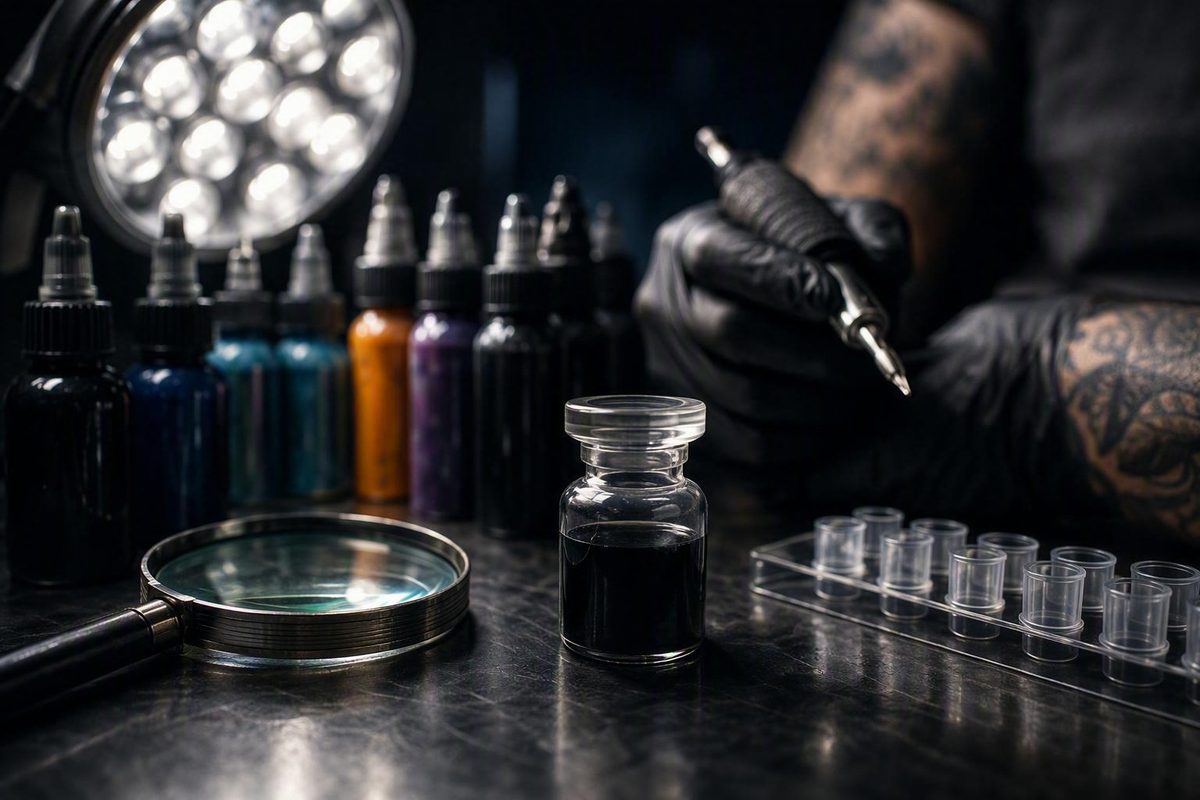
No. A sterile label does not guarantee that a bottle of tattoo ink contains no viable microorganisms. In pooled FDA research, bacteria grew from 30.5% of sterile-labeled unopened inks, compared with 35.5% of unlabeled inks. The difference barely changes the practical decision: the label is one assurance, but traceable ink handling and vigilance during healing matter more.
Choose the ink category, label claim and healing signs that apply; the explorer shows what the research can—and cannot—tell you.
The explorer reports only published figures supplied by the studies. A dash means no subgroup percentage was provided; it does not mean zero contamination.
This is a pooled research result, not a prediction for a bottle purchased today.
| Selection | Samples | Measured Result | Meaning |
|---|---|---|---|
| All products pooled | 259 | 35.4% contaminated; 95% CI 21.6%–49.1% | Four surveys; tattoo and PMU products combined |
| Sterile-labeled | 118 | 30.5% contaminated | The wording was not a bottle-level guarantee |
| No sterile label | — | 35.5% contaminated | Sample count was not supplied in the brief |
| Tattoo ink | — | ~33% contaminated | Approximate category-specific rate |
| Permanent-makeup ink | — | ~33% contaminated | Approximate category-specific rate |
| US versus imported | — | — | No subgroup percentage supplied; no significant association reported |
| Separate aerobic/anaerobic study | 75 | 26 samples positive | 34 isolates, 14 genera and 22 species |
Sources: Scientific Reports retrospective analysis, DOI 10.1038/s41598-026-65785-x; sterile-label subset as reported by ScienceAlert; separate 75-sample study indexed by PubMed. Contamination findings are not infection rates.
A Sterile Label Is a Claim, Not a Bottle-Level Test
Tattoo ink is deposited into the dermis, so microbial control matters. The FDA says these inks should be manufactured to be free of viable microorganisms and that final-product sterility testing can help protect consumers. It has also documented contamination-related alerts and recalls involving commercially distributed inks. The FDA’s tattoo and permanent-makeup overview explains its expectations and regulatory role.
The word sterile describes an intended microbial state: free of viable microorganisms. A sterile label represents the manufacturer’s claim that the product has that state. It is not independent test evidence for the individual bottle in front of an artist.
A sterilized claim describes a process rather than a test result. Its strength depends on whether the process was validated, critical conditions were monitored, the production environment was controlled, packaging integrity was assessed and continuing quality checks supported its performance.
A validated process provides meaningful assurance under defined conditions. It does not establish absolute certainty about every unit after filling, distribution, storage and handling.
A laboratory-confirmed contamination result is narrower: a test detected microorganisms in the sample examined under the methods and conditions used. A negative result is also limited. “Not detected” does not mean that every possible microorganism was absent under every possible test condition.
These concepts should remain separate:
- A sterile label states the manufacturer’s claim.
- A validated process supports the reliability of a manufacturing control.
- A laboratory result describes one tested sample.
- A clinically proven ink-related infection connects a patient’s illness to a specific exposure.
Finding bacteria in one bottle does not establish the condition of every bottle in its lot. Finding bacteria in ink also does not, by itself, prove that the ink caused a recipient’s infection.
An intact seal answers only whether the bottle appears unopened. It cannot establish that the contents were contamination-free before filling or that package integrity was preserved throughout shipping and storage. The FDA expressly warns that sealed packaging and sterile wording do not guarantee microorganism-free ink in its consumer tattoo-safety guidance.
Normal color, consistency and smell cannot establish sterility either. Nor can a familiar brand, country of origin, premium price, future expiration date or reassuring package language. Visible damage can provide a reason to reject a bottle, but a normal appearance cannot clear it as contamination-free.
Unopened Inks Tested Positive Regardless of Label Claim
The strongest current evidence is a retrospective analysis of four FDA surveys covering 259 unopened tattoo and permanent-makeup products collected in the United States over the preceding decade.
The pooled bacterial-contamination prevalence was 35.4%, with a 95% confidence interval of 21.6% to 49.1%. Category-specific rates were approximately 33% for both conventional tattoo ink and permanent-makeup ink. Nearly one-third of products carrying sterile claims contained microorganisms, and contamination was not significantly associated with a sterility claim.
Secondary reporting supplied the more precise sterile-label comparison: among 118 sterile-labeled samples, 30.5% contained culturable bacteria, compared with 35.5% of products without that wording. The peer-reviewed analysis appears in Scientific Reports.
Those percentages describe the selected products and culture conditions used in the research. They are not a current market-wide forecast for any bottle bought today.
The analysis combined products from several collection periods and included both body-art and permanent-makeup inks. The brands, lots and purchasing channels may not represent the entire present market. Culture methods recover organisms capable of growing under the chosen conditions and may not reveal every viable microorganism.
The confidence interval around the pooled estimate also reflects substantial statistical uncertainty. The result should not be converted into a claim that exactly one-third of all tattoo ink worldwide is contaminated.
A separate investigation tested 75 commercial tattoo and permanent-makeup ink samples for aerobic and anaerobic bacteria. Bacteria were detected in 26 samples. Researchers recovered 34 isolates representing 14 genera and 22 species, and found no significant association between a label’s sterility claim and the absence of contamination. The study is indexed by PubMed.
That investigation used methods from the FDA’s Bacteriological Analytical Manual together with 16S rRNA gene sequencing. It recovered organisms that grow in the presence of oxygen and organisms capable of growing without it.
Neither investigation was a random census of every brand and bottle. Complete brand, batch and lot information was not supplied for every sample in the available abstracts, and recipients were not followed to determine how often a positive ink sample resulted in illness.
Even with those limitations, the central finding is clear: viable bacteria can be present in unopened commercial ink, and sterile wording did not reliably identify contamination-free samples.
Contamination Percentages Are Not Infection Rates
In the retrospective analysis, Bacillus species were isolated most often, followed by organisms in the Pseudomonas, Staphylococcus and Lysinibacillus genera. The authors described some isolates, including Pseudomonas putida and Alcaligenes faecalis, as opportunistic organisms with documented links to human infections.
The 75-sample investigation recovered bacteria under anaerobic conditions, including Cutibacterium acnes and Staphylococcus epidermidis. Nineteen of its 34 isolates were classified as possibly pathogenic strains.
“Possibly pathogenic” or “opportunistic” does not mean an organism causes disease every time someone encounters it. The research did not establish the microbial dose required to cause infection, whether every contaminated product was used or whether recipients received a clinically meaningful exposure.
The reported contamination percentages therefore are not infection rates. The studies do not show that roughly one-third of tattoos become infected. They identify a potential exposure route and a product-control failure, not a corresponding rate of patient illness.
Connecting an infection to ink can require clinical assessment, patient testing, product testing, lot records and epidemiological evidence. A positive result from a research bottle cannot establish what caused another person’s redness, drainage or fever.
Contamination Can Precede Opening or Happen in the Studio
Finding bacteria in an unopened bottle establishes that contamination can exist before an artist breaks the seal. It does not identify precisely where the organisms entered.
Potential points include pigment and ingredient handling, preparation, mixing, dilution, processing, filling, capping, packaging, distribution and storage. Loss of package integrity is another possibility. These are possible stages, not findings that assign blame to a particular manufacturer, distributor or studio.
Water is one recognized concern. The FDA says using non-sterile water to dilute pigments is a common, though not exclusive, contamination source. The agency distinguishes contamination already present in a product from infection risks created by non-sterile equipment or unhygienic tattooing practices.
After a bottle is opened, its tip can contact gloves, caps, skin or work surfaces. A non-sterile liquid may be added, or unused ink may be returned from a cap. These handling failures can introduce contamination even when the original product was appropriately manufactured.
That creates two separate safety barriers. Product control covers ingredients, processing, filling, packaging, storage and distribution. Procedural control covers dilution, dispensing, handling and application inside the studio.
Neither barrier replaces the other. Clean technique cannot neutralize organisms already inside a sealed bottle. Properly manufactured ink cannot compensate for contaminated equipment or poor handling.
FDA Oversight Is Not Bottle-by-Bottle Certification
In the United States, tattoo and permanent-makeup inks fall within the definition of cosmetics under the Federal Food, Drug, and Cosmetic Act. Tattooing procedures and many parlor-safety requirements are generally overseen by state or local authorities. Federal product oversight and local procedure oversight are therefore distinct.
Manufacturers and distributors remain responsible for the safety of the inks they sell. FDA oversight does not mean the agency independently tests, approves or certifies every bottle, lot or sterile claim before sale.
The FDA provides laboratory methods for sterility testing and detecting nontuberculous mycobacteria in tattoo ink. It has also issued guidance addressing insanitary conditions during preparation, packing and holding that may cause microbial contamination. Guidance expresses agency recommendations and regulatory thinking; it should not be treated as proof that every marketed bottle satisfied an independently verified sterility standard.
The agency lists contamination-related tattoo-ink alerts or recalls from 2011, 2012, 2014, 2017 and 2019. That history shows that contamination is a recurring product-safety problem rather than a purely theoretical one.
A separate pigment issue is often confused with sterility: no color additives are FDA-approved for injection into the skin. That statement concerns the regulatory status and intended use of color additives. It does not establish whether a particular bottle contains microorganisms.
Traceability and Handling Carry More Weight Than Label Wording
An artist cannot verify sterility by inspecting a bottle. The useful checks are the ones that reduce exposure opportunities and preserve enough information to respond if a product is recalled or a client becomes ill.
Artists should buy through traceable supply channels and record the brand, color, batch and lot used for each client. Official FDA and manufacturer alerts should be checked against those records. Recalled products should be removed from active stock and handled according to the applicable recall or disposal instructions.
Broken seals, leakage, swelling, unexplained deposits, altered consistency or suspicious labeling are reasons to reject a bottle. Storage instructions and expiration dates should be observed, although an intact bottle within its stated date still is not proven sterile.
For each appointment, ink should be dispensed into clean, single-use caps. The bottle tip should not touch gloves, caps, skin or work surfaces, and unused ink should never be returned to the original container. When dilution is required, an appropriate sterile diluent should be used rather than tap water or another non-sterile liquid.
Clean supplies also need separation from used equipment and the active work area. Use should stop when a product’s identity, storage history or package integrity is uncertain.
A client can ask where the studio buys its ink, whether it records lot numbers, how it checks recalls, how ink is dispensed and what is used for dilution. Ask whether unused ink is discarded and whether the studio could identify the exact products used if a health concern arose later.
Good answers do not prove that an individual bottle is sterile. They show whether the studio treats ink safety as a traceable process rather than relying on package wording.
The evidence does not support ranking brands, colors, countries or sterilization methods. The studies found that sterility claims and origin did not reliably distinguish contaminated from uncontaminated samples, but they did not establish a defensible safety league table.
Spreading Redness, Pus, Fever or Red Streaking Need Medical Review
A healing problem does not automatically mean contaminated ink was used. The condition of the studio, equipment, aftercare and the person’s health can also matter, and some changes are part of healing.
As a precautionary site rule rather than an individual diagnosis, spreading redness, pus, fever or red streaking should prompt medical evaluation instead of experimentation with another ointment. This guidance is subject to the site’s general-information and medical-advice disclaimer.
Tell the clinician when the tattoo was performed, how the symptoms developed and what products were applied afterward. If available, provide the studio’s name and the ink’s brand, color, batch or lot information. Those details may be useful to a clinician, public-health authority or regulator if contaminated ink is suspected.
Do not try to culture ink or drainage at home, and do not assume the bottle caused the problem. Traceability makes an investigation possible; it does not prove causation.
For the expected progression rather than contamination specifically, use How Long a Tattoo Takes to Heal and What Slows It.
A Sealed Bottle Can Still Contain Bacteria
Researchers recovered bacteria from unopened tattoo and permanent-makeup inks, including products with sterile claims. A seal indicates that a container appears not to have been opened. It does not prove the contents were contamination-free before sealing or remained protected throughout distribution.
This does not mean every sealed bottle is contaminated. Many tested products did not yield detectable bacteria. The evidence means that sealed packaging and sterile wording cannot substitute for manufacturing controls and appropriate microbial testing.
The practical verdict is narrow but firm: sterile tattoo ink is intended to contain no viable microorganisms, yet the word on the bottle cannot establish the condition of that bottle. Product traceability, recall checks, hygienic dispensing and prompt attention to concerning healing signs provide more useful protection than treating the label as a guarantee.