
15 min read ·
When to Unwrap a New Tattoo—and What to Do Next
Ordinary cling film usually comes off after 2-4 hours. Multi-day methods change the film or use adhesive second skin, rather than leaving the original untouched.
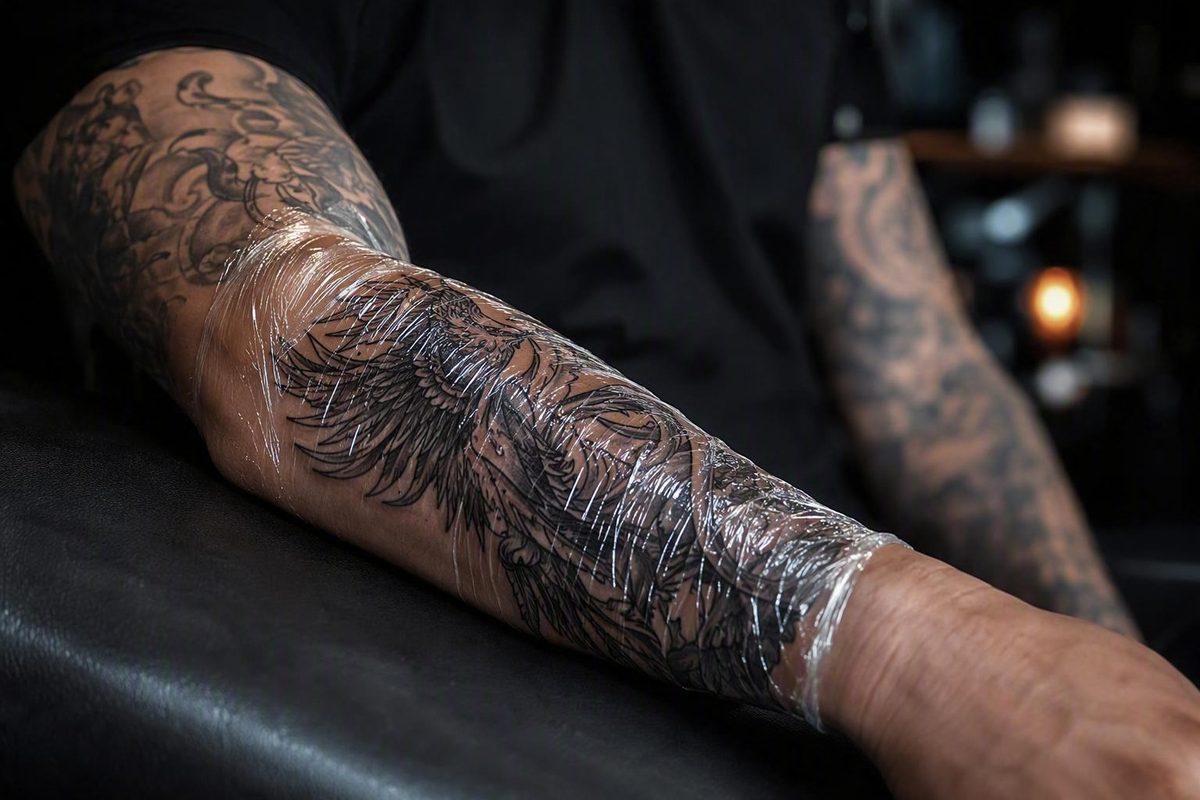
The short answer: ordinary cling film usually comes off after 2–4 hours
If your tattoo is covered with ordinary cling film—the loose plastic wrap commonly used in kitchens—a practical default is to remove it after about 2–4 hours. This is common tattoo-industry guidance, not a clinically established limit that applies to every person or tattoo. Mantra Tattoo & Piercing recommends approximately 2–4 hours for ordinary cling film.
Practitioner instructions are not completely consistent. Tattoo Lounge Helsinki recommends two to three hours, while Canggu Ink Club recommends removing ordinary plastic wrap within a maximum of one hour in its hot, humid setting. Taken together, the supplied studio guidance spans roughly one to four hours rather than establishing one exact universal cutoff. Canggu Ink Club explains its one-hour, climate-specific protocol.
Use this decision order:
- Identify the covering. Is it loose ordinary cling film or a self-adhesive tattoo dressing?
- Check your artist’s written instructions. Follow them when they clearly match the covering used.
- If it is ordinary cling film and no special method was prescribed, use about 2–4 hours as the common practitioner default.
- If you cannot identify the covering, call the studio before applying a generic timeline.
Your artist knows what material was applied and whether the intended method involves short-term coverage, a fresh first-night rewrap, a managed wet-healing routine, or an adhesive second-skin dressing. Clear, covering-specific instructions from the treating artist should therefore take priority over a general online timeline.
Most importantly, do not interpret the original piece of ordinary cling film as a multi-day dressing. Even protocols that use plastic wrap for more than one day require the film to be removed repeatedly, followed by cleaning, complete drying, and application of a new piece. They do not mean leaving the original sheet untouched for two or three days.
If the covering is tightly adhered to the skin around the tattoo, the two-to-four-hour default may not apply. It could be an adhesive second-skin dressing intended for longer wear. Contact the studio if you are unsure what was used.
First identify the covering: cling film is not second skin
“Tattoo wrap” can refer to two very different materials. Confusing them can lead you to remove a purpose-made dressing too soon or leave ordinary plastic on much longer than your artist intended.
Ordinary cling film is loose, flexible plastic placed over the finished tattoo and sometimes secured around the area. It does not create its own adhesive seal against the surrounding skin. Studios generally use it as short-term protection immediately after the appointment.
Second skin is a thin, self-adhesive film that sticks directly to the skin around the tattoo. Saniderm and Tegaderm are familiar examples, but brand names should not be treated as interchangeable instructions. Products and artist protocols may have different application, replacement, and removal schedules.
| Feature | Ordinary cling film | Adhesive second skin |
|---|---|---|
| Material | Loose household-style plastic wrap | Purpose-made self-adhesive film or transparent dressing |
| How it attaches | Sits over the tattoo and may be secured separately | Adheres directly to the surrounding skin |
| Typical immediate purpose | Short-term coverage after the tattoo session | Sealed coverage during an initial healing period |
| Initial wear approach | Commonly removed after a few hours unless another method was prescribed | Usually worn substantially longer according to product- and artist-specific instructions |
| Reapplication | Use fresh film only if the artist prescribed rewrapping | Replacement depends on the particular dressing and protocol |
| When uncertain | Call the studio before choosing a removal time | Call the studio rather than guessing or attempting an improvised repair |
The two-to-four-hour default applies to ordinary cling film, not adhesive second skin.
Supplied practitioner recommendations for adhesive film range from an initial period of about 24 hours to several days. Tattoo Lounge Helsinki, for example, advises keeping its initial second-skin layer for 24 hours before following a replacement schedule, while distinguishing that routine from its two-to-three-hour cling-film instructions. Its aftercare guide gives separate schedules for cling film and self-adhesive second skin.
Because the studio instructions vary and the evidence pack does not include manufacturer directions, there is no universal second-skin duration here. Follow your artist’s instructions and the directions for the specific dressing where available.
Contact the studio promptly if an adhesive dressing:
- leaks;
- peels enough to expose the tattoo;
- traps shower or bath water;
- develops a broken seal;
- causes significant irritation; or
- cannot be confidently identified.
Do not assume that a failing adhesive dressing can be managed by adding ordinary cling film or household tape. Ask the treating studio for product-specific instructions instead.
Why wrapping instructions range from a few hours to several days
Apparently contradictory advice becomes easier to understand when it is separated into three pathways.
1. Short-term ordinary cling film
In this approach, the initial film protects the tattoo during the trip home and for the first few hours. The wearer then removes it, washes and dries the tattoo, and does not routinely rewrap it.
This is the pathway behind the common two-to-four-hour answer. Some studios recommend a shorter period, while others use two to three hours. These differences reflect practitioner protocols, not proof that one precise minute marks a universal safety threshold.
2. An artist-directed first-night rewrap or wet-healing method
Some artists permit one fresh piece of plastic wrap for the first night. Others prescribe a more intensive wet-healing routine involving fresh film for two or three days.
A multi-day wet-healing method does not mean wearing the original film continuously. One individual artist’s less conventional protocol calls for removing the initial bandage after three to four hours, washing the tattoo, allowing it to air-dry for 15 minutes, and applying fresh plastic. The tattoo is then washed and rewrapped every four to six hours and after sweating for a total of approximately 48–72 hours. James Hall Creative describes this repeated cleaning, complete drying, and replacement routine.
That artist presents wet healing as an option particularly for some larger, heavily worked, awkwardly placed, or clothing-covered tattoos. These characteristics may influence an artist’s choice, but they are not universal eligibility rules. A large tattoo does not automatically require multi-day plastic wrapping, and a small tattoo does not establish that such a method is appropriate.
3. Adhesive second skin
Second skin follows a different protocol because it adheres around the tattoo rather than sitting over it as loose plastic. Its longer wear schedule must not be transferred to ordinary cling film.
This difference often explains online advice to “leave the wrap on for three days.” The person giving that advice may mean a sealed adhesive dressing while the reader assumes they mean household plastic. Always identify the material before following a duration.
Why an artist might choose one method over another
Practitioners may consider:
- tattoo size and how heavily the area was worked;
- body placement;
- likely contact with clothing;
- pressure during sleep;
- the wearer’s work environment;
- sweating and exercise;
- heat and humidity;
- fluid collecting beneath the covering; and
- whether the dressing can maintain its intended position or seal.
These factors provide context but do not prove that rewrapping is necessary. Clothing friction might lead one artist to prescribe a fresh first-night wrap, while another may recommend loose, clean clothing and no plastic.
Brilliance Tattoo illustrates that middle ground. Its studio guidance allows a first-night plastic rewrap when the artist recommends one—generally for certain larger or solid-color tattoos—but otherwise says to leave the tattoo exposed to air and stop wrapping after the first night. The studio makes overnight rewrapping conditional rather than routine.
The available evidence consists mainly of conflicting artist and studio protocols. It does not provide comparative clinical proof that dry healing, wet healing, or second skin produces the best results for every tattoo. The practical aim is not to construct a hybrid from unrelated guides, but to identify and follow the method selected for your covering.
How to remove the wrap and clean the tattoo
When it is time to remove ordinary cling film, prepare before touching the tattoo. Have mild fragrance-free soap and clean paper towel available, and use a reasonably clean area.
Unless your artist gave different covering-specific instructions:
- Wash your hands. Clean them thoroughly before touching the film or tattoo.
- Remove the film gently. Avoid scraping the skin or dragging the dirty outer surface across the tattoo.
- Discard the old film. Do not save, reverse, rinse, or reuse it.
- Wash the tattoo gently. Use lukewarm water and a small amount of mild, fragrance-free soap.
- Use clean fingertips. Avoid abrasive cloths, sponges, brushes, and vigorous rubbing.
- Rinse away the soap. Make sure residue is not left on the area.
- Dry carefully. Pat with clean paper towel rather than rubbing. If your artist’s protocol calls for it, let the tattoo finish air-drying.
- Continue with the prescribed method. Leave it unwrapped unless your artist explicitly instructed you to apply a new covering.
Tattoo Studio Pro’s traditional-plastic instructions likewise call for gentle cleaning with lukewarm water and fragrance-free soap, followed by patting the tattoo dry with clean paper towel. The guide also advises calling the studio before removal if the covering type is uncertain. See its covering-specific first-clean instructions.
Do not try to remove every trace of ink-colored moisture by repeatedly rubbing the skin. Gentle washing is the objective. Avoid using a shared bath towel that may be unclean, shed fibers, or catch against the fresh tattoo.
If your artist prescribed rewrapping, wash and dry the tattoo according to that protocol before applying a new, clean piece. Do not reuse the removed film or casually seal moisture beneath a replacement because you are in a hurry.
If no rewrapping was prescribed, do not automatically apply more kitchen plastic. Leaving the studio under cling film does not mean the tattoo needs to remain under plastic throughout healing.
Moisturizer is a separate decision from film removal. Some artists recommend a small amount after the tattoo is clean and dry; others delay moisturizer or exclude it during a wrapped wet-healing period. Follow the selected method rather than assuming cream is always the next step.
Should you rewrap the tattoo or put cream under the film?
There is no single practitioner consensus on rewrapping. The supplied protocols include:
- no routine rewrapping after the initial film is removed;
- one fresh wrap for the first night;
- replacement film for particular work or clothing situations; and
- frequently changed film for approximately 48–72 hours under an artist-directed wet-healing method.
The best general rule is to follow one coherent method supplied by your artist instead of combining steps from unrelated guides.
For example, do not take the multi-day duration from a wet-healing protocol, the washing routine from a dry-healing protocol, and the cream recommendation from a third artist. Each instruction may have been designed around a different covering and moisture-management approach.
If rewrapping was explicitly prescribed:
- Wash your hands before every change.
- Remove and discard the existing film.
- Wash the tattoo as directed.
- Dry it thoroughly using the prescribed method.
- Apply a new, clean piece of film.
- Change it again at the stated time or after a circumstance identified by the artist, such as sweating.
The schedule of changing film every four to six hours and after sweating belongs to one individual artist’s 48–72-hour wet-healing protocol; it is not the default schedule for every new tattoo.
What about cream beneath cling film?
Practitioner guidance conflicts. In one compilation of tattoo artists’ methods, one artist recommends cream before applying fresh cling film, while another specifically says never to place cream beneath it. The same source reports disagreement over whether to rewrap at all or continue with fresh film for 48 hours to three days. Stories & Ink documents these conflicting artist instructions.
If your artist selected a wrapped method, ask:
- Should anything be applied before the fresh film?
- Which product, if any, should be used?
- Must the tattoo be completely dry first?
- How often should the film be removed and replaced?
Do not improvise by adding cream beneath an occlusive wrap. More product does not necessarily make a protocol better. The supplied evidence also does not establish that cream beneath ordinary plastic prevents infection or that any one wrapping method guarantees better healing.
Can you sleep with cling film on a new tattoo?
The answer depends on the covering and your artist’s method.
For an ordinary short-term cling-film protocol, the original film generally is not intended to remain on overnight. If it has already been in place for the prescribed few hours, do not extend its use simply because you are going to bed.
Some artists permit or prescribe one fresh first-night wrap, particularly for certain larger or solid-color tattoos or for an area likely to press against bedding. Other studios advise against ordinary plastic overnight. Both are established practitioner approaches, but neither is a universal clinical rule.
If your artist prescribed a first-night rewrap:
- remove and discard the original film at the stated time;
- wash the tattoo;
- dry it as instructed;
- apply a new piece rather than reusing the original;
- follow the artist’s directions about cream; and
- remove the replacement in the morning or at the specified time.
A first-night rewrap does not mean stretching the original film’s wear time until morning.
If no overnight wrap was prescribed, reduce unwanted contact without automatically adding plastic:
- sleep on clean bedding;
- wear loose, clean clothing if it does not rub the tattoo;
- choose a position that minimizes direct pressure;
- keep pets away from the tattoo and bedding;
- avoid tight waistbands, cuffs, or seams over the area; and
- keep the room comfortable enough to limit unnecessary sweating.
Heat, humidity, and sweating may increase the moisture accumulating beneath ordinary plastic. This can influence an artist’s recommendation, particularly in a hot climate, but it does not establish a universal medical cutoff.
If the tattoo sticks to clothing or a sheet, do not pull the dry fabric away. Wet the stuck section with lukewarm water and wait until it releases gently. If you have an intact adhesive second-skin dressing instead, follow its separate overnight schedule.
Fluid, loose film, rashes, and signs that need professional attention
A fresh tattoo may release some plasma and excess ink, and studio guidance notes that this material can collect beneath a covering. Appearance alone, however, cannot establish that every type or amount of fluid is harmless.
For ordinary cling film, follow the removal or replacement schedule you were given. Do not leave a dirty, loose, or fluid-filled piece in place indefinitely. If rewrapping was prescribed, remove the old film, clean and dry the tattoo as directed, and apply fresh film.
Cloak & Dagger London treats some plasma and ink beneath cling film as expected within its own multi-day protocol, but says the film should be changed rather than ignored. Its instructions require clean hands, washing, and a new piece at every prescribed replacement. See the studio’s cling-film replacement procedure.
For adhesive second skin, contact the treating artist if it leaks, peels badly, exposes the tattoo, traps external water, or causes notable irritation. Ask for instructions for the specific dressing rather than assuming it should be patched or covered with household plastic.
Do not automatically diagnose a red, itchy, or pimpled rash as “cling-film irritation.” One artist reports excessive moisture as a possible cause of a painful, itchy rash with small pimples, but similar symptoms can have other causes. Persistent, severe, or worsening symptoms may require medical assessment.
It helps to distinguish questions for the studio from symptoms that warrant healthcare advice.
Contact the tattoo studio about:
- what covering was used;
- whether and when to remove it;
- whether rewrapping was intended;
- whether cream belongs in the selected protocol;
- an adhesive dressing that is lifting, leaking, or trapping water; and
- uncertainty about whether the covering is behaving as expected.
Seek prompt medical assessment for spreading or worsening redness, increasing warmth or swelling, pus, foul odor, or increasing discomfort. These signs appear in practitioner warning guidance, although the supplied evidence does not include an independent clinical tattoo-care guideline. Mantra Tattoo & Piercing lists these among warning signs requiring attention.
Spreading redness, fever, red streaking, or pus should prompt same-day medical care, according to Tattoo Aftercare Guide’s general-use notice. The notice also emphasizes that general aftercare information is not medical advice.
This article cannot determine whether a tattoo is infected, whether a rash is an allergic or irritant reaction, or whether fluid beneath a dressing is harmless. Do not rely on a photograph or generic timeline to rule out a problem when symptoms are escalating.
Is three hours long enough to keep cling film on a new tattoo?
Usually, yes. Three hours falls within the common two-to-four-hour practitioner range for ordinary cling film. If your artist gave a different clear instruction for the specific covering used, follow that instead.
Confirm that the material is loose cling film rather than adhesive second skin. Then discard it, wash gently, dry carefully, and rewrap only if instructed.
Can I leave ordinary cling film on my tattoo overnight?
Not by default. Most short-term protocols do not mean leaving the original piece on overnight.
If your artist prescribed a fresh first-night wrap, remove the original film and follow the specified cleaning, drying, replacement, and morning-removal routine. Otherwise, use clean bedding, loose clothing, minimal pressure, and reduced friction.
How often should I change cling film if my artist told me to rewrap?
Use the schedule your artist provided. Protocols range from one fresh first-night covering to repeated replacement during a managed multi-day method.
One less conventional wet-healing schedule requires fresh film every four to six hours and after sweating, but it should not be adopted without the artist’s direction. If your instructions merely say “rewrap” without giving an interval, contact the studio.
Should I put tattoo cream under cling film?
Only if the artist who prescribed the wrapping method specifically told you to do so. Artist guidance conflicts: some protocols include cream, while others prohibit moisturizer beneath the plastic.
Ask which product to use, how much to apply, and whether the tattoo must be completely dry first. Do not invent this step based on an unrelated aftercare routine.
What if I cannot tell whether the covering is cling film or second skin?
Call the studio before using the two-to-four-hour timeline. Describe whether the covering is loose or adhered directly to the skin, how its edges are secured, when it was applied, and whether it is leaking or peeling. A photograph may help the studio identify the material it used.
Do not remove an adhesive dressing merely because ordinary cling film commonly comes off after a few hours. Conversely, do not apply a multi-day second-skin schedule to loose household plastic.
The compact decision rule is this: if it is ordinary cling film and no special protocol was prescribed, remove it after about 2–4 hours, wash gently, and dry carefully. Do not leave the original film unchanged for days, and do not invent a rewrapping or cream routine. Call the studio when the covering or instructions are unclear, and seek medical care for worsening or spreading warning signs.