
18 min read ·
How to Decide Whether Your Fresh Tattoo Is Ready for a Flight
Same-day travel may be manageable when the tattoo is small, protected, in a low-friction location, and not bleeding or swelling substantially.
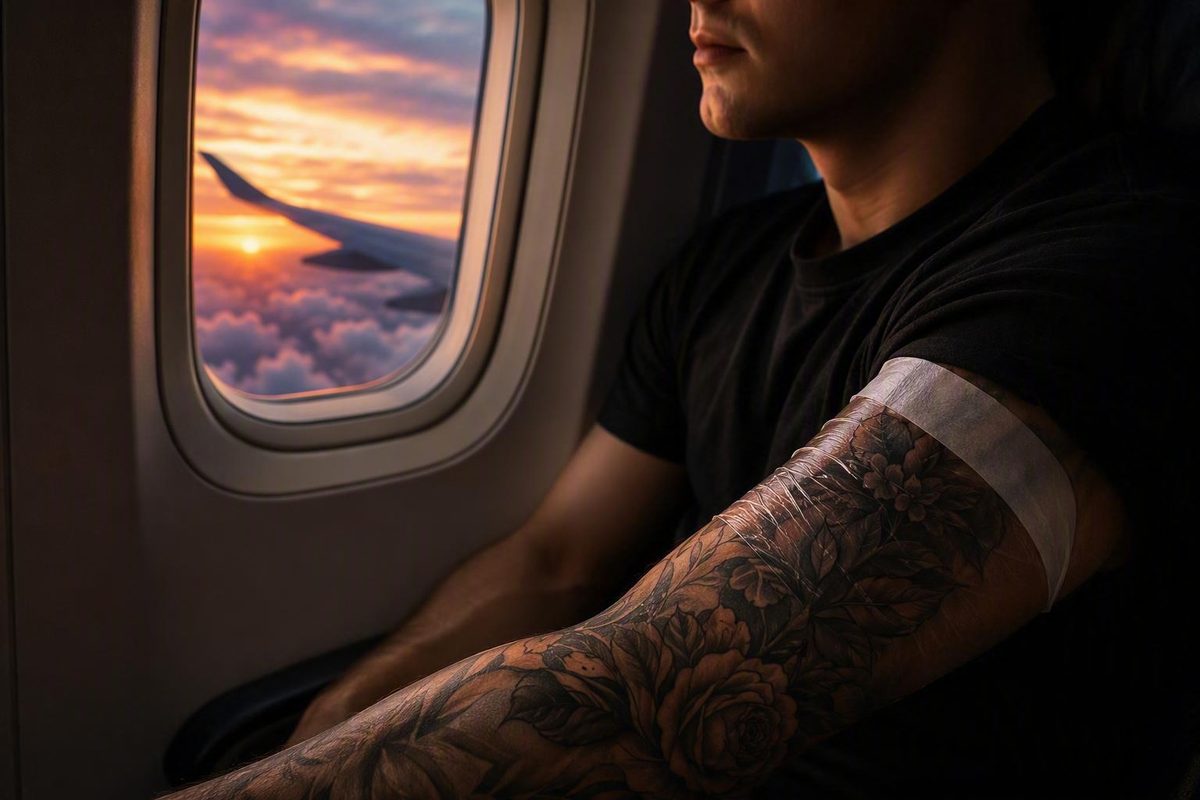
The short answer: flying is possible, but immediate travel is not always practical
The reviewed tattoo-industry guidance treats flying after a tattoo as possible, but not necessarily comfortable or advisable in every situation. It does not establish a universal medical waiting period, and it does not verify airline-specific boarding policies. The practical question is whether you can protect the tattoo and follow its aftercare routine throughout the journey.
Going directly from the studio to an airport can make it harder to manage seepage, keep the area clean, avoid persistent rubbing, and respond if the dressing fails. Readiness therefore depends less on a fixed countdown than on the tattoo’s condition, placement, and travel itinerary.
Published recommendations vary:
- Tattoo-aftercare brand Hustle Butter recommends waiting at least 36 hours when possible. It presents that interval as advice, not a medical or aviation requirement. Read Hustle Butter’s flying guidance.
- Tattoo-supply seller Electrum suggests scheduling the appointment three to four days before departure when possible. See Electrum’s travel guidance.
- Skincare company Stories & Ink recommends getting tattooed at least two weeks before a trip as an ideal planning preference. Read its fresh-tattoo travel guide.
- Legassy Studio says a small tattoo in a low-friction location may be manageable on a short same-day flight if the traveler can maintain aftercare. See the studio’s risk-based assessment.
These intervals come from commercial tattoo businesses. They are practical preferences, not clinically validated thresholds. None proves that every tattoo becomes safe to travel with at a particular hour or that waiting a specified number of days guarantees uncomplicated healing.
Instead, consider:
- Tattoo size and how extensively the skin was worked
- Placement relative to clothing, seats, straps, and restraints
- Whether bleeding and seepage are controlled
- Whether redness, discomfort, and swelling are mild and improving
- Dressing type and condition
- Flight duration, connections, delays, and ground transportation
- Access to clean aftercare supplies and facilities
- Personal health circumstances or clinician instructions that make general guidance insufficient
A small, securely covered tattoo on a short direct journey may be comparatively easy to protect. A large, painful, leaking tattoo beneath a bag strap or pressed against a seat may be difficult to manage even if travel remains physically possible.
Why the first few days require more planning
During the first one to three days, a tattoo is commonly described as being in an open-wound stage. Mild localized redness, warmth, tenderness, swelling, and seepage of plasma or excess ink may occur. Redness and swelling should generally decrease rather than spread or intensify. The publisher’s non-clinical stage-by-stage tattoo-healing guide describes this early stage and identifies worsening changes as reasons to seek medical attention.
Travel complicates this period mainly through logistics. At home, you may have clean hands, appropriate washing facilities, loose clothing, and the supplies specified by your artist. In transit, you may be handling identification, phones, luggage, security bins, doors, tray tables, and other frequently touched objects. That does not mean touching a shared surface will automatically cause an infection. It does mean you should avoid unnecessary contact with the tattoo and clean your hands before essential aftercare.
Ordinary movement can also create persistent rubbing:
- A forearm may rest against an armrest.
- A shoulder tattoo may sit beneath a backpack or shoulder-bag strap.
- A back tattoo can press against the seat.
- A waist or torso tattoo may rub against a waistband or seat belt.
- A thigh tattoo may contact a seat edge or tight clothing.
- A lower-leg tattoo may feel tighter if swelling develops.
Handling luggage can stretch or compress the area. Rushing through a terminal may also cause sweat to collect beneath clothing or a covering, while a long connection can delay access to an appropriate aftercare setting.
The dressing adds another variable. Depending on what the artist applied, some fluid beneath it may be expected. A covering that is leaking, peeling, saturated, or trapping substantial moisture can be harder to manage while traveling. Excess moisture may irritate the skin or leave it overly moist, but that does not create a universal instruction to remove or replace the dressing. The correct response depends on the type of covering and the artist’s directions.
The reviewed evidence does not demonstrate that altitude, cabin pressure, or cabin air distorts, ruptures, or fades tattoo ink. The better-supported practical concerns are pressure, friction, moisture, discomfort, hygiene, and disruption to aftercare.
A risk-based decision guide for same-day, short-haul, and long-haul flights
Rather than relying on one mandatory waiting period, compare the features of your situation.
| Comparatively manageable | Higher concern |
|---|---|
| Small tattoo | Large, heavily shaded, saturated, or extensively worked tattoo |
| Placement away from seats, straps, and tight clothing | Placement beneath a waistband, bag strap, restraint, or seat-contact point |
| Short, direct journey | Long flight, multiple connections, or lengthy ground transfers |
| Mild, localized symptoms that are improving | Substantial, spreading, or worsening swelling and discomfort |
| Controlled seepage | Heavy bleeding or uncontrolled leakage |
| Secure dressing behaving as the artist described | Dressing that is peeling, torn, saturated, or otherwise compromised |
| Supplies and clear artist instructions available | No supplies or uncertainty about what to do if the covering fails |
| Access to a clean setting soon after landing | Long delay before suitable inspection or aftercare is possible |
Same-day travel
Same-day travel may be manageable when the tattoo is small, protected, in a low-friction location, and not bleeding or swelling substantially. A short direct journey is easier to plan around than several hours in airports with multiple connections.
Assess the whole trip, not merely the scheduled time in the air. Transportation to the airport, security lines, boarding, delays, baggage collection, and the trip from the destination airport can turn a short flight into many hours of limited aftercare access.
If ordinary sitting, walking, or loose clothing already causes substantial pain or repeated contact with the area, delaying may be the more practical choice.
Short-haul travel
A short flight means fewer hours of continuous pressure, but placement still matters. A covered forearm tattoo can rub against an armrest throughout a brief journey, while a back tattoo may remain pressed against the seat.
Before leaving, identify likely contact points. Adjust clothing and posture to reduce rubbing, but do not alter or avoid required travel-safety equipment to protect a tattoo. If a required restraint will repeatedly press on the area and you cannot manage that contact comfortably, postponement may be more sensible.
Long-haul travel
A longer journey means more time sitting, more opportunities for friction, and a longer interval before you can inspect the tattoo in a suitable setting. Tattoo-industry guidance also reports that a tattooed limb may feel tighter and more uncomfortable if swelling develops during extended travel.
Concern increases when the itinerary includes:
- A large or heavily worked piece
- Significant initial swelling
- Clothing that cannot be adjusted comfortably
- A dressing already showing signs of failure
- Several connections or an overnight journey
- Heavy luggage that presses on or stretches the area
- No suitable place to continue aftercare after arrival
Placement changes the calculation. A shoulder tattoo and backpack are a poor pairing; a back piece may face hours of seat pressure; and a waist tattoo may sit beneath both clothing and a restraint. A thigh, calf, ankle, or foot tattoo may become difficult to accommodate if the area feels increasingly tight.
Before departure, ask the tattoo artist:
- What exact type of dressing was applied?
- How long should it remain in place?
- How much fluid beneath or around it is expected?
- What should you do if it leaks, peels, tears, or comes off?
- When is washing due?
- Is moisturizer appropriate at this stage?
- Which replacement materials, if any, are suitable?
Those answers are more useful than generic instructions to rewrap or moisturize. If symptoms suggest infection or another medical complication, postpone the trip when possible and obtain medical guidance rather than relying on a timing formula.
Before leaving for the airport
The artist’s instructions should be your starting point. Dressing types and care protocols differ, so do not remove, replace, reinforce, or add a covering solely because you are flying.
Before leaving a clean environment, check:
- Is the covering secure around its edges?
- Is seepage consistent with what the artist told you to expect?
- Is bleeding controlled?
- Can you sit, walk, and handle your luggage without repeatedly striking or rubbing the area?
- Do you know what to do if the dressing fails?
- Will you have a suitable place to inspect and care for the tattoo after landing?
If the tattoo is bleeding heavily, leaking uncontrollably, severely swollen, or too painful to protect during ordinary movement, contact the artist about the dressing and routine aftercare. Seek clinical advice when symptoms are severe, worsening, or appear to involve more than a dressing problem.
Dress for the tattoo’s placement
Wear clean, loose, breathable clothing that does not repeatedly drag across the skin or compress the dressing.
For example:
- Forearm: Choose a loose sleeve with enough room that the cuff will not catch the covering.
- Upper arm or shoulder: Avoid tight sleeve seams and keep bag straps away from the tattoo.
- Back: Wear a clean, loose shirt without thick seams, fasteners, or decorations pressing against the area.
- Waist or torso: Avoid tight waistbands and excessive fabric bunching over the tattoo.
- Thigh or calf: Choose clothing that will not constrict the area if mild swelling develops.
- Foot or ankle: Consider whether required footwear will press against the tattoo throughout the journey.
The clothing does not need to be specialized. Prioritize cleanliness, minimal friction, and enough room to move without disturbing the dressing.
Reconfigure your luggage
A carefully covered tattoo can still be irritated by a heavy bag.
- Do not place a backpack strap over a fresh shoulder or upper-back tattoo.
- Avoid cross-body straps running across new chest, rib, or torso work.
- Keep waist straps away from tattoos near the hips or abdomen.
- Use wheeled luggage or a light hand-carried bag when that reduces contact.
- Avoid overpacking if lifting the bag will repeatedly stretch or brush the area.
Pack a product-neutral aftercare kit
Base the kit on the artist’s protocol rather than a generic product list. Depending on those instructions, useful items may include:
- The artist-approved cleanser
- Approved moisturizer, if appropriate at that stage
- Clean, disposable drying materials
- Artist-authorized replacement dressing materials, if replacement is part of the contingency plan
- Clean, loose spare clothing
- A sealable bag for soiled clothing or discarded materials
- Saved or written aftercare instructions
- The studio’s contact details
Keep essential items in an accessible travel bag rather than checked luggage, and bring enough for delays, missed connections, or an unexpected overnight stay. Check current official airport and airline requirements before packing liquids or medical supplies; this article does not verify whether any particular item or container will be accepted.
Protecting the tattoo at the airport and during the flight
The aim in transit is to preserve the artist’s care plan while reducing unnecessary touching, rubbing, moisture, and disruption.
Keep your hands away unless contact is necessary
Avoid repeatedly touching the tattoo or lifting the edge of the dressing to check beneath it. Before necessary contact, wash your hands properly when facilities are available.
Where practical, keep the tattoo from resting directly against shared surfaces. Adjust your position or clothing instead of improvising another dressing layer.
Reduce friction without changing the dressing unnecessarily
Small adjustments can make the trip easier:
- Keep a tattooed forearm off the armrest when comfortable.
- Move a bag strap to the untattooed side.
- Prevent loose clothing from twisting tightly over the area.
- Do not rest luggage on a tattooed thigh.
- Position clothing so hard seams do not press into a back tattoo.
- Smooth clothing around required restraints rather than allowing it to bunch against the tattoo.
Drink water as a general travel and comfort measure, but do not treat hydration as a tattoo-healing intervention. It does not guarantee normal healing.
On a long flight, change position and move periodically when it is safe and permitted. This may reduce prolonged pressure and stiffness, but it is not a treatment for the tattoo.
Do not moisturize automatically
Applying it simply because you are on a plane could require an unnecessary dressing change or conflict with the prescribed protocol.
Use moisturizer only when:
- The artist’s instructions say the tattoo should be uncovered at that stage;
- The scheduled care routine calls for it; and
- You can clean and dry the area as directed first.
Do not lift an intact covering merely to apply lotion.
Do not rewrap automatically
If a dressing leaks, peels, traps substantial moisture, or becomes contaminated, follow the contingency instructions given by the artist.
An airport restroom may be the most suitable facility available during a journey, but it can still be cramped and awkward for detailed aftercare. Limited space and the need to manage clothing and luggage can make a dressing change difficult, so unnecessary changes are best avoided.
If the covering fails and you do not know how to respond, contact the studio if possible. Contact a clinician when the concern involves worsening symptoms or a suspected medical complication rather than the dressing alone.
Three common travel scenarios
Small covered forearm tattoo on a short flight: Keep the artist-applied covering in place for the instructed period. Wear a loose, clean sleeve and avoid resting the forearm against the armrest or tray table. Do not wash or moisturize in flight unless the prescribed schedule requires it.
Shoulder tattoo beneath a backpack strap: Move the load away from the tattoo. Carry the bag by hand, use a wheeled case, or place the strap on the opposite shoulder if practical. A secure covering cannot eliminate the pressure and repeated movement of a heavy strap.
Large lower-leg tattoo on a long flight: Consider delaying if swelling, leakage, or discomfort is already substantial. If travel proceeds, wear non-restrictive clothing, keep luggage away from the leg, reposition periodically when permitted, and arrange access to an appropriate inspection and aftercare setting after landing.
What to do after landing
Once you reach a clean, well-lit, private setting, compare the tattoo and dressing with their preflight condition.
Check:
- Has redness remained localized, or is it expanding?
- Is swelling stable or improving, or has it increased?
- Is pain settling, or is it escalating?
- Is the dressing still sealed and positioned as intended?
- Is seepage within the range the artist described?
- Is there unusual, thick, or pus-like discharge?
- Has clothing adhered to the area?
Continue the artist-directed washing, drying, dressing, and moisturizing routine. Air travel does not require an entirely separate aftercare regimen.
If cleaning is due, follow the prescribed method and dry without rubbing. Do not scrub or pick at peeling skin or scabs. If the original covering is meant to remain in place, leave it alone unless its condition triggers the artist’s contingency instructions.
Change out of clothing that has become sweaty, dirty, or restrictive. Choose clean clothing and bedding that are unlikely to stick to or repeatedly rub the tattoo.
Plan the first day at your destination conservatively. Carrying luggage, walking for hours, exercising, or wearing sightseeing equipment can recreate the same friction and sweating problems experienced during the journey.
For routine dressing questions, contact the tattoo artist. For suspected infection, a significant reaction, severe swelling, or another medical complication, contact a clinician. An artist can explain how a particular covering should behave but is not a substitute for medical assessment.
The destination may be a bigger challenge than the flight
The flight may account for only a small part of the trip. Activities after landing can be harder to reconcile with a fresh tattoo.
Common concerns include:
- Swimming in pools, lakes, or the sea
- Using hot tubs or spas
- Prolonged baths or soaking
- Direct sun exposure
- Heavy sweating during exercise or excursions
- Sand, dirt, and tight swimwear
- Repeated rubbing from backpacks, life jackets, climbing equipment, or sports clothing
Tattoo-industry sources consistently recommend avoiding submersion while a tattoo is healing, although they disagree about the exact restriction period. Brief washing under the artist’s protocol is different from prolonged soaking in a bath, pool, hot tub, lake, or sea.
Commercial studios also recommend avoiding direct sun and persistent friction, but some accompanying claims—such as water pulling or washing ink from the skin—are not substantiated in the reviewed material. Fine Ink Studios, for example, advises avoiding beaches, pools, direct sun, tight clothing, and prolonged water exposure, but its fixed timelines are studio guidance rather than validated medical rules. Review the studio’s vacation-tattoo advice.
Keep direct sun off a fresh tattoo. The available evidence does not support assuming that sunscreen applied to open or incompletely healed skin makes sun exposure appropriate. Use shade and clean, loose clothing, and ask the artist or a clinician when topical sun protection is suitable.
Likewise, do not assume a waterproof covering makes swimming, spa use, beach visits, or prolonged sun exposure risk-free. A covering may peel, trap moisture, or be disturbed by movement. Plan these activities around healing rather than attempting to preserve every vacation booking.
Surface healing is generally described as taking approximately two to four weeks, but that is an estimate rather than a deadline. Size, placement, the amount of work performed, rubbing, and individual progress may change the timeline. Judge activities by the condition of the skin and the instructions you received, not solely by the number of days since the appointment.
If swimming, a beach visit, a spa, a strenuous hike, or a sporting event is central to the trip, scheduling the tattoo near the end of the vacation—or after returning home—may be more practical.
Normal early healing versus signs to seek medical care
The available sources for this article are tattoo-industry and first-party aftercare guidance, not authoritative clinical guidelines. They can describe common patterns and warning signs, but they cannot diagnose a complication or replace individualized medical advice.
Mild, localized symptoms that improve are different from redness, swelling, heat, discharge, or pain that spreads or becomes more intense.
| Level | What you may notice | What to do |
|---|---|---|
| Commonly expected early changes | Mild tenderness, warmth, localized redness, modest swelling, and limited plasma or excess-ink seepage that are improving | Continue the artist-directed routine, reduce friction, and monitor the area |
| Changes that deserve close attention | Redness or swelling that is not settling, increasing discomfort, persistent heat, unexpected leakage, unusual discharge, or symptoms that look worse than before travel | Contact the artist for dressing-specific questions and obtain clinical advice when symptoms are worsening or appear medical |
| Warning signs requiring prompt medical evaluation | Spreading redness or swelling, escalating pain, thick yellow discharge or pus, red streaks, or fever | Seek prompt medical care and postpone or interrupt travel when possible |
The reviewed healing guidance identifies increasing redness after the third day, pronounced heat, spreading swelling, fever, red streaks, and thick yellow discharge as warning signs rather than routine travel irritation. Because the supplied material is not a clinical guideline, it should not be used to self-diagnose the cause or determine that waiting is safe.
A tattoo artist can answer questions about expected seepage, dressing wear time, or the studio’s routine. A clinician should assess suspected infection, a significant reaction, severe swelling, fever, or another medical problem.
When urgent warning signs are present, the relevant question is no longer how many hours to wait before flying. This article provides general information, not individualized medical advice.
Can I fly on the same day I get a tattoo?
Possibly. Same-day travel may be manageable when the tattoo is small, away from pressure and straps, covered according to the artist’s protocol, and showing only controlled seepage and mild symptoms.
It becomes less practical when the tattoo is large, heavily worked, actively bleeding, substantially swollen, very painful, or positioned where clothing, a seat, a required restraint, or luggage will repeatedly rub it. Count the full airport journey rather than only the flight time.
If symptoms are severe or worsening, seek clinical guidance rather than relying on the fact that same-day travel is sometimes possible.
How long should I wait to fly after getting a tattoo?
There is no evidence-backed universal waiting period in the reviewed material. Commercial recommendations range from selected same-day travel to waiting 36 hours, three to four days, or ideally two weeks. Those are planning preferences, not medical thresholds.
If you can choose, allow time for initial bleeding and seepage to become manageable, for the dressing to prove secure, and for you to understand the aftercare routine. The larger the tattoo and the longer the journey, the stronger the practical case for more recovery time.
Should I keep my tattoo covered during the flight?
Follow the artist’s instructions for that specific dressing. Do not remove an intact covering merely because you are boarding a plane, and do not automatically add another layer or rewrap an uncovered tattoo.
Before departure, ask how long the covering should remain in place and what to do if it leaks, tears, or peels. If it remains intact and behaves as expected, avoid unnecessary in-flight changes. Moisturizer should also follow the prescribed routine and may not be appropriate beneath an intact dressing.
Is a long flight more difficult with a large or lower-leg tattoo?
It can be. A large tattoo leaves more recently worked skin to protect, while a lower-leg tattoo may feel tighter and more uncomfortable if swelling develops. A long journey also creates more time for pressure, friction, limited movement, and delayed access to an appropriate aftercare setting.
Consider postponing when a large leg tattoo is already substantially swollen, leaking, painful, or difficult to accommodate beneath loose clothing.
Which symptoms mean I should seek medical care instead of flying?
Seek prompt medical evaluation for spreading redness, increasing or spreading swelling, escalating pain, pronounced heat, thick yellow discharge or pus, red streaks, fever, or other clearly worsening symptoms.
Do not rely on a tattoo artist or a different aftercare product to manage suspected infection. The artist can advise on routine aftercare and the dressing, but medical symptoms require a clinician.
The bottom line: There is no evidence-backed countdown that makes every tattoo ready to fly. A short trip with a small, protected, low-friction tattoo may be manageable. A large, swollen, leaking, painful, or awkwardly positioned tattoo on a long journey may justify delaying. If you travel, follow the artist’s dressing protocol, minimize rubbing and unnecessary contact, resume aftercare in a suitable setting after landing, and obtain prompt medical care when warning signs appear.